Dementia or Normal Ageing? 6 Early Warning Signs — TCM Guide
Memory lapses in older adults do not always mean dementia. But when a person repeatedly asks the same question, forgets recent events, gets lost, makes mistakes with cooking, or shows clear personality changes, it should not be dismissed as ageing alone. This guide explains the differences between normal ageing and dementia, six early warning signs, common assessment methods, and how TCM may support prevention and overall function.
Medical review: Dr. Chan Wing Kiu, Joanne,Registered Chinese Medicine Practitioner #009463
1-Minute Quick Answer
Memory lapses in older adults aren't always dementia. But repeatedly asking the same question, forgetting recent events, getting lost, or showing personality changes warrant attention. This guide (medically reviewed by Dr Chan, CMCHK 009463) explains how to distinguish normal ageing from 6 early dementia warning signs, common assessments, and how TCM may support prevention.
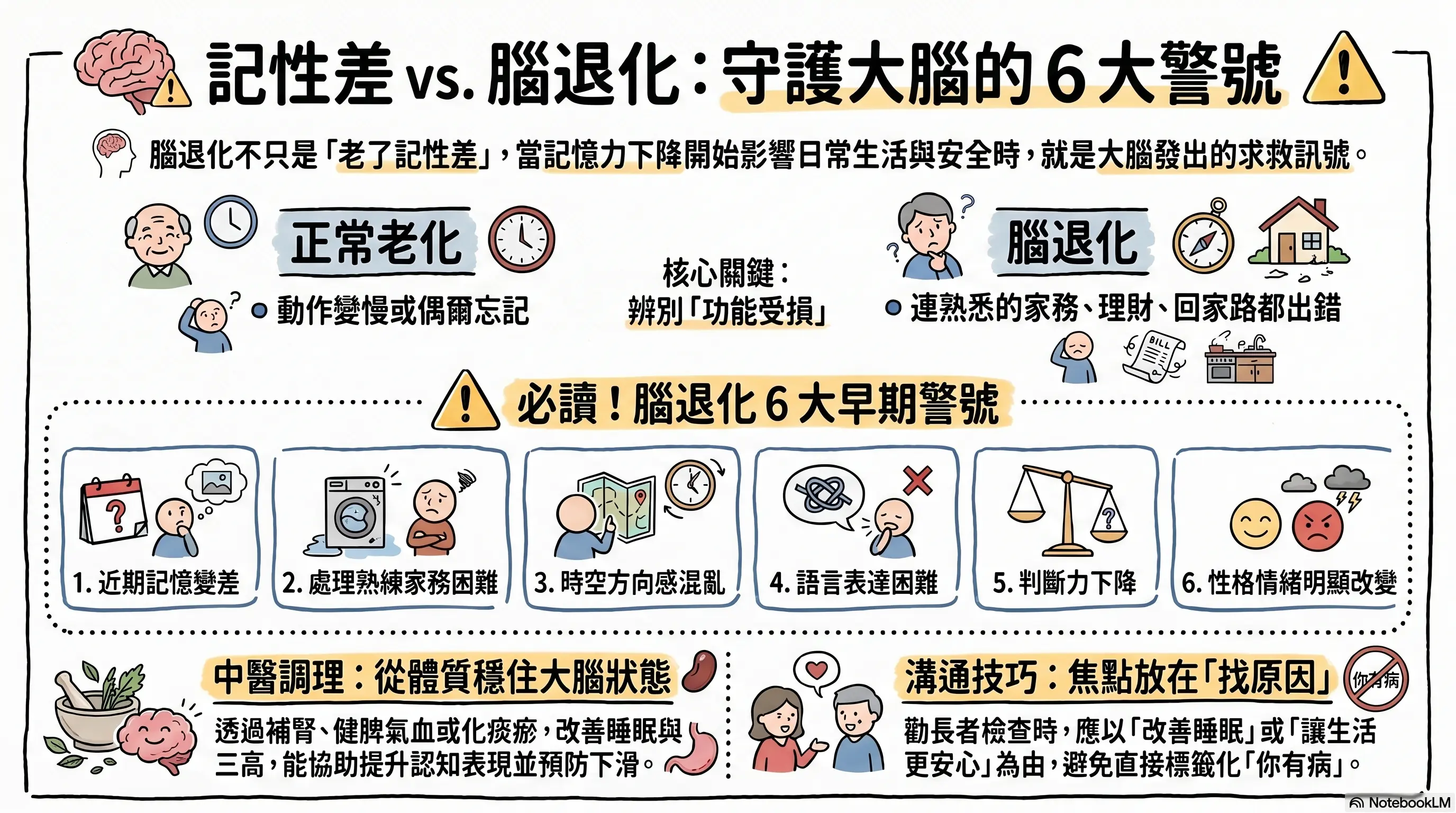 To help readers grasp the content quickly, the cover image was generated with NotebookLM. Some Chinese characters may not render correctly — thank you for understanding.
Memory lapses in older adults do not always mean dementia. But if a person repeatedly asks the same question, forgets recent events, gets lost, makes mistakes with cooking, or shows a clear personality change, it should not simply be explained away as old age. This article explains the differences between dementia and normal ageing, six early warning signs, common assessment methods, and how TCM may support prevention and day-to-day functioning through a whole-body approach.
"Mum has been asking the same question again and again lately. Is that normal ageing?"
"Dad keeps misplacing his keys. Could this be dementia?"
"When should we actually seek medical advice for memory problems in an older family member?"
These are common questions in clinic. In Hong Kong, many people casually call the condition "brain degeneration", while the medical term used more often is dementia or cognitive impairment. It is not just about poor memory. It can gradually affect memory, understanding, language, judgment, executive function, spatial awareness, and the ability to manage everyday life.
Occasionally forgetting a name, or briefly forgetting a plan and later remembering it again, does not necessarily mean dementia. But when memory decline begins to affect cooking, medication use, finances, going out, communication, or safety, it should no longer be dismissed as ordinary ageing.
Normal Ageing vs Dementia: What Is the Difference?
Normal ageing may feel like being a little slower — taking longer to find a word, forgetting a name, or walking into a room and momentarily forgetting what you meant to get. Dementia is more concerning because it begins to affect function, and family members can also sense that "this is not how the person used to be."
| Situation | More like normal ageing | More concerning for dementia |
|---|---|---|
| Memory | Occasionally forgets, but remembers after a reminder | Repeatedly forgets recent events and still cannot recall them after prompts |
| Daily tasks | Slower, but still able to complete them | Starts making mistakes with familiar chores, cooking, or paying bills |
| Time and place | Occasionally mixes up dates | Frequently gets confused about dates or places, or gets lost in familiar areas |
| Language | Occasionally cannot find a word | Often cannot find words and speech becomes vague enough to affect communication |
| Judgment | Occasionally careless | Eats spoiled food, misuses medication, or handles money very poorly |
| Mood and personality | Occasional irritability | Clear changes in personality, mood, suspiciousness, or withdrawal |
In short: normal ageing is often "slower"; dementia is more often "daily life starts to go wrong."
Six Early Warning Signs of Dementia
These signs are not for self-diagnosis. They are meant to help families judge when a proper assessment should be arranged.
1. Clearly worsening recent memory, with repeated questioning
Typical examples include forgetting what was just eaten, what was just said, or whether a phone call has just happened, and repeating the same question within a short time. Family members may feel they have already answered several times, while the older person may not notice the repetition.
Forgetting an old colleague's name now and then is not the main concern. The real issue is a decline in short-term memory and the ability to store new information.
2. Familiar tasks become unexpectedly difficult
Someone who used to cook every day may suddenly forget to add salt, forget to turn off the stove, or become confused by the steps. Someone who always knew how to get to the market may suddenly not know where to change transport. Someone who used to handle simple bills may start missing payments, paying twice, or falling prey to sales pressure.
This is not simply "slowing down." It may reflect changes in executive function and judgment.
3. Confusion about time, place, or direction
The person may mix up dates, forget where they are, get lost near a familiar shopping mall or housing estate, or even be unable to find the way home after going out. These situations deserve particular attention because the risks of wandering, falls, and safety incidents increase.
4. Language or comprehension becomes weaker
Speech may involve frequent pauses, difficulty finding suitable words, or using vague phrases like "that thing" for many objects. Some older adults may also find it harder to follow longer sentences from family members. Because they feel they "cannot get the words out", they may gradually withdraw from social situations.
5. Poorer judgment, money handling, or safety awareness
Examples include crossing the road unsafely, eating spoiled food, forgetting to turn off the stove, taking medication twice or missing doses, handing large sums of cash to strangers, or suddenly buying many unnecessary supplements. These changes can have major safety consequences and should be addressed early.
6. Clear emotional, personality, or social changes
Dementia does not always start with memory symptoms. Some people first become more indifferent, unwilling to go out, more anxious, more suspicious, suddenly short-tempered, or no longer interested in activities they used to enjoy. If these changes persist, especially together with memory or functional decline, a proper assessment is worthwhile.
What Tests Can Be Done if Dementia Is Suspected?
Families often ask whether there is an online test that can confirm dementia. The answer is no. Screening tools can be useful as a first step, but they cannot replace medical assessment.
More reliable assessment usually includes:
| Assessment | What it looks at | Who it is useful for |
|---|---|---|
| Family observation record | Changes in memory, cooking, medication, going out, finances, mood | Useful for all suspected cases |
| Brief cognitive questionnaire | Recent memory, daily function, orientation, language | Useful when family members want to organise concerns first |
| Cognitive testing | Attention, memory, language, executive function, spatial ability | More reliable when done by trained staff or healthcare professionals |
| Blood tests | To rule out thyroid problems, vitamin deficiency, metabolic causes, liver or kidney issues | When the doctor suspects reversible causes |
| Brain imaging | To rule out stroke, tumour, bleeding, or other brain disease | Arranged when clinically needed |
| Review of mood, sleep, and medication | To see whether depression, insomnia, or drug side effects are contributing | Especially important when decline is sudden or multiple medications are used |
In Hong Kong, tools such as the Hong Kong version of the Montreal Cognitive Assessment (HK-MoCA) may be used. But diagnosis is never based on one questionnaire alone. It must be interpreted together with history, examination, blood tests, and sometimes imaging.
How Does TCM View Memory Decline and Dementia Risk?
TCM does not replace modern dementia diagnosis with a traditional label. At Aspira TCM, the first principle is that if daily functioning is already being affected, a Western medical or memory assessment should be arranged. At the same time, TCM can look at body constitution and identify factors that may be worsening both brain and overall function.
Common TCM patterns include:
| TCM pattern | Common features | Treatment direction |
|---|---|---|
| Kidney essence deficiency | Low back weakness, tinnitus, night urination, low energy, weaker memory | Nourish the liver and kidneys, replenish essence |
| Spleen deficiency with low qi and blood | Poor appetite, pale complexion, fatigue, poor concentration, loose stools | Strengthen the spleen, boost qi, nourish blood, calm the mind |
| Phlegm turbidity disturbing the head | Heavy-headedness, chest oppression, obesity or excess phlegm, brain fog, drowsiness | Strengthen the spleen, transform phlegm, improve metabolism |
| Blood stasis obstructing the channels | Headache, dark tongue, poor sleep, numbness, poor circulation | Invigorate blood and unblock the channels, after acute stroke has been ruled out |
| Poorly nourished spirit | Insomnia, vivid dreams, anxiety, palpitations, being easily startled | Nourish the heart, calm the mind, stabilise sleep |
For many older adults, memory decline is not caused by one factor alone. Poor sleep, poor appetite, constipation, inactivity, chronic pain, poorly controlled diabetes or hypertension, hearing or visual decline, and low mood can all worsen cognitive performance. This is where TCM may offer value by supporting the wider state of health rather than focusing on memory alone.
Preventing Dementia Is About More Than Puzzles
Prevention is not just about doing Sudoku or brain games. For older adults, healthy routines, exercise, social engagement, stable sleep, and control of chronic disease are all important.
1. Control diabetes, high blood pressure, and high cholesterol
Vascular cognitive impairment is closely linked to stroke, heart disease, and circulation problems. High blood pressure, diabetes, and abnormal lipids should not be managed only when symptoms appear. Regular follow-up and good medication adherence matter.
2. Maintain regular physical activity
Walking, tai chi, ba duan jin, strength training, and balance exercises can all be adapted to the person's ability. Consistency matters more than occasional bursts of effort.
3. Keep sleep stable
Long-term insomnia, day-night reversal, and poor sleep quality can make daytime confusion worse, increase fall risk, and affect mood and appetite. A sudden change in sleep pattern should also prompt attention to possible physical or cognitive problems.
4. Preserve social contact and daily roles
It does not have to mean large events. Buying groceries downstairs, meeting friends for tea, doing simple chores, caring for plants, and taking part in family decisions all help support cognition and mood.
5. Address hearing, vision, and dental problems
If a person cannot hear clearly, see well, or chew properly, they may communicate less, go out less, and become more vulnerable to poor nutrition. These do not look like brain problems on the surface, but they can strongly affect daily function.
6. Plan home safety early
If an older adult has started forgetting to turn off the stove, forgetting medication, or getting lost outside, do not wait for an accident. Automatic stove shut-off, pill organisers, reminder notes near the door, family division of duties, and location tools may all be helpful.
When Should Western Medical Assessment Be Urgent?
The following may not be simple dementia and should prompt medical attention quickly:
- Memory or consciousness worsens suddenly over a few days
- Sudden confusion after fever, dehydration, or a urinary tract infection
- Drowsiness, vomiting, or confusion after a fall with head injury
- One-sided weakness, slurred speech, facial drooping, or sudden visual change
- Hallucinations, severe delusions, aggression, or an immediate safety risk
- Rapid new walking instability, urinary or faecal incontinence, or severe headache
Dementia usually changes gradually. A sudden deterioration is more concerning for infection, stroke, drug side effects, metabolic problems, or other acute illness.
Can a Person Start With TCM Assessment?
Yes, but with a clear understanding of the goal. TCM assessment does not replace diagnosis. It helps review sleep, appetite, bowel and bladder habits, mood, energy, blood sugar and blood pressure control, pain, activity level, and home safety. When needed, the practitioner should advise formal medical or memory assessment first.
At Aspira TCM, the principle is "clarify risk first, then talk about regulation." For older adults with milder memory issues, poor sleep, fatigue, poor appetite, or unstable chronic disease control, TCM may help by supporting constitution and lifestyle before the overall situation declines further.
How Can Families Raise the Topic if the Older Person Refuses Assessment?
For many caregivers, the hardest part is not noticing the problem but knowing how to start the conversation. Saying "you may have dementia" right away can feel stigmatising and may make the person defensive. The result is often more resistance and longer delay.
A more effective approach is to focus on "finding the cause" and "making daily life safer and easier" rather than trying to force the person to accept a label.
1. Do not begin with the label "dementia"
It is often easier to say:
"You have not been sleeping very well recently, and there was that time the stove was left on. Let us ask the practitioner whether sleep, energy, or general health could be affecting things."
"This does not mean you definitely have an illness. Let us simply do a memory and general health check to see whether anything can be improved."
This preserves dignity and makes the first step easier to accept.
2. Use specific examples rather than broad criticism
Avoid saying "your condition has become very bad" or "you always forget things." Such phrases easily trigger defensiveness.
Instead, try examples like:
- "Last week there was one time the soup was left on the stove, so we are a bit worried about safety and want to handle it earlier."
- "It looks as though there may have been two missed medication doses recently. Let us see whether we can make the arrangement simpler and more reassuring."
- "The last trip back from the market took much longer than usual. We are a little concerned and want to check whether you have been extra tired, or whether going out has become less convenient lately."
Specific incidents are more persuasive and also give the doctor or practitioner clearer clinical information.
3. Starting with TCM assessment may reduce resistance
Some older adults strongly resist the idea of a memory clinic or brain scan, but may be more willing to see a TCM practitioner for sleep, appetite, fatigue, or night urination. Framing the first visit as a broader health review can reduce pressure.
At Aspira TCM, assessment includes memory changes, sleep, appetite, bowel and bladder habits, chronic disease control, medication use, home safety, and family observations. If further memory assessment or Western medical review is needed, this can then be explained in a calmer and clearer way.
4. Bring a simple observation record
Before the consultation, family members can note three to five concrete events such as forgetting to turn off the stove, repeating questions, confusion with medication, getting lost, or sudden personality changes. The note does not need to be long. A date, what happened, whether there was danger, and whether the older person noticed it is enough.
This avoids repeated arguments in front of the older person and allows the practitioner to judge more quickly whether the picture is simple forgetfulness, sleep- or mood-related change, or genuine early dementia warning signs.
5. If safety is already involved, act first
If the person has already forgotten to turn off the stove, taken repeated doses of medication, become lost outside, or been scammed out of money, the family should not wait passively for consent. High-risk situations should be addressed first through safer equipment, pill boxes, reduced solo handling of finances, accompaniment when going out, and timely assessment.
The point of encouraging assessment is not to prove who is right. It is to stabilise safety, health, and care planning while there is still room to do so.
FAQ
Q1: If an older adult often forgets things, does that definitely mean dementia?
No. Poor sleep, low mood, hearing loss, thyroid problems, vitamin deficiency, and medication side effects can all worsen memory. The key question is whether daily life is being affected and whether the decline is ongoing.
Q2: Can dementia be cured?
Most forms of dementia do not currently have a cure. But early diagnosis, medication, non-drug intervention, community support, and home safety measures can improve quality of life and help slow functional decline.
Q3: Is dementia testing frightening?
In most cases, early assessment mainly involves questions and basic cognitive or functional testing. It is not usually a painful experience. The harder part is often simply opening the conversation. Framing it as a memory and health review can help.
Q4: Can TCM improve memory?
TCM first looks for contributing factors such as poor sleep, qi and blood deficiency, weak digestion, phlegm-dampness, liver-kidney deficiency, or emotional strain. When memory problems are linked to modifiable whole-body factors, improving general condition may help attention and mental clarity. But warning signs that already affect everyday function should still be assessed through Western medicine.
Disclaimer: This article is for health education only and does not replace medical diagnosis, cognitive assessment, or individual treatment advice. If you or a family member develops sudden confusion, stroke symptoms, head injury, severe emotional disturbance, or immediate safety risk, please seek medical care promptly.
Disclaimer: This article is for health education and reference purposes only and does not constitute medical advice, diagnosis, or treatment. Each patient's condition is unique and treatment outcomes vary. Please consult a registered TCM practitioner or qualified healthcare professional for health concerns.
Further Reading
Hand-picked related articles and real cases to read next.
When a Parent Forgets the Stove: A TCM Dementia Assessment
Ms Lee’s 75-year-old mother has recently begun repeating the same questions, mixing up her medication, and even forgetting to turn off the stove. Is this ordinary forgetfulness, poor sleep, or an early dementia warning sign? This article explains how TCM can assess an older adult’s memory changes step by step through the lenses of safety, cognitive function, vascular risk, sleep, constitution, and family caregiving.
TCM Stroke Prevention for Seniors: Signs & Key Acupoints
Stroke has only a 3-hour golden window. Drawing on Dr Chan Wing-kiu’s lecture, this guide explains the FAST-style "Tan-Siu-Yung-Bing" warning signs, three TCM causes of stroke, four daily acupoints and dietary do’s and don’ts, with an emergency response checklist at the end so you can care for elderly parents day by day.
Want to learn more? WhatsApp us for a free consultation
Book via WhatsAppExplore our full range of treatments: Traditional TCM Services
Related Articles
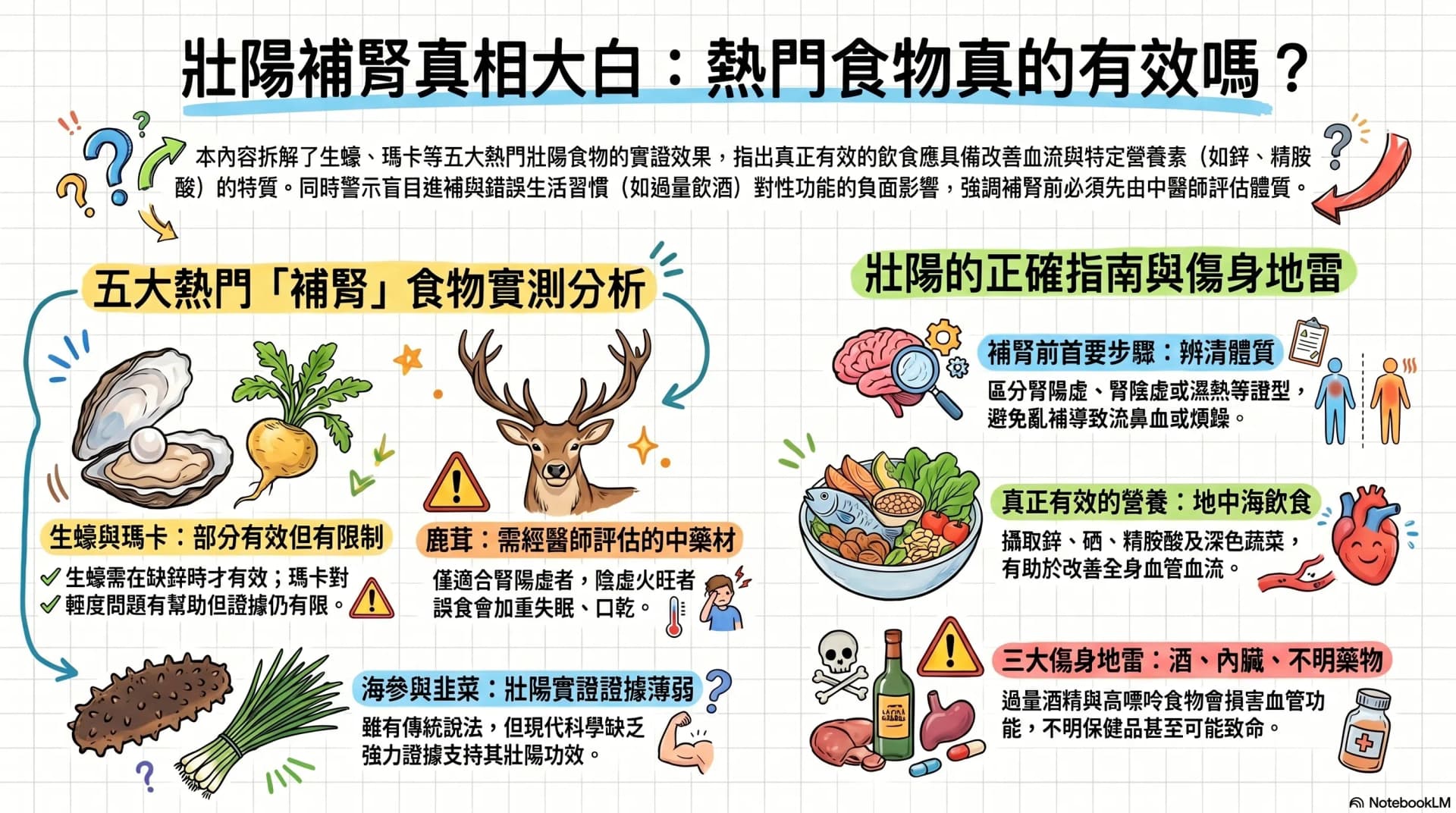
Do Oysters, Maca and Deer Antler Boost Male Vitality? 5 Myths
Do aphrodisiac foods actually work? This article opens with a rating table (effective / partly effective / effective within a TCM framework / weak evidence / no strong evidence), reviews the Chinese and Western medical evidence behind oysters, maca, deer antler, sea cucumber and Chinese chives, distils the 3 shared traits of foods that genuinely support male sexual function, and flags 3 commonly eaten items that can actually harm performance.
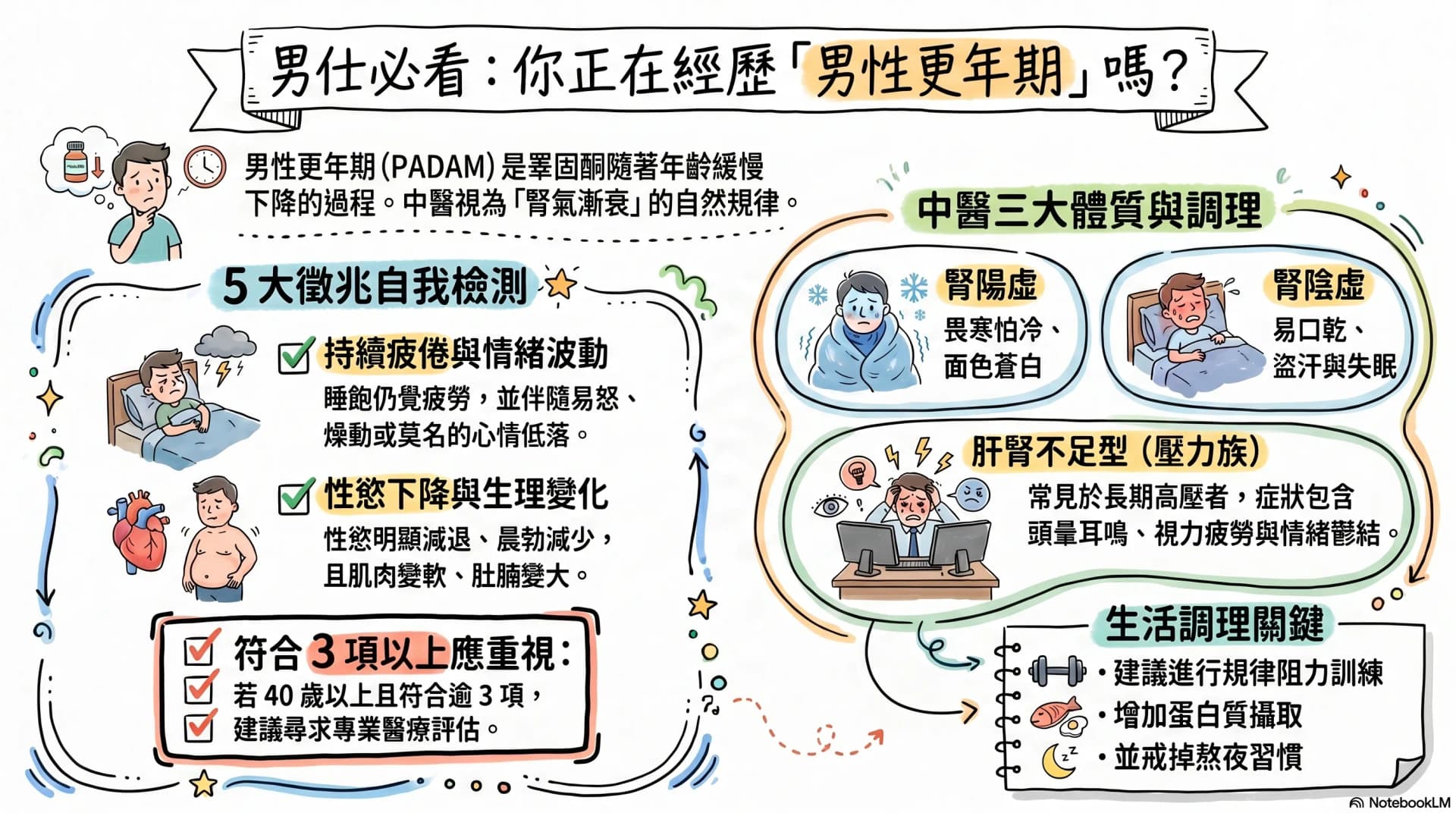
Male Menopause Through the TCM Lens: 5 Signs in Men Over 40
Unexplained fatigue, irritability, lower libido, poorer sleep and a growing belly after 40 are not just ageing or work stress — they may be male menopause. This article begins with a five-sign self-check, sets out three TCM patterns (kidney-yang deficiency, kidney-yin deficiency, liver-and-kidney insufficiency) with matching improvements, and compares the two treatment routes — testosterone replacement therapy versus TCM constitutional care.
Enlarged Prostate: Are Nocturia and a Weak Stream Warning Signs?
After age 50, urinary frequency, nocturia, a weaker stream and having to urinate in stages may not simply be ageing. This article opens with a 7-symptom self-check, then sets out warning signs that warrant seeing a Western doctor immediately, four TCM constitution patterns, and four daily care directions any man can start with — helping you or your father decide the next step.