Acupoint Embedding in Hong Kong: 2026 Pricing & Clinic Guide
Hong Kong acupoint embedding fees range from a few hundred to over three thousand dollars per session — but why? This guide breaks down 2026 market price ranges, six factors driving the fee differences, seven questions to ask before booking, four red-flag warnings, and a transparent line-by-line look at Aspira TCM's three packages — to help you choose what genuinely suits you.
Medical review: Dr. Au Kwok Po, Arthur,Registered Chinese Medicine Practitioner #009884
1-Minute Quick Answer
Hong Kong acupoint embedding costs range from a few hundred to over HK$3,000 per session — but why? This guide breaks down 2026 market pricing, six fee drivers, seven questions to ask before booking, four red flags, and a transparent line-by-line look at Aspira TCM's three packages.
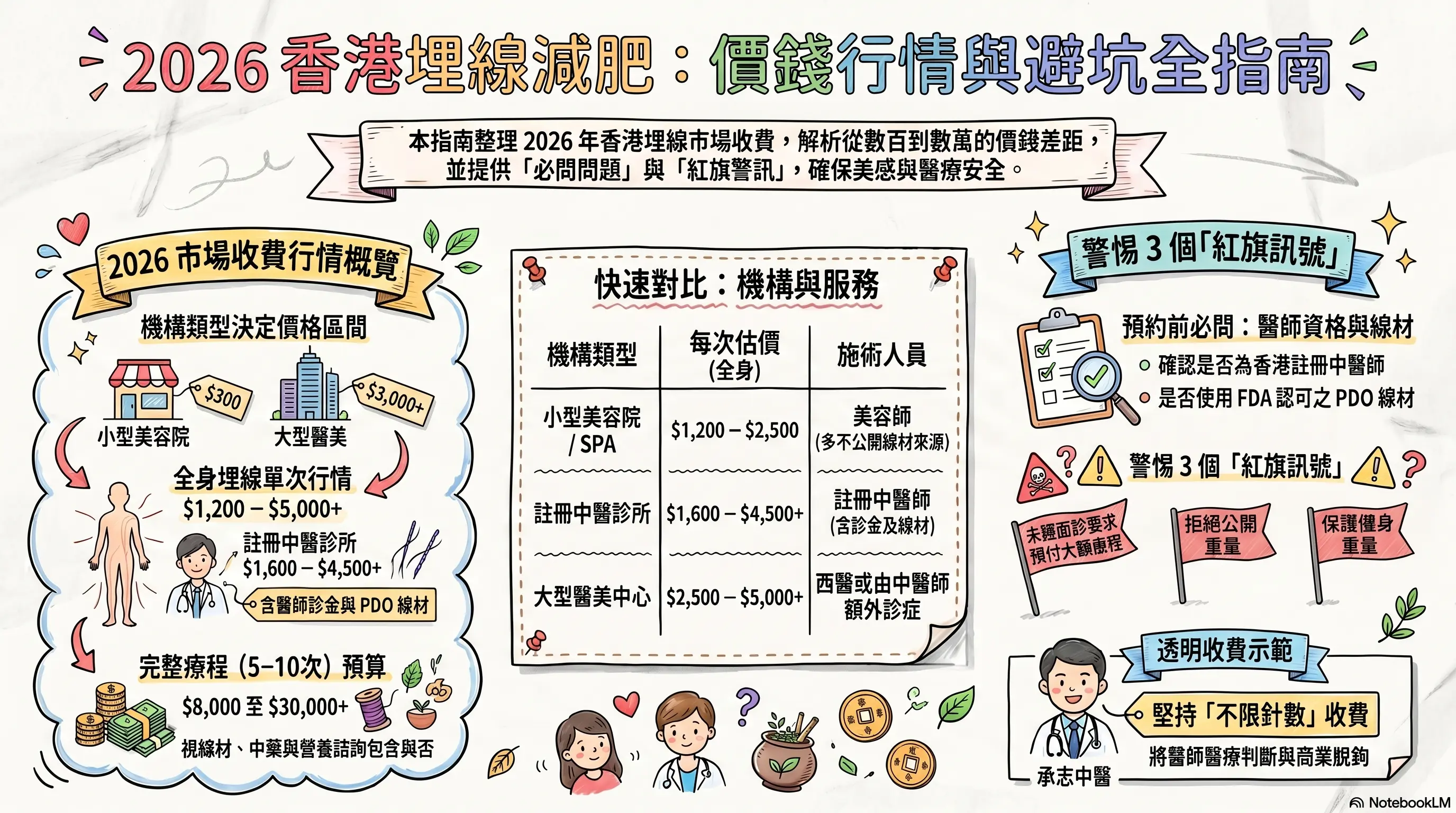 To help readers quickly grasp the content, this image was generated by NotebookLM. Some Chinese characters may not render correctly.
"How can the same 'embedding treatment' cost HK$300 at one place and HK$30,000 at another?"
This is the question patients ask most often when first researching the treatment. The price range is not an illusion — providers in Hong Kong offering "embedding" range from registered TCM clinics, to chain TCM groups, to beauty parlours, medical-aesthetic centres, and even some spas. The qualifications of the practitioner, the quality of the thread material, the contents of the treatment package, and the safety protocols all vary substantially.
Rather than listing the rates of specific institutions (which would be unfair and quickly outdated), this guide covers:
- The pricing landscape in Hong Kong and the logic behind it
- Six factors that drive fee differences
- Seven questions to ask before booking
- Four red flags that warrant a second thought
- A transparent breakdown of Aspira TCM's three packages
By the end, you should be able to compare clinics with greater confidence and make a choice that genuinely suits you.
Hong Kong's Embedding Pricing Landscape
The price ranges below reflect general 2026 market observations, not the official rates of any specific provider. Always confirm current pricing directly with the clinic concerned.
1. Single-Area Embedding (e.g. abdomen, arms, or thighs only)
| Provider Type | Per-Session Range (Single Area) | Includes Practitioner Consultation | Thread Material Disclosure |
|---|---|---|---|
| Small beauty parlours / spas | HK$300 – HK$800 | No, or operated by "beauty therapists" | Often unclear |
| Chain beauty centres | HK$500 – HK$1,500 | Sometimes includes a registered practitioner | Varies by institution |
| Registered TCM clinics (including Aspira TCM) | HK$900 – HK$1,500 (consultation included) | Yes, performed by a Registered Chinese Medicine Practitioner | Commonly PDO or equivalent absorbable thread |
| Large medical-aesthetic centres | HK$1,500 – HK$3,000+ | Sometimes includes a Western doctor; TCM consultation may be separate | Varies |
2. Whole-Body Embedding (arms + back + abdomen + thighs + calves + buttocks, etc.)
| Provider Type | Per-Session Range (Whole Body) | Includes Practitioner Consultation | Thread Material Disclosure |
|---|---|---|---|
| Small beauty parlours / spas | HK$1,200 – HK$2,500 | No, or beauty-therapist operated | Often unclear |
| Chain beauty centres | HK$1,500 – HK$3,000 | Sometimes includes a registered practitioner | Varies |
| Registered TCM clinics (including Aspira TCM) | HK$1,600 – HK$4,500+ (depending on whether herbal medicine / nutrition consultation is included) | Yes, performed by a Registered Chinese Medicine Practitioner | Usually PDO or equivalent absorbable thread |
| Large medical-aesthetic centres | HK$2,500 – HK$5,000+ | May include Western medical consultation; TCM consultation may be separate | Varies |
3. Complete Course (5–10 sessions)
Multiplying the per-session cost above across 5–10 visits, a full course generally falls around HK$8,000 – HK$30,000+, depending on provider type, thread material, whether herbal medicine is included, and whether nutrition consultation is provided.
Why Are the Prices So Different? 6 Key Drivers
Factor 1: Practitioner qualifications
This is often the single biggest driver of price. Embedding is an invasive medical procedure, and under Hong Kong's regulatory framework it should be performed by a Registered Chinese Medicine Practitioner. If a provider cannot supply the practitioner's registration number, patients should be cautious.
| Practitioner Type | Typical Market Pricing Level |
|---|---|
| Beauty therapist (no medical licence) | Lower (but often with higher risk) |
| Registered Chinese Medicine Practitioner | Mid to higher |
| Registered practitioner with additional expertise (e.g. nutrition) | Mid-high |
Factor 2: Thread quality
Threads range from catgut (animal-derived) to generic protein thread, to PDO (polydioxanone). PDO is a medical-grade polymer recognised by the US FDA, used globally for over 40 years, with an allergy rate of approximately 0.05% — and accordingly costs more than traditional materials. For a detailed comparison of safety records, absorption times, and allergy rates across all three materials, see the "PDO Threads vs Other Common Materials" section in A Complete Guide to TCM Acupoint Embedding for Weight Loss →.
Factor 3: Whether pricing is based on needle count
Some providers charge "per needle" (for example HK$30–HK$80 each). That may look cheaper at first glance, but the total can become more expensive in practice. Others use "per area" or "unlimited needle count for whole-body treatment." The billing logic differs, so the fairest comparison is usually the all-in cost of one visit.
Factor 4: Whether herbal medicine and nutrition consultation are included
Embedding alone is only one part of a weight-management strategy. From a TCM perspective, if constitution and diet are not adjusted alongside the procedure, results are often weaker and rebound more likely. That is why more complete programmes may include 7 days of herbal medicine and nutrition consultation — a major reason for fee differences.
Factor 5: Clinic scale, location, and overhead
Clinics in Central or Causeway Bay naturally face higher rent and operating costs than those in areas such as Lai Chi Kok or Kwun Tong. A premium address does not automatically mean better care; patients should focus more on practitioner qualifications and course contents.
Factor 6: Follow-up care and policies for reactions
A proper TCM clinic should have a clear process for dealing with rare allergies, nodules, and post-treatment follow-up. Some clinics even include management of embedding-related allergy reactions within the course fee. These "hidden" operational costs are part of what protects the patient.
7 Questions to Ask Before Booking
No matter which clinic you are considering, these seven questions are worth asking in advance. If the provider cannot or will not answer them clearly, that alone is a reason to pause.
Question 1: Is the practitioner a Hong Kong Registered Chinese Medicine Practitioner? Can you provide the registration number?
Why ask: the Chinese Medicine Council of Hong Kong maintains a public register. Registered practitioners have completed recognised training and are subject to professional regulation.
Ideal answer: the clinic should immediately provide the practitioner's name and registration number, and welcome independent verification.
Question 2: What thread material is used? Where is it made? Is it FDA-recognised?
Why ask: thread quality directly affects safety and effectiveness. Animal-derived catgut may carry a higher allergy risk; PDO has a much stronger global safety track record.
Ideal answer: the clinic should clearly state the material (e.g. PDO / polydioxanone), its origin, the manufacturer, and any relevant regulatory recognition.
Question 3: Is there a needle limit? Do extra needles cost more?
Why ask: this directly affects both your bill and potentially the way treatment is designed.
Ideal answer: the clinic should clearly explain whether the pricing is per area, per needle, or unlimited-needle whole-body, and should disclose any additional charges with no hidden fees.
Question 4: Does the package include herbal medicine, medical assessment, and nutrition consultation?
Why ask: embedding alone is not the whole treatment. Herbal medicine and dietary guidance are often what help patients achieve more stable, longer-term results.
Ideal answer: each package should be transparently described, such as "7 days of herbal medicine" or "30-minute nutrition consultation."
Question 5: How many sessions are usually needed, and how is progress assessed?
Why ask: a reasonable course often involves 5–10 sessions at 7–10 day intervals. If a provider pushes a very large package before assessment, that deserves scrutiny.
Ideal answer: the clinic should explain the usual session range, the follow-up interval, and how progress is tracked through weight, body-fat percentage, and measurements.
Question 6: If an allergy or side effect occurs, how is it handled? Is there an extra fee?
Why ask: PDO allergy is rare (around 0.05%), but if it happens, patients need to know the response plan.
Ideal answer: the clinic should have a clear management process and explain whether treatment of embedding-related reactions is covered.
Question 7: What are the cancellation or rescheduling terms?
Why ask: some providers request deposits or reservation fees. If terms are unclear, disputes can arise later.
Ideal answer: the clinic should state reservation fees, notice periods, and refund conditions clearly in writing or by message.
4 Red Flags to Watch For
Red Flag 1: Asking for a large prepayment before any in-person assessment
Why it matters: embedding is a medical procedure that should follow a face-to-face assessment by a Registered Chinese Medicine Practitioner. Taking payment before that assessment means skipping the most important safety checkpoint.
Red Flag 2: Refusing to disclose the thread material or the practitioner's registration details
Why it matters: safe medical care depends on transparency. If the clinic cannot say what the thread is or whether the practitioner is registered, the patient is effectively proceeding blind.
Red Flag 3: Claiming "100% effective", "guaranteed X pounds lost", or "never rebounds"
Why it matters: no qualified practitioner should make absolute promises of that kind. Weight-loss outcomes depend on constitution, lifestyle, and adherence. Guarantee-style sales language is already drifting outside professional boundaries.
Red Flag 4: Pushing an excessively long package or large bundle of add-ons that exceeds your actual needs
Why it matters: for example, being urged after a first assessment to buy "20 sessions + beauty acupuncture + high-cost herbal packs." A legitimate clinic should recommend treatment based on constitution and progress, not bundle-selling pressure.
Aspira TCM's 3 Packages: Transparent Breakdown
Our positioning is simple: clear, transparent, and not limited by arbitrary needle count.
| Package | Price | Includes | Best For |
|---|---|---|---|
| Basic Package | HK$1,640 | Consultation (HK$100) + whole-body embedding (unlimited needle count) | Budget-conscious patients who want to try one session first; those already managing herbs or diet elsewhere |
| Signature Package | HK$1,980 | Consultation (HK$100) + whole-body embedding (unlimited needle count) + 7 days of herbal medicine | The most common first choice; those wanting constitution adjustment alongside the procedure |
| Premium Package | HK$2,380 | Consultation (HK$100) + whole-body embedding (unlimited needle count) + 7 days of herbal medicine + nutrition consultation | Patients wanting dietary-pattern support with professional nutrition input |
Optional extras:
- Single-area embedding: HK$1,050 (each additional area +HK$700), unlimited needle count
- Beauty acupuncture add-on: +HK$800 when added to any package
- Acupuncture weight-loss option: Acupuncture HK$350 + consultation HK$100 + herbal medicine HK$90/day
Why do we insist on "unlimited needle count"?
Many first-time patients ask whether an unlimited-needle policy means they might be overcharged or, conversely, under-treated.
We use this model because:
- It separates clinical judgement from commercial pressure — if every needle carries a separate fee, the doctor can be pulled between what is clinically appropriate and what feels "sellable"
- It removes the incentive to save needles — some capped-needle packages subtly encourage under-treatment
- It better fits whole-body embedding — the goal of whole-body embedding is systemic adjustment, so the needle count should remain flexible according to constitution
That said, "unlimited" does not mean "the more the better." Our doctors still decide needle count according to actual need. Too many needles may simply prolong soreness and recovery without improving outcomes.
Our Commitment
Aspira TCM is based in Lai Chi Kok and run by a team of five Registered Chinese Medicine Practitioners and one Registered Physiotherapist. For embedding-based weight management, our commitments are:
- All assessment and treatment are performed by Registered Chinese Medicine Practitioners
- We use FDA-recognised PDO thread material, with origin and supplier information available
- We assess first, then recommend a course — no forced bundle selling
- If you are not suitable for embedding, we will say so directly and recommend alternatives
- Fees are clear and transparent, with no hidden charges
Our guiding principle is: "The healer should give their full effort; the physician should act with conscience." In an area like weight management, where body image and emotion are often involved, honesty and professionalism matter more than pushing a sale.
Want to know whether embedding actually suits you? Consultation welcome
If you are comparing clinics and would prefer an in-person assessment before deciding, you are welcome to book with us. Even if the final conclusion is that you are not a suitable candidate for embedding, we will tell you frankly.
Booking:
- WhatsApp: Book here
- Tel: 2110 9337
- Address: Room 2706, Saxon Tower, 7 Cheung Shun Street, Lai Chi Kok
Disclaimer: The price ranges in this article reflect broad market observations in Hong Kong in 2026 and do not constitute the formal fees of any specific institution. Aspira TCM's latest announced fees take precedence. Every patient differs in constitution, goals, and medical background, so outcomes vary. This article is for health education and clinic-selection reference only and does not constitute diagnosis or treatment advice. Please always undergo in-person assessment by a Registered Chinese Medicine Practitioner before deciding on any course of treatment.
Disclaimer: This article is for health education and reference purposes only and does not constitute medical advice, diagnosis, or treatment. Each patient's condition is unique and treatment outcomes vary. Please consult a registered TCM practitioner or qualified healthcare professional for health concerns.
Further Reading
Hand-picked related articles and real cases to read next.
TCM Acupoint Embedding for Weight Loss: Complete Guide + FAQ
TCM acupoint catgut embedding has become a popular weight-loss option in Hong Kong, but online information varies widely. Drawing on clinical experience, Dr Au explains the mechanism, compares thread materials, identifies six common "hard-to-slim" body types, walks through the treatment procedure, and answers 11 frequently asked questions — helping you decide whether the treatment is right for you.
TCM Embedding vs Injections vs Aesthetics vs Liposuction
With so many weight-loss options on the market, which is right for you — TCM embedding, weight-loss injections, fat-freezing, or liposuction? Dr Au compares all four mainstream approaches across mechanism, speed of results, side effects, price range, rebound rate, and suitability — helping you avoid the pitfalls of "stop the drug, gain it back" and "treat the symptom, not the root."
How Much Does TCM Treatment Cost in Hong Kong? 2026 Pricing Guide
TCM treatment costs in Hong Kong typically range from HK$120 to HK$2,000 depending on the type of treatment and condition. This guide covers pricing for herbal medicine, acupuncture, bone-setting, thread embedding, and more — plus the five key factors that affect your total cost.
Want to learn more? WhatsApp us for a free consultation
Book via WhatsAppExplore our full range of treatments: Traditional TCM Services
Related Articles
Do Oysters, Maca and Deer Antler Boost Male Vitality? 5 Myths
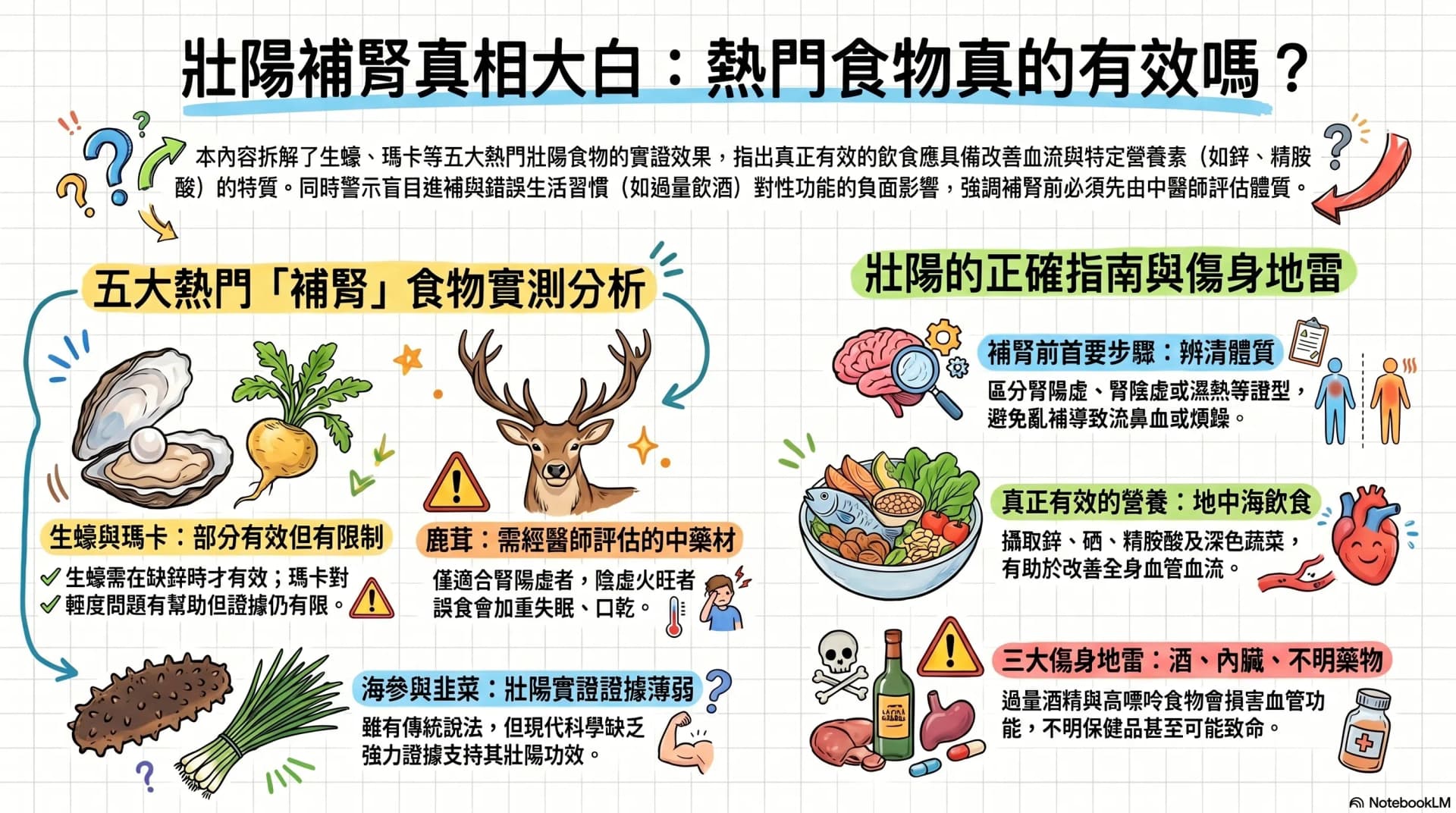
Do aphrodisiac foods actually work? This article opens with a rating table (effective / partly effective / effective within a TCM framework / weak evidence / no strong evidence), reviews the Chinese and Western medical evidence behind oysters, maca, deer antler, sea cucumber and Chinese chives, distils the 3 shared traits of foods that genuinely support male sexual function, and flags 3 commonly eaten items that can actually harm performance.
Male Menopause Through the TCM Lens: 5 Signs in Men Over 40
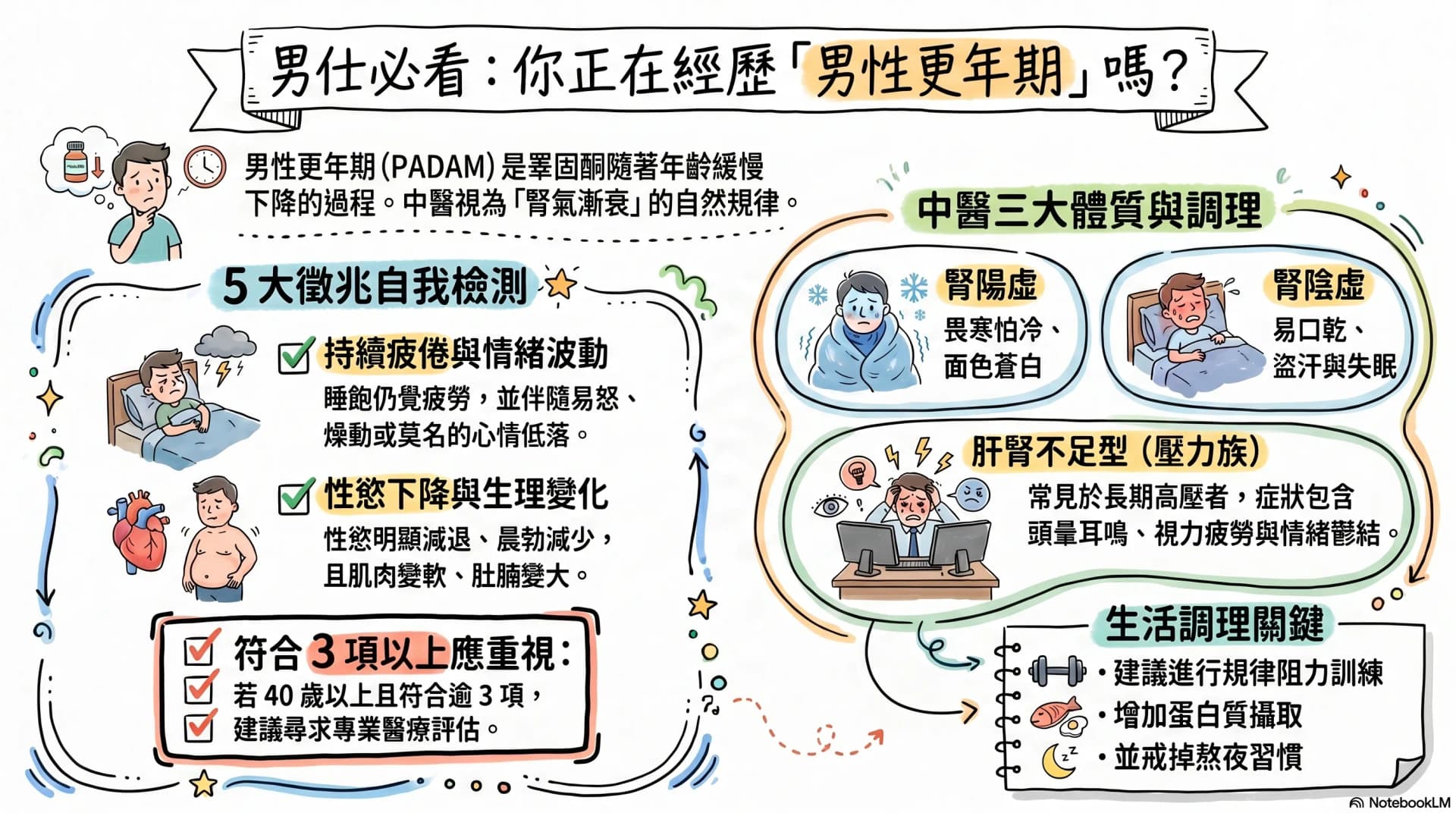
Unexplained fatigue, irritability, lower libido, poorer sleep and a growing belly after 40 are not just ageing or work stress — they may be male menopause. This article begins with a five-sign self-check, sets out three TCM patterns (kidney-yang deficiency, kidney-yin deficiency, liver-and-kidney insufficiency) with matching improvements, and compares the two treatment routes — testosterone replacement therapy versus TCM constitutional care.
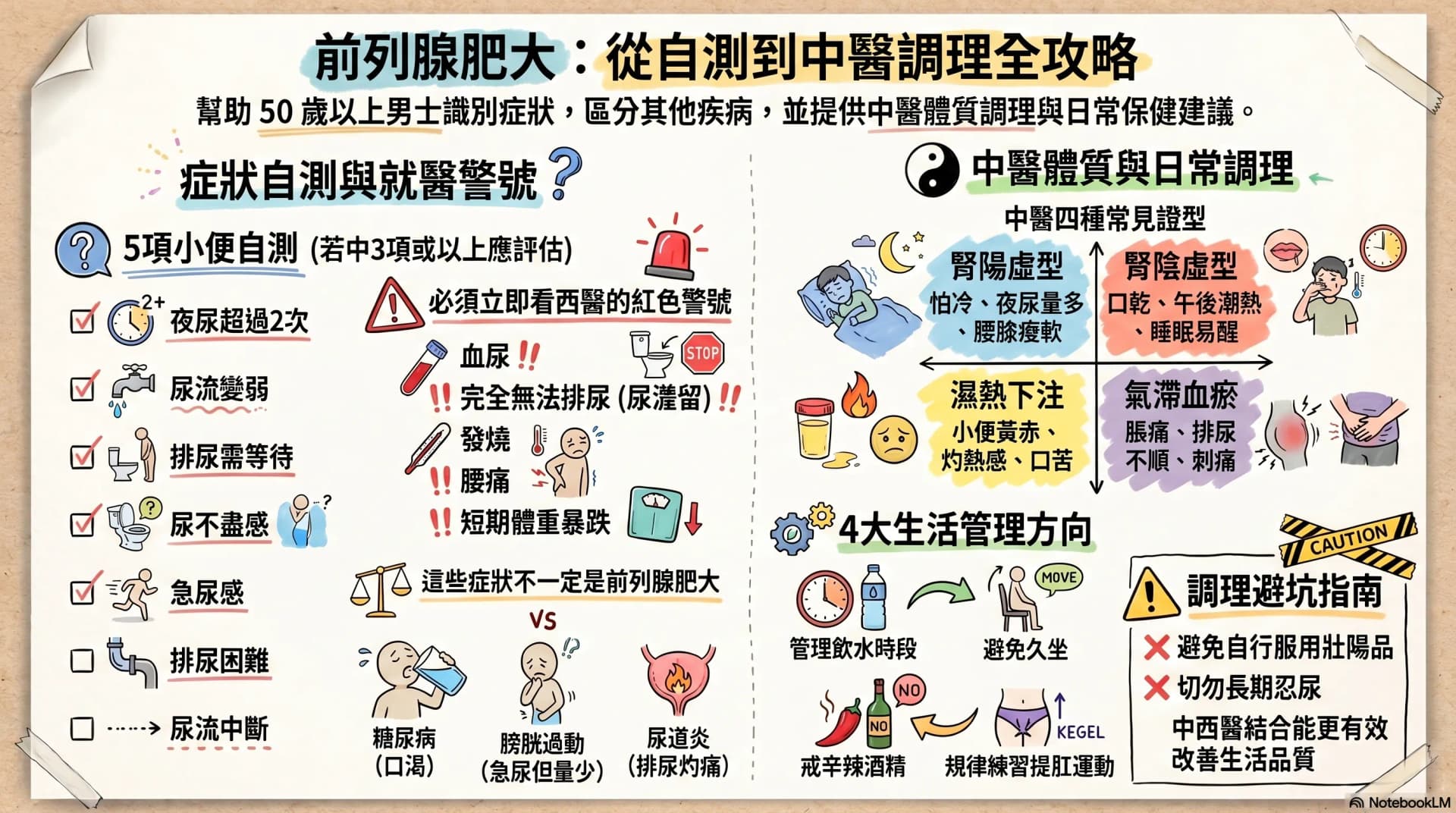
Enlarged Prostate: Are Nocturia and a Weak Stream Warning Signs?
After age 50, urinary frequency, nocturia, a weaker stream and having to urinate in stages may not simply be ageing. This article opens with a 7-symptom self-check, then sets out warning signs that warrant seeing a Western doctor immediately, four TCM constitution patterns, and four daily care directions any man can start with — helping you or your father decide the next step.