
An Itchy Throat and a Cough Whenever You Speak: Throat Sensitivity and Sensitive Cough
A long-standing itchy throat with a dry cough triggered by talking, cold air or smells — not a cold, yet recurring for years. This article explains the causes of throat sensitivity and sensitive cough, how to distinguish its links with allergic rhinitis, acid reflux and voice overuse, when to see a doctor, and how Chinese medicine can help.
Medical review: Dr. Tai Wai Ho, Samson,Registered Chinese Medicine Practitioner #008702
1-Minute Quick Answer
A long-standing itchy throat with a dry cough triggered by talking, cold air or smells often reflects an over-sensitive throat and airway, postnasal drip, allergy or voice overuse, rather than infection. Seek care if hoarseness lasts weeks, or there is difficulty swallowing or a neck lump (reviewed by Dr Tai Wai Ho, CMCHK 008702).
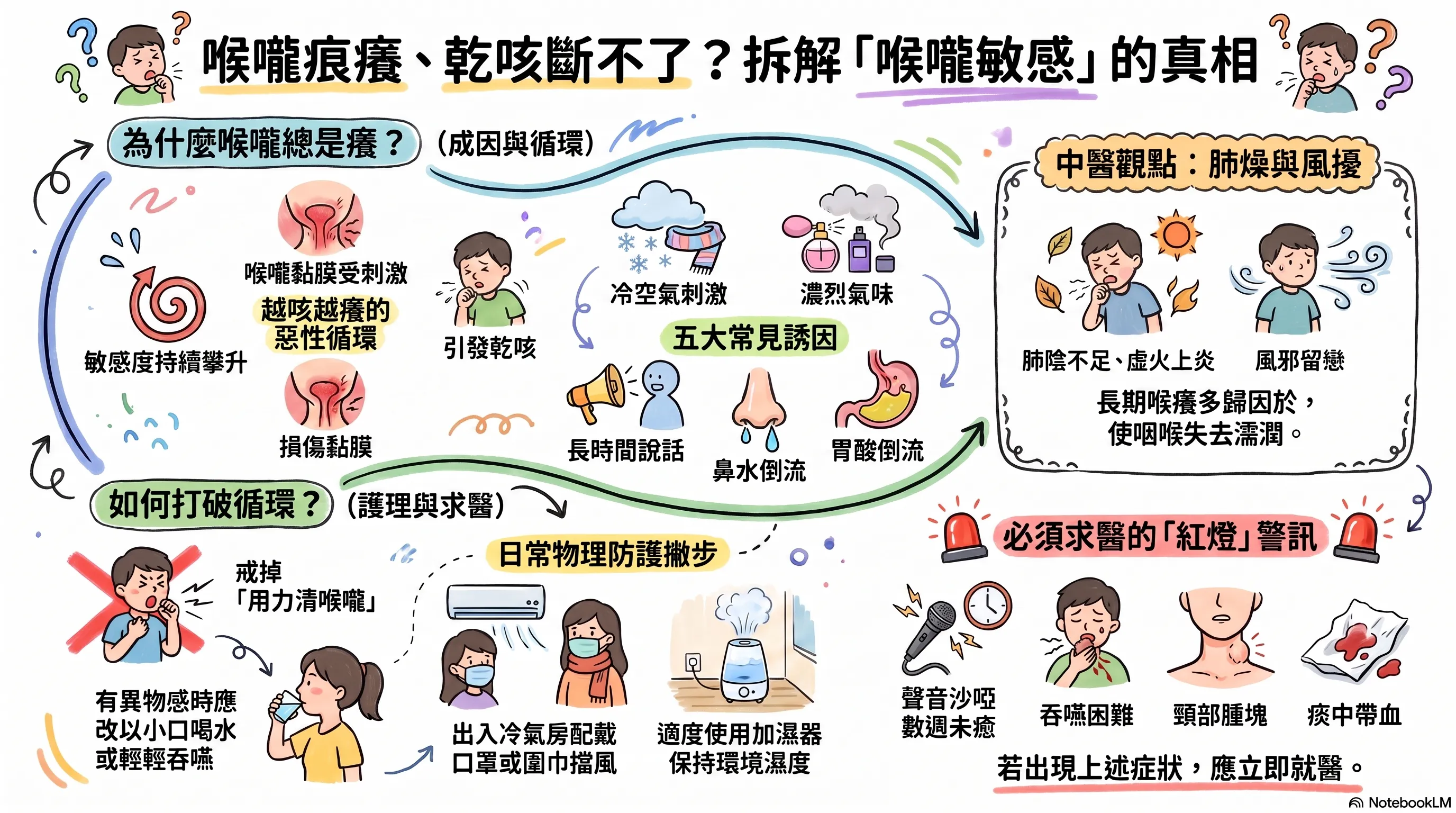 To help readers quickly grasp the content, this image was generated by NotebookLM. Some Chinese characters may not render correctly.
Important
Seek medical care first if hoarseness lasts for weeks without improvement, if swallowing is difficult or painful, if you feel a lump in the neck, or if you cough up blood or lose weight without explanation.
Your throat is always a little itchy. Speak a few sentences too many, breathe in air-conditioned air, catch the scent of perfume or cooking fumes, and you cannot help a few dry coughs — it is not a cold, yet it recurs year after year. You have seen a doctor, had your throat examined, and often nothing obvious is found.
Many people assume a cough must mean "inflammation" or "infection", and return to the clinic hoping for an anti-inflammatory that will cure it. In fact, this kind of sensitive cough is usually not a bacterial infection and may involve no obvious inflammation. The problem is that the throat and airway are over-sensitive: the slightest irritation triggers itching and coughing.
This article will explain the common causes of throat sensitivity and sensitive cough, how to distinguish its relationship with allergic rhinitis, acid reflux and voice overuse, which situations warrant seeing a doctor first, everyday voice care and environmental adjustments, and how Chinese medicine can help. By the end, you should have a clearer idea of which type you might have, and whether your next step is conservative care or medical assessment.
What Exactly Is a Sensitive Cough?
At the heart of this cough is a throat and airway in a state of heightened sensitivity: the nerves and mucosa become easily triggered, so that cold air, smells, dryness or talking — ordinarily harmless — are enough to bring on an itchy throat and coughing. Common contributing causes include:
- Throat and airway hypersensitivity: after a cold or prolonged irritation, airway sensitivity fails to settle, creating a cycle of itching, coughing, and more itching.
- Postnasal drip: allergic rhinitis or sinus problems cause secretions to run down the back of the throat, irritating it continually.
- Allergy: to dust mites, pollen, animal dander, cold air and so on.
- Environmental irritants: air-conditioning, dryness, cooking fumes, strong fragrances, second-hand smoke, dust.
- Voice overuse: long hours of speaking, teaching, selling or singing strain the throat and leave it sensitive.
From a Chinese medicine perspective, this kind of long-standing itchy, dry cough is often attributed to lung-yin deficiency with deficiency-heat rising (when yin fluids are insufficient, the throat lacks moisture, so it is dry, itchy, and coughs), or to lingering wind ("where wind prevails, there is itching" — unresolved wind leaves the throat itchy and the cough coming in bouts). In short: dryness of the lung, depleted yin, and disturbing wind.
It is worth noting that this sensitivity tends to sustain itself: the more you cough, the more the throat lining is irritated, and the more sensitive it becomes — hence the cycle of itching and coughing. Many cases begin after a cold, when airway sensitivity never fully recovers and gradually becomes long-standing throat sensitivity. Recognising this cycle is the first step in treating it: the focus is not only on suppressing the cough, but on reducing sensitivity and breaking the cycle.
First, Distinguish: Its Relationship With Rhinitis, Acid Reflux and Voice Overuse
A sensitive cough often has another source. Identify what is primary and what is secondary:
- With nasal congestion, a runny nose, sneezing, and a persistent sensation in the throat → often related to allergic rhinitis and postnasal drip.
- With regurgitation, heartburn, a bitter taste, morning hoarseness, and frequent throat-clearing → possibly related to acid reflux irritating the throat.
- Markedly worse after long or loud speaking, whether by occupation or habit → often related to voice overuse and throat strain.
Clarifying the main source often does more to settle the cough than simply suppressing it.
When Should You See a Doctor First?
Most throat sensitivity can be managed once the cause is clear, but see a doctor first if any of the following occur, to rule out throat or other problems:
- hoarseness persisting for weeks without improvement;
- difficulty or pain on swallowing;
- a lump felt in the neck;
- coughing up blood, or blood-streaked phlegm;
- unexplained weight loss;
- symptoms that keep worsening.
Long-term smokers and drinkers should be especially vigilant.
Everyday Voice Care and Environmental Adjustments
- Drink enough water to keep the throat moist; humidify moderately if indoor air is very dry.
- Avoid forceful throat-clearing — it irritates the throat and increases sensitivity. When you feel something in your throat, take small sips of water or swallow gently instead.
- Reduce exposure to irritants: do not let air-conditioning blow directly on you; in cold weather or on entering air-conditioned places, a scarf or mask can screen cold air; avoid smoke, dust, strong fragrances and second-hand smoke.
- Use your voice in moderation: those who must speak at length should rest appropriately and avoid prolonged loud speaking or shouting.
- Stop smoking and limit alcohol; sleep well, and avoid late nights that deplete yin fluids.
If symptoms remain mild, see also Persistent Cough? 6 Home Remedies and When to See a Doctor.
How Can Chinese Medicine Help?
In treating throat sensitivity and sensitive cough, Chinese medicine works through pattern differentiation — distinguishing lung-yin deficiency with deficiency-heat rising, from lingering wind with the lung failing to disperse, or from accompanying nasal blockage and rebellious stomach-qi — then providing care accordingly.
At Aspira TCM, Dr Tai Wai Ho manages coughs primarily with oral Chinese herbal medicine: according to the pattern, moistening the lung and nourishing yin while clearing deficiency-heat, dispersing wind to stop the itch and free lung-qi, or additionally opening the nasal passages and harmonising the stomach to direct qi downwards. The aim is to reduce the throat's over-sensitivity and lessen the itching and bouts of coughing. Acupuncture may be used in some cases, though herbal treatment remains the mainstay. For more on the Chinese medicine management of cough, see TCM Treatment for Cough.
It should be made clear that the role of Chinese medicine here is supportive — easing symptoms and improving the constitution. It does not replace necessary medical examination, nor does it guarantee a cure. If any of the situations above apply, see a doctor first. Do not stop prescribed medication on your own.
Rather Than Suppressing the Cough, Reduce the Sensitivity
A sensitive throat and a nagging dry cough affect speech, sleep and daily life over time. Rather than repeatedly searching for an "anti-inflammatory", identify the cause and set about reducing the sensitivity.
If you would like to know whether your throat sensitivity is suitable for Chinese medicine care, you are welcome to enquire with Aspira TCM via WhatsApp (WhatsApp: 9679 2293 / wa.me/85296792293); a practitioner can then assess and advise. If any of the situations above apply, please see a doctor first.
Medical disclaimer: This article is for health education only and does not constitute personalised medical advice. Throat sensitivity has many possible causes, and each person's constitution and condition differ, so treatment plans and outcomes vary. Chinese medicine can provide supportive care and ease symptoms but cannot replace necessary Western examination. If warning signs such as hoarseness lasting weeks, difficulty swallowing, a neck lump, coughing up blood or unexplained weight loss occur, please seek prompt care from a qualified healthcare professional.
Disclaimer: This article is for health education and reference purposes only and does not constitute medical advice, diagnosis, or treatment. Each patient's condition is unique and treatment outcomes vary. Please consult a registered TCM practitioner or qualified healthcare professional for health concerns.
Further Reading
Hand-picked related articles and real cases to read next.
Want to learn more? WhatsApp us for a free consultation
Book via WhatsAppExplore our full range of treatments: Traditional TCM Services
Related Articles

Sleep Talking, Limb Movements and Sleepwalking: What's Behind Them?
Many parents and partners have noticed a family member talking in their sleep, moving their limbs, or even sleepwalking. This article explains who this is most common in, how TCM understands it, and when it's time to see a doctor.
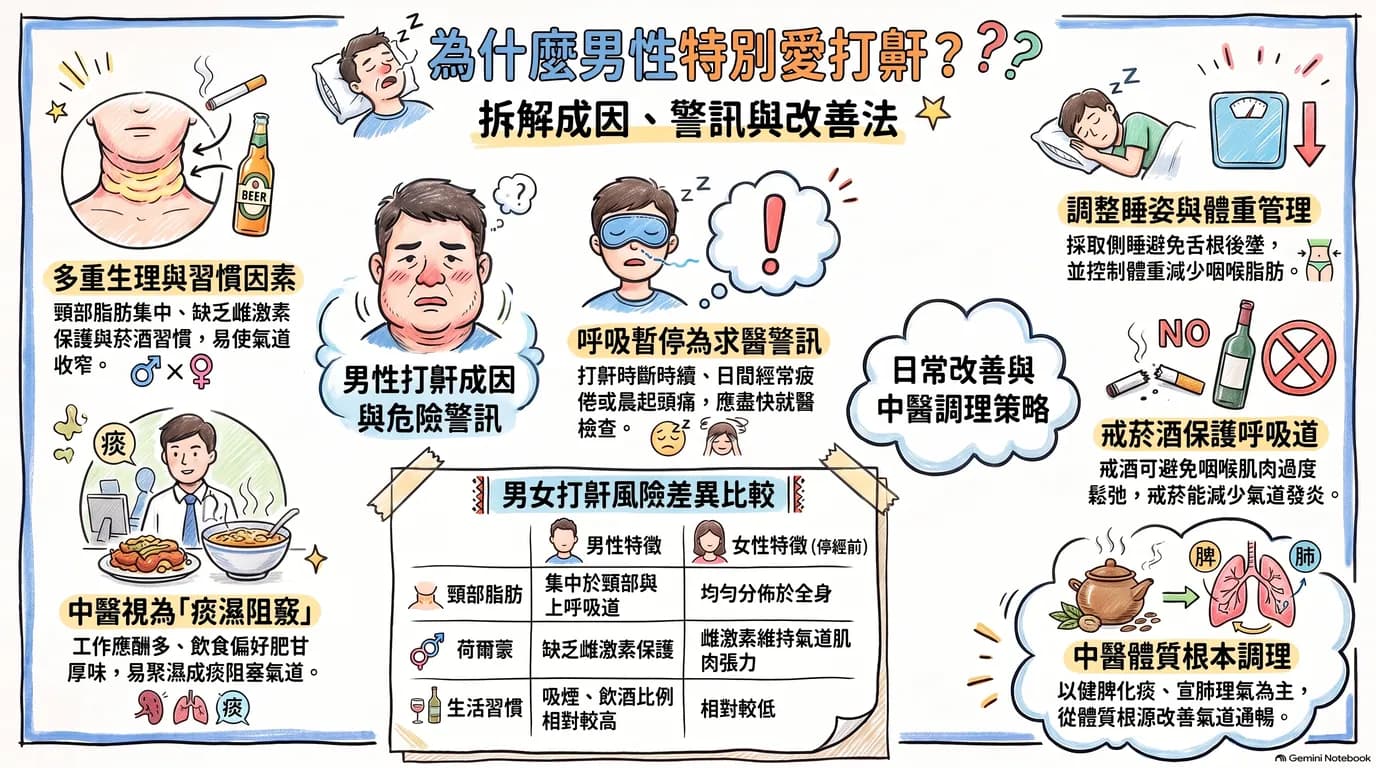
Why Do Men Snore More Than Women? Causes and Warning Signs
Snoring is far more common in men than women, and the reasons go beyond habit — physiology, hormones and lifestyle all play a part. This article explains why men snore more, which signs suggest a more serious problem, and how to ease snoring day to day.

The Cold Has Gone but the Cough Will Not Clear: Causes of a Lingering Post-Cold Cough and How TCM Can Help
The cold is gone, but the cough drags on for weeks. This article breaks down the common types and causes of a lingering post-cold cough, the situations that warrant medical attention, the treatment blind spots, and how Chinese medicine can help through pattern differentiation.