The Cold Has Gone but the Cough Will Not Clear: Causes of a Lingering Post-Cold Cough and How TCM Can Help
The cold is gone, but the cough drags on for weeks. This article breaks down the common types and causes of a lingering post-cold cough, the situations that warrant medical attention, the treatment blind spots, and how Chinese medicine can help through pattern differentiation.
Medical review: Dr. Tai Wai Ho, Samson,Registered Chinese Medicine Practitioner #008702
1-Minute Quick Answer
A cough lingering after a cold usually persists because the airway stays sensitive, not from bacterial infection, so antibiotics rarely help. First distinguish the type: dry or productive, worse in cold air or at night. Seek care if you cough blood, have fever or breathlessness, or it lasts beyond four weeks (reviewed by Dr Tai Wai Ho, CMCHK 008702).
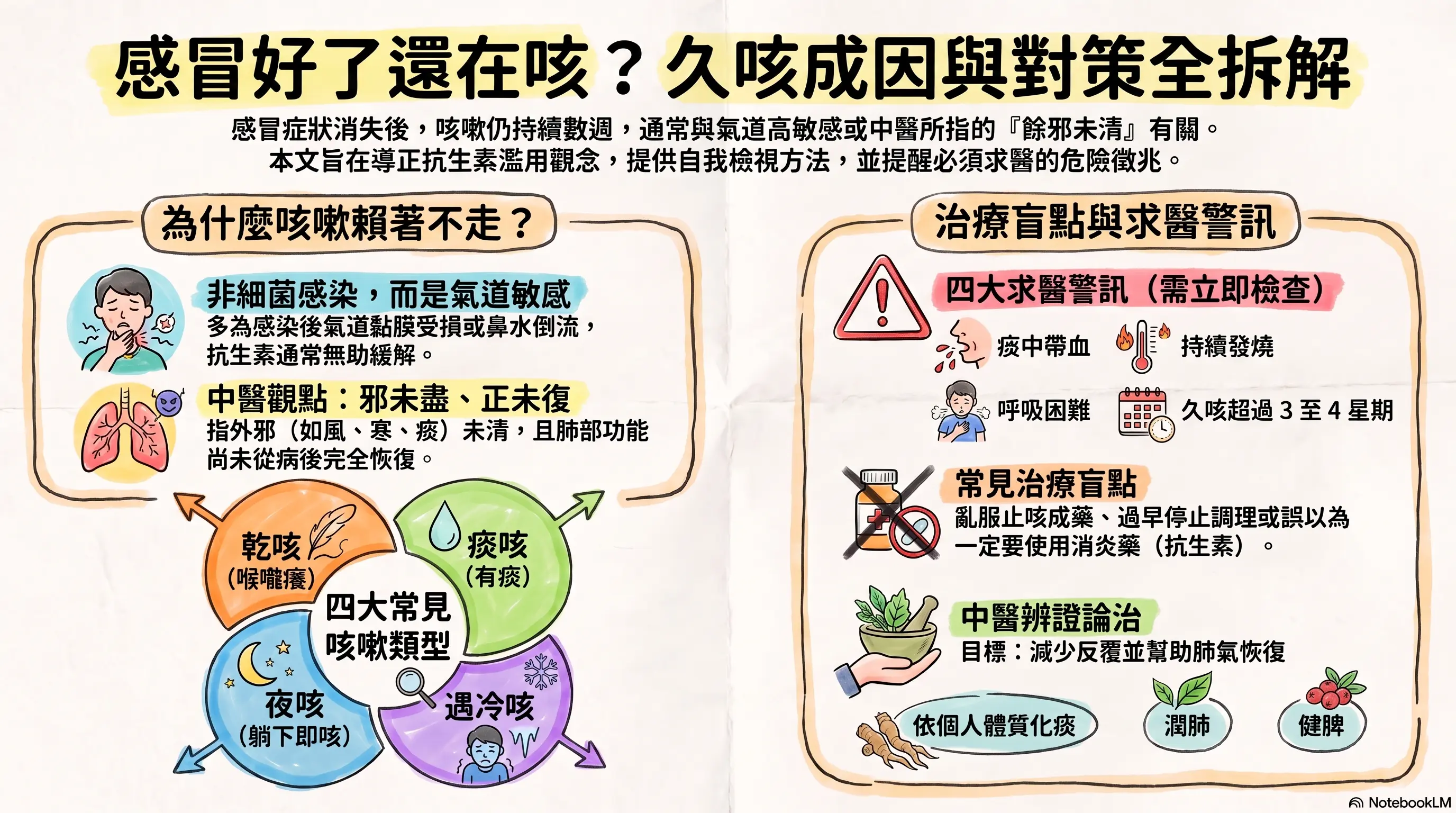 To help readers quickly grasp the content, this image was generated by NotebookLM. Some Chinese characters may not render correctly.
Important
Seek medical care first if you cough up blood or blood-streaked phlegm, have a persistent fever, breathlessness, chest pain, unexplained weight loss, or a cough lasting beyond three to four weeks without improvement, to rule out lung or other problems.
A cough that lingers through the day, set off by cold air or a strong smell, dragging on for three or four weeks — sometimes for years. The cold itself is long gone: the blocked nose, the fever, the sore throat have all cleared. Only the cough remains.
Many people, seeing the cough persist, worry the cold has "not fully cleared" and buy more over-the-counter medicine, or assume antibiotics must be needed. In fact, a cough left over after a cold is usually not a bacterial infection, and antibiotics generally do not help. It more often reflects an airway that remains sensitive after the infection.
This article will help you identify which type of post-cold cough you have, explain why the cough persists after the cold has resolved, list the situations that require immediate medical attention, discuss common treatment blind spots, and outline how Chinese medicine can help. By the end, you should have a clearer idea of whether your next step is conservative care, or medical assessment.
First, Identify Your Type of Post-Cold Cough
Post-cold coughs present differently. A simple self-comparison helps point the direction:
- Mainly dry cough: a dry, itchy throat, with little or no phlegm — often related to airway sensitivity and lung-yin deficiency.
- Productive cough: a sense of phlegm in the throat, thin and white or thick and yellow — often related to a residual pathogen and phlegm-damp.
- Mainly night cough: manageable during the day, but coughing on lying down or waking at night — often related to postnasal drip or airway sensitivity.
- Worse with cold or wind: coughing on entering an air-conditioned room or breathing cold air — often a cold-constricted airway with unresolved cold.
The above is for preliminary comparison only, not a diagnosis; many people have a mix of types. Identifying the broad direction helps you communicate with your practitioner and shapes the focus of care. If symptoms remain mild, you may first try home care — see Persistent Cough? 6 Home Remedies and When to See a Doctor.
Why Does the Cough Persist After the Cold Has Gone?
From a Western medical perspective, after an upper respiratory infection, the airway lining and nerves remain in a heightened state of reactivity — post-infectious airway hypersensitivity. Mild triggers such as cold air, smells or talking can then set off the cough reflex. Add postnasal drip, where sinus secretions run down and keep irritating the throat, and the cough readily drags on. This kind of post-infectious cough often takes weeks to settle.
From a Chinese medicine perspective, after an external pathogen invasion, if a residual pathogen (wind, cold, dryness or phlegm) has not fully cleared, and lung-qi and lung-yin have been depleted by the illness so that the lung's dispersing and descending functions have not yet recovered, the cough will linger. In short: the pathogen is not gone, and the body's strength has not returned.
Some everyday factors also make a post-infectious cough harder to settle: long hours in air-conditioned or dry indoor air, overusing the voice, changes in weather, or catching a chill again before fully recovering — all repeatedly irritate an already-sensitive airway. One further point deserves attention: if you already have allergic rhinitis, acid reflux or asthma, a cold is often only the trigger that brings the underlying sensitivity to the surface. Treated as an ordinary post-cold cough, such cases tend to drag on, and the underlying condition needs to be identified and followed up as well.
When Should You Seek Medical Care Immediately?
Most post-infectious coughs gradually improve, but seek medical care promptly if any of the following occur, to first rule out lung or other problems:
- coughing up blood, or blood-streaked phlegm;
- persistent or recurring fever;
- breathlessness, wheezing or difficulty breathing;
- chest pain;
- unexplained weight loss, or night sweats;
- a cough lasting more than three to four weeks without improvement.
Smokers, older adults, and those with chronic lung or heart disease should be especially vigilant and should not simply wait it out.
Common Treatment Blind Spots
Post-cold coughs that resist clearing are often linked to the following blind spots:
Taking medicine indiscriminately. Reaching for a cough suppressant or over-the-counter remedy without first distinguishing a dry from a productive cough, or a cold from a heat pattern. The wrong type can sometimes hinder recovery.
Stopping care too early. Stopping as soon as the cough eases, while the residual pathogen remains and lung-qi has not recovered, leaves the cough ready to return at the next trigger.
Ignoring constitution and triggers. An inherently sensitive airway, frequent late nights, a fondness for cold and raw foods, or long hours in air-conditioned, dry or dusty environments all prolong a cough. Suppressing the cough without addressing these factors means it returns after each course.
Assuming an "anti-inflammatory" is essential. Post-infectious coughs are mostly not bacterial infections; overusing antibiotics does not help and adds to the body's burden. Whether antibiotics are needed should be judged by a doctor.
How Can Chinese Medicine Help?
In treating a lingering post-cold cough, Chinese medicine focuses on pattern differentiation — first distinguishing an unresolved residual pathogen or unresolved phlegm-damp from lung-yin depletion with an airway that lacks moisture, then providing care accordingly.
At Aspira TCM, Dr Tai Wai Ho manages coughs primarily with oral Chinese herbal medicine: according to the pattern, dispersing wind to clear the residual pathogen, transforming phlegm to stop the cough, moistening the lung and nourishing yin, or strengthening the spleen to cut off the source of phlegm. The aim is both to ease the cough and to help lung-qi recover, reducing recurrence. Acupuncture may be used in some cases, though herbal treatment remains the mainstay. For more on the Chinese medicine management of cough, see TCM Treatment for Cough.
For herbal treatment of coughs arising from a simple cold, Aspira TCM offers a "results within three courses of treatment, or your money back" commitment (applicable to Dr Tai's herbal courses). However, each person's cause and constitution differ, results vary from person to person, and whether it applies and how long it takes can only be judged after assessment by a practitioner.
It should be made clear that the role of Chinese medicine here is supportive — easing symptoms and helping the body recover. It does not replace necessary medical examination. Chinese medicine care does not guarantee a cure. If any of the situations listed above apply, seek medical care first. Do not stop prescribed medication on your own.
A Lingering Cough: Identify the Cause First
When a post-cold cough drags on for weeks, rather than repeatedly medicating yourself, first identify the cause. If the cough persists, or affects daily life and sleep, it is best addressed early.
If you would like to know whether your lingering cough is suitable for Chinese medicine care, you are welcome to enquire with Aspira TCM via WhatsApp (WhatsApp: 9679 2293 / wa.me/85296792293); a practitioner can then assess and advise. If any of the situations above apply, please seek medical care first.
Medical disclaimer: This article is for health education only and does not constitute personalised medical advice. A cough has many possible causes, and each person's constitution and condition differ, so treatment plans and outcomes vary. Chinese medicine can provide supportive care and ease symptoms but cannot replace necessary Western examination or emergency care. If symptoms persist or worsen, or if warning signs such as coughing up blood, persistent fever, breathlessness or chest pain occur, please seek prompt care from a qualified healthcare professional.
Disclaimer: This article is for health education and reference purposes only and does not constitute medical advice, diagnosis, or treatment. Each patient's condition is unique and treatment outcomes vary. Please consult a registered TCM practitioner or qualified healthcare professional for health concerns.
Further Reading
Hand-picked related articles and real cases to read next.
Want to learn more? WhatsApp us for a free consultation
Book via WhatsAppExplore our full range of treatments: Traditional TCM Services
Related Articles
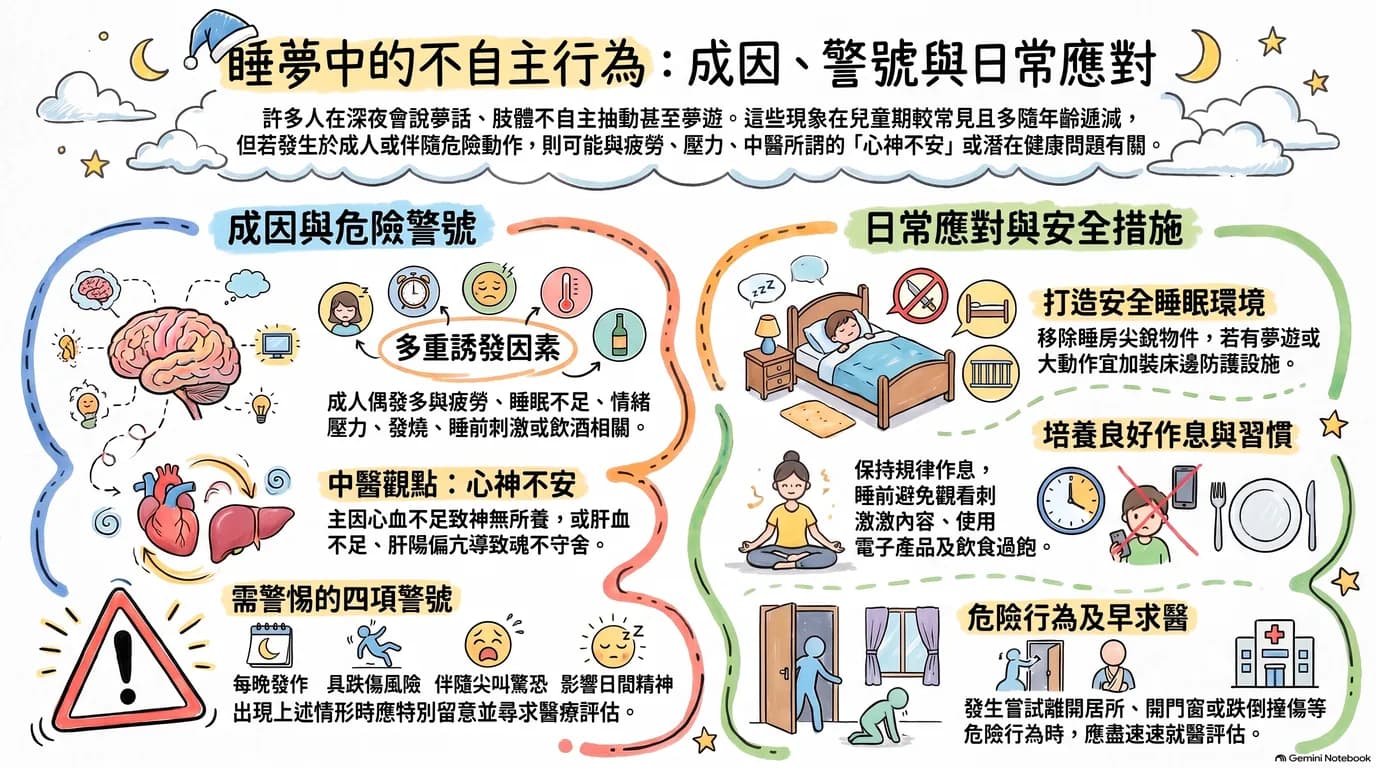
Sleep Talking, Limb Movements and Sleepwalking: What's Behind Them?
Many parents and partners have noticed a family member talking in their sleep, moving their limbs, or even sleepwalking. This article explains who this is most common in, how TCM understands it, and when it's time to see a doctor.
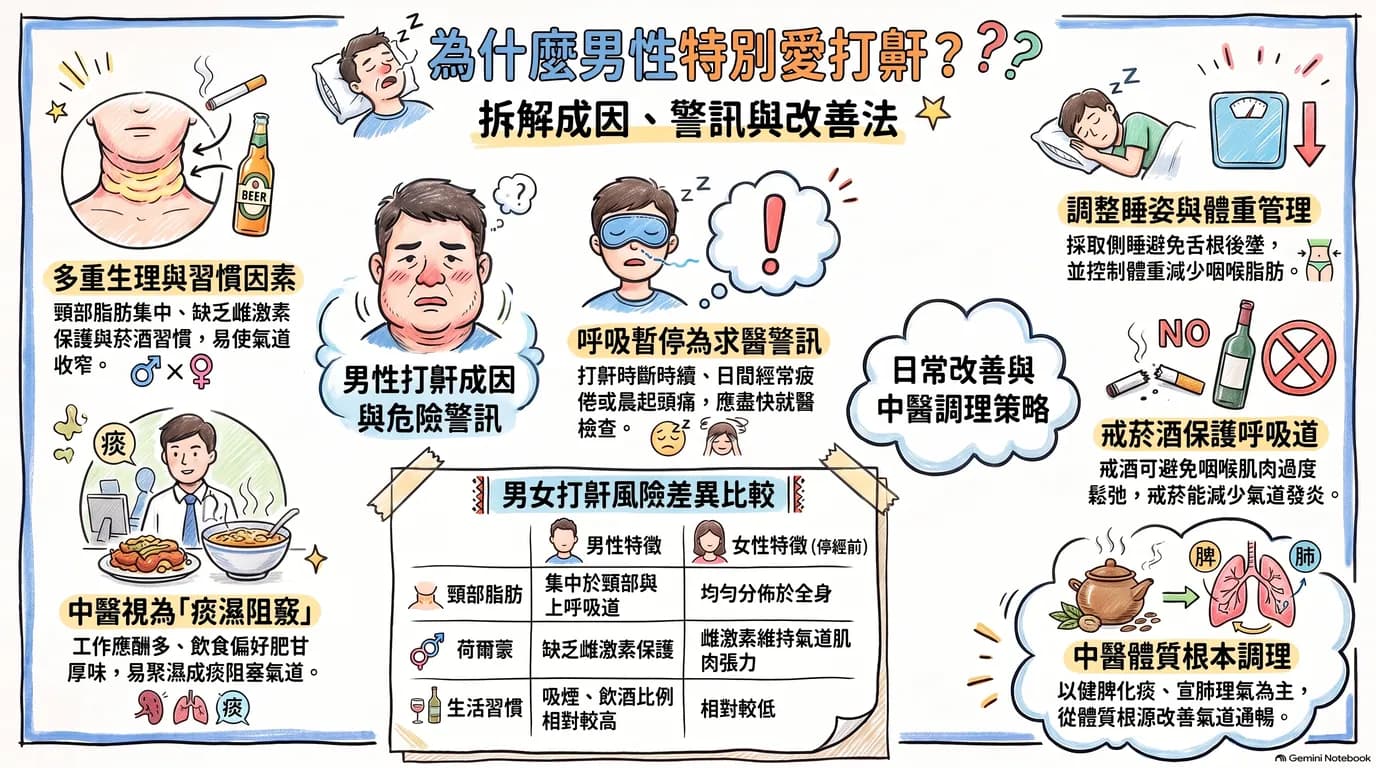
Why Do Men Snore More Than Women? Causes and Warning Signs
Snoring is far more common in men than women, and the reasons go beyond habit — physiology, hormones and lifestyle all play a part. This article explains why men snore more, which signs suggest a more serious problem, and how to ease snoring day to day.
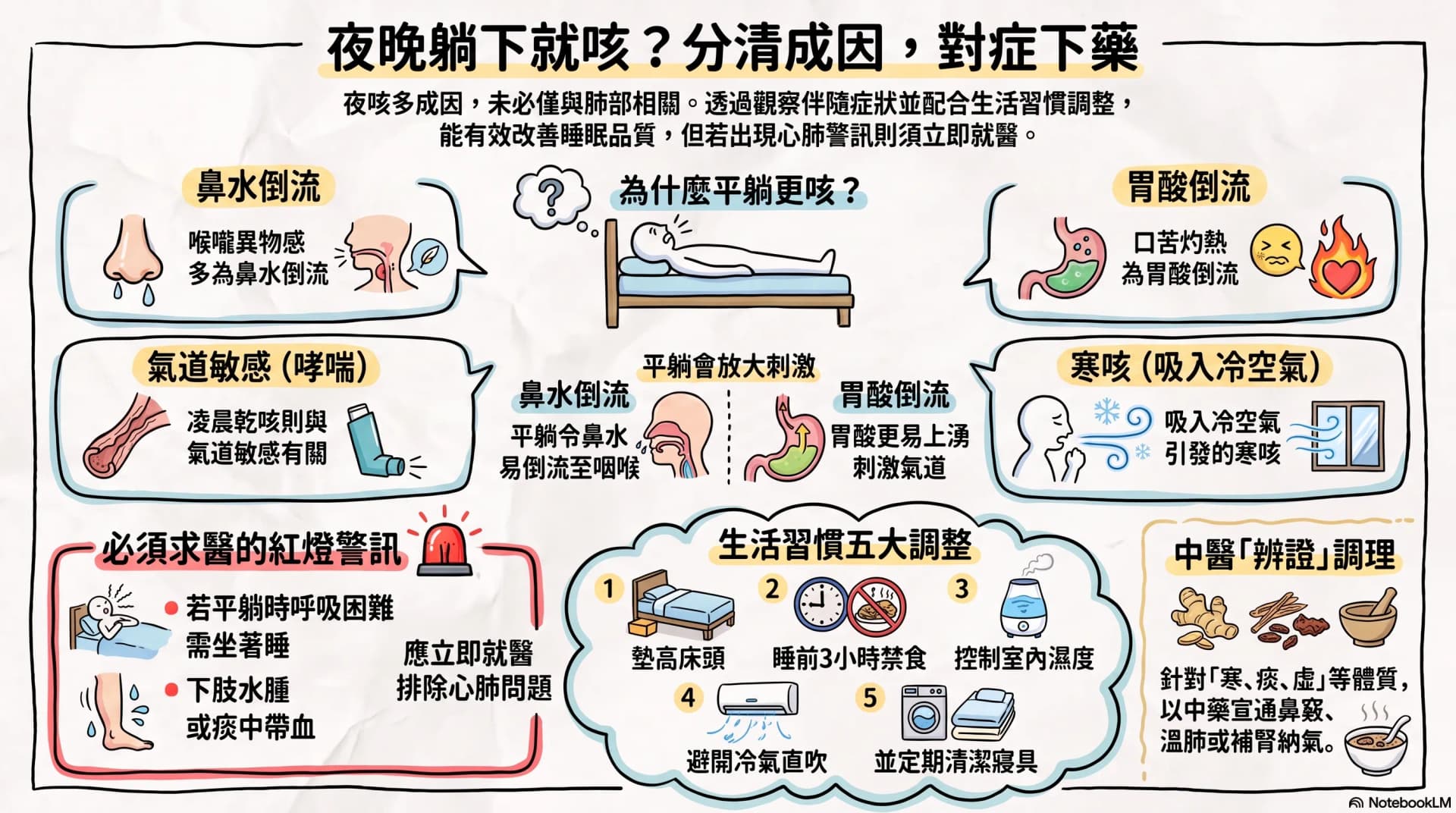
A Cough That Comes On When You Lie Down at Night: Common Causes and How TCM Can Help
Fine during the day, but coughing the moment you lie down, or waking at night? A night cough has more than one cause, and some have little to do with the lungs. Learn how to identify the type by accompanying symptoms, why lying flat makes it worse, when to seek medical care, and how Chinese medicine can help.