Paediatric Allergic Rhinitis: A TCM Guide for Hong Kong Parents
A child who sneezes every morning with a blocked nose, rubs the nose and eyes, has dark under-eye shadows, sleeps poorly and struggles to concentrate at school — this is very likely allergic rhinitis. This article explains how to tell allergic rhinitis from a cold, how TCM works through lung, spleen and kidney insufficiency and a weak surface defence, treating the flare and the quiet phase differently, how the home dust-mite environment fits in, and when to see a Western doctor first.
Medical review: Dr. To Ching, Jenny,Registered Chinese Medicine Practitioner #009330
1-Minute Quick Answer
A child who sneezes daily, rubs nose and eyes, but rarely runs a fever and drags on for weeks is more likely to have allergic rhinitis than repeated colds. TCM treats it in two phases — opening the nose during flares, and tonifying lung and spleen between them — alongside dust-mite control. See a Western doctor first if sleep apnoea, wheezing or sinus infection is a concern.
A Child Who Keeps Sneezing With a Blocked Nose? A TCM Guide to Paediatric Allergic Rhinitis
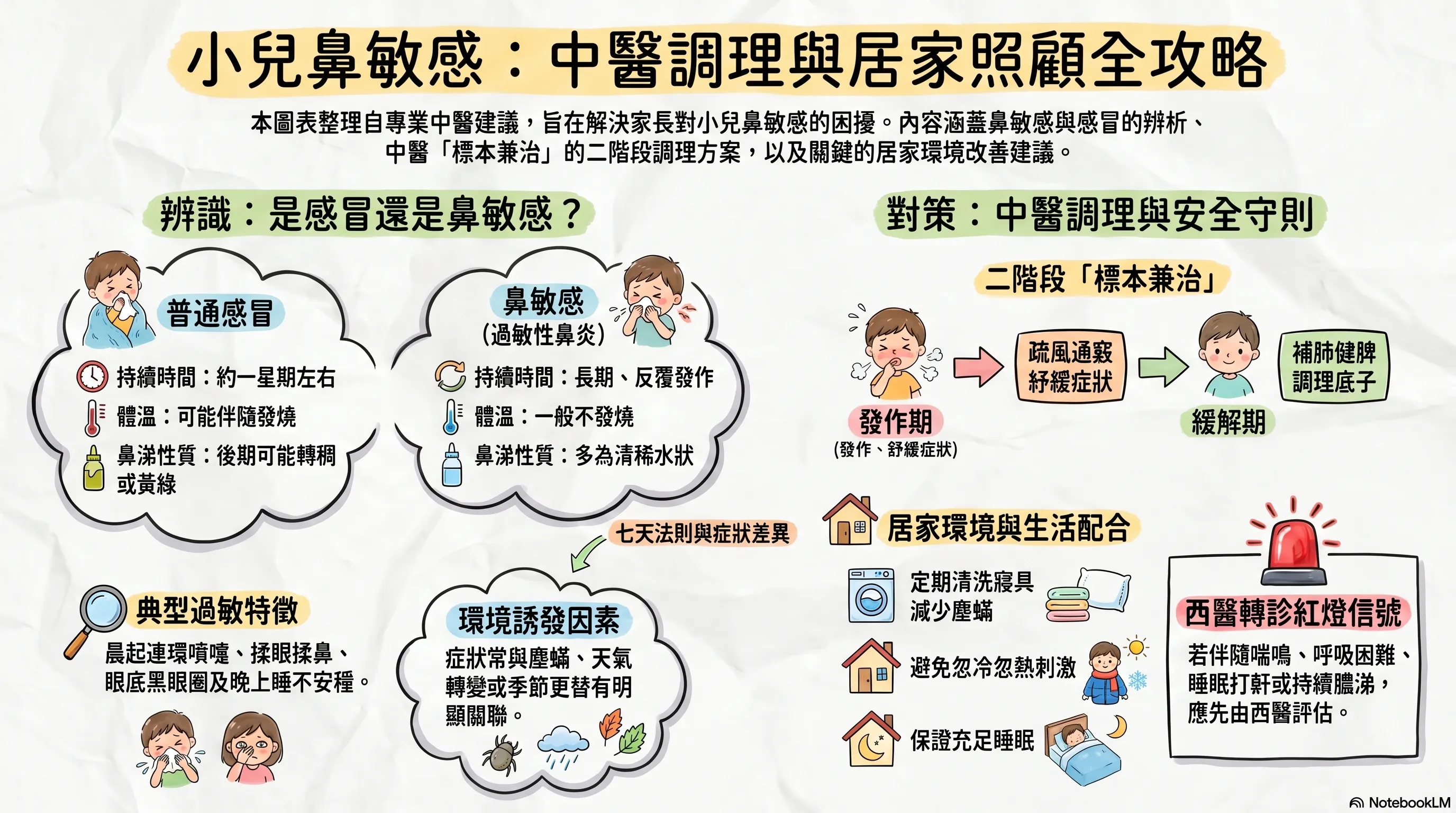 For quick reference, this image was generated by NotebookLM. Some Chinese characters may not render perfectly; we appreciate your understanding.
"As soon as my child wakes up, there is a run of sneezes, a blocked nose and a runny nose; they rub their nose and eyes all day. There are dark shadows under the eyes, sleep is restless, daytime energy is poor and concentrating at school is hard." This is a shared frustration for many Hong Kong parents — watching a child go through this year after year, feeling for them yet unsure where to begin.
Here are the two things parents most want to know. First: if a child often sneezes, has a blocked nose and a clear runny nose, yet rarely runs a fever, drags it out every time, and the symptoms track waking up or a change of season, it is most likely not one cold after another but allergic rhinitis — a long-term problem of an allergic constitution, different from catching repeated colds.
Second: there is a fair amount parents can do, and it matters as much as medication — controlling house dust mites (the most common allergen in Hong Kong), avoiding hot-cold shocks, and making sure the child sleeps enough. TCM care, in turn, works in two phases: during a flare, dispersing wind and opening the nose to ease the blockage and sneezing; in the quiet phase, tonifying the lung and strengthening the spleen to smooth the child's foundation and reduce future flares.
And what does not count as "ordinary allergic rhinitis" and should be seen by a Western doctor first? A blocked nose that seriously affects sleep or breathing, snoring or mouth-breathing during sleep, marked wheeze or cough, or persistent yellow-green nasal discharge with facial pain and fever — these should all be assessed by a Western doctor or paediatrician first.
Below, we work through how to tell allergic rhinitis from a cold, how TCM understands and conditions paediatric allergic rhinitis, and how the home environment fits in.
Note: This article is general health education. If a child's blocked nose seriously affects sleep or breathing, comes with marked wheeze, cough or breathlessness, or with persistent yellow-green nasal discharge, facial pain and fever, see a Western doctor or paediatrician first; TCM care should come in only once these are excluded.
What Is Allergic Rhinitis? Telling It Apart From a Cold
Allergic rhinitis is an allergic reaction of the nasal lining to triggers such as dust mites, dander, pollen and weather changes — commonly sneezing, a blocked nose, clear runny nasal discharge and an itchy nose, sometimes with itchy eyes.
What parents most often confuse is "allergic rhinitis" with "a cold". A simple distinction:
- A cold: caused by a virus, usually clearing on its own in about a week; may come with a sore throat and fever, and nasal discharge may thicken or turn yellow-green later.
- Allergic rhinitis: an allergic constitution, long-term and recurrent; usually no fever, with mostly clear, thin discharge; often tied to the environment or weather changes (a change of season, waking up, dust-mite contact); many children have a family history of allergy (rhinitis, asthma, eczema).
If a child "always has a cold", drags it out every time, yet does not seem to have a feverish infection, think of allergic rhinitis rather than repeated colds.
How TCM Views Paediatric Allergic Rhinitis
TCM places allergic rhinitis largely within the category of "bi qiu", and its hallmark is deficiency at the root with excess at the surface.
The "root deficiency" refers to an insufficient bodily foundation, mainly in the lung, spleen and kidney, leaving the "defensive qi" (the body's surface defence) not firm enough; the "surface excess" refers to wind, cold and other external triggers stirring things up on that deficient base, producing the flare symptoms of sneezing, blocked nose and clear discharge.
A simple analogy: defensive qi is like a "wind gate" on the child's surface; when the gate is not firm, the slightest disturbance outside makes the nose react first. So TCM care for paediatric allergic rhinitis is divided into the flare phase and the quiet phase — the flare phase first disperses wind, opens the nose and eases symptoms; the quiet phase (when there is no flare) focuses on rebuilding the lung, spleen and kidney foundation to reduce future flares.
Common Patterns
Paediatric allergic rhinitis commonly presents along these lines:
- Lung-qi deficiency: frequent sneezing, clear discharge, easy sweating, frequent colds, a softer voice; triggered by wind or a change of season.
- Spleen-qi deficiency: on top of the above, poor appetite, loose stools, a sallow complexion and easy fatigue.
- Kidney-yang deficiency: more pronounced cold-aversion, cold hands and feet, a longer and more stubbornly recurrent course.
- With external cold or pent-up heat: flares leaning towards clear discharge with cold-aversion, or towards thicker discharge with marked itch.
In practice children often present with mixes such as "lung-and-spleen deficiency" or "lung-spleen-kidney insufficiency"; the picture must be judged by a registered TCM practitioner from tongue, pulse, symptoms and the child's age.
The TCM Approach
The emphasis in TCM care for paediatric allergic rhinitis is to condition the constitution in the quiet phase and ease symptoms in the flare.
In the quiet phase (when there is no flare), the focus is tonifying the lung, strengthening the spleen and consolidating the surface, with kidney-yang support where needed — the aim being to smooth the child's foundation and reduce the frequency and severity of flares. This is preventive conditioning, not "waiting for a flare to act". The flare phase focuses on dispersing wind and opening the nose to ease the blockage and sneezing of the moment.
The methods include Chinese herbs (with doses adjusted to pattern and age), paediatric tui-na (suited to younger children or those who resist taking medicine, performed by a practitioner with relevant experience, with some simple techniques taught to parents) and acupoint care. The exact formulas and techniques are decided by a registered TCM practitioner; this article does not list formula names or doses.
It should be said plainly: allergic rhinitis reflects an allergic constitution, and the goal of TCM care is to reduce flares and improve quality of life — it takes time (usually measured in months) before changes appear, and is not a "cure" from one or two doses. If a child is also under Western care, using a nasal spray or an antihistamine, TCM care can run alongside it, but both sides should be kept informed.
Home and Lifestyle: As Important as the Herbs
Allergic rhinitis is closely tied to the environment, so home adjustments often matter as much as conditioning:
- Dust-mite control: dust mites are one of the most common allergens in Hong Kong. Wash bed linen regularly in hotter water; cut down on soft toys, carpets and heavy curtains; keep rooms ventilated and dry.
- Avoid hot-cold shocks: keep the child warm on waking and when moving in and out of air-conditioned rooms; TCM also suggests easing off cold and raw foods.
- Moderate exercise: regular, moderate exercise helps build the constitution, though the exercise environment and temperature swings need attention.
- Enough sleep: too little sleep leaves a child's constitution and resistance weaker.
- No need for extreme food restriction: unless a specific food allergy is known, blanket heavy restriction is unnecessary and can affect a child's nutrition and growth.
When to See a Western Doctor First
Most allergic rhinitis can improve through environmental adjustment and combined Western-TCM care, but the following should be assessed by a Western doctor or paediatrician first:
- A blocked nose seriously affecting sleep, or snoring, mouth-breathing or pauses in breathing during sleep
- Marked wheeze, cough or breathlessness — asthma should be assessed
- Persistent yellow-green nasal discharge with facial pain and fever — sinusitis should be assessed
- Long-standing severe rhinitis affecting the child's growth, development or learning
- Frequent nosebleeds, or one-sided blockage or blood-tinged discharge — these need further investigation
The role of TCM is to help reduce flares from a constitutional angle once a Western doctor has excluded the above.
How Aspira TCM Clinic Helps
When Dr To sees a child for allergic rhinitis, the first visit generally involves:
- Understanding the child's symptoms, the timing and settings of flares, the family allergy history and any current Western medication
- Using tongue, pulse and the four examinations to tell whether the picture is mainly lung, spleen or kidney
- Setting an herbal and/or paediatric tui-na plan for the flare and quiet phases, adjusted for age
- Going through home dust-mite control, keeping warm, sleep and other lifestyle points
- If asthma, sinusitis or another condition needing Western care is suspected, advising the relevant checks first
Dr To does not market this care with "cured for good" claims; the aim is to reduce flares and help the child sleep well and feel comfortable.
FAQ
Q1: My child "always has a cold" — is it actually allergic rhinitis?
It may be. If a child often sneezes, has a blocked and clear runny nose, but rarely runs a fever, drags it out every time, and the symptoms track waking up or a change of season, think of allergic rhinitis rather than repeated colds. A doctor should assess this.
Q2: Can allergic rhinitis be "cured for good"?
Allergic rhinitis reflects an allergic constitution, so "a cure" is hard to claim. The goal of TCM care and environmental control is to reduce the frequency and severity of flares and improve sleep and quality of life. Any "guaranteed cure" claim should be treated with caution.
Q3: My child resists taking Chinese herbs — what can be done?
Paediatric tui-na is worth considering — it needs no medication and suits younger children or those who resist it, performed by a practitioner with relevant experience, with some simple techniques taught to parents to use at home. Whether it suits and how it fits in is for a registered TCM practitioner to assess.
Q4: Should we stop the child's Western nasal spray or medication to see a TCM practitioner?
Do not stop on your own. TCM care can run alongside Western care; tell the TCM practitioner about the nasal spray, antihistamine and so on that the child uses. Any change to Western medication should be decided by the prescribing doctor.
Q5: How long before TCM care shows results?
Constitutional conditioning for allergic rhinitis is generally measured in months and, alongside environmental control, takes time before flares gradually lessen — not a stop from one or two doses. Logging the child's flares helps the practitioner adjust.
— Dr To Ching | Registered Chinese Medicine Practitioner (Gynaecology, TCM Aesthetics, Thread-Embedding Weight Loss, Postpartum Belly Binding) Aspira TCM Clinic
Experiencing a Similar Problem? Book a Consultation
If your child's allergic rhinitis is recurrent and affecting their sleep and energy, you are welcome to book a consultation with Dr To.
How to book:
- WhatsApp: Book here
- Phone: 2110 9337
- Address: Unit 2706, Saxon Tower, 7 Cheung Shun Street, Lai Chi Kok
Disclaimer: This article is for general health education only and does not replace individual diagnosis, examination, medication or treatment advice. Every child's constitution and situation differ; please consult a registered TCM practitioner for an actual plan. If a child's blocked nose seriously affects sleep or breathing, or asthma or sinusitis is suspected, see a Western doctor or paediatrician first; any change to Western medication should be discussed with the prescribing doctor.
Disclaimer: This article is for health education and reference purposes only and does not constitute medical advice, diagnosis, or treatment. Each patient's condition is unique and treatment outcomes vary. Please consult a registered TCM practitioner or qualified healthcare professional for health concerns.
Further Reading
Hand-picked related articles and real cases to read next.
Want to learn more? WhatsApp us for a free consultation
Book via WhatsAppExplore our full range of treatments: Traditional TCM Services
Related Articles
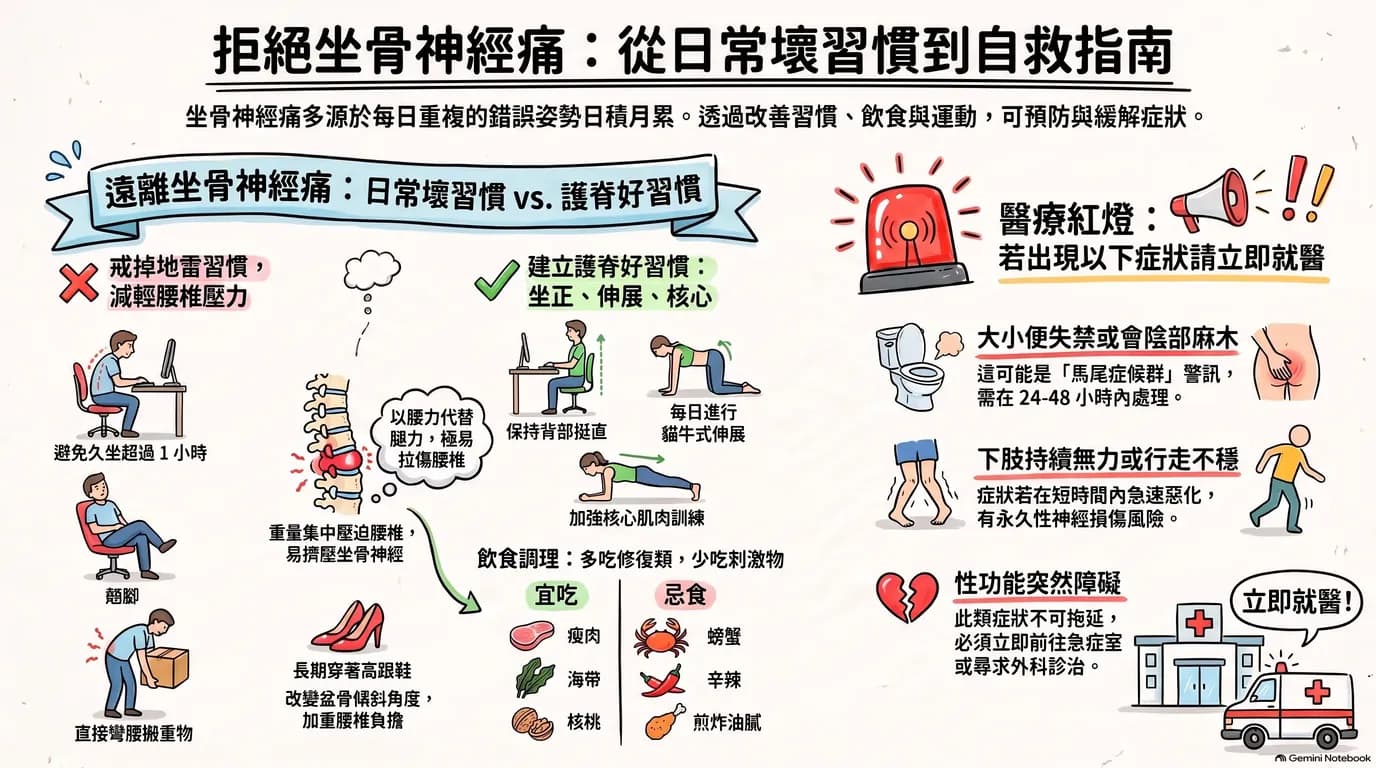
Sciatica Prevention: Bad Habits, Diet and Daily Care Tips
Sciatica isn't only about treatment — your daily habits and diet play a big role too. In this article, Dr Wong explains which everyday habits increase your risk of sciatica, which foods may help ease it, and simple daily habits that reduce the chance of it coming back.
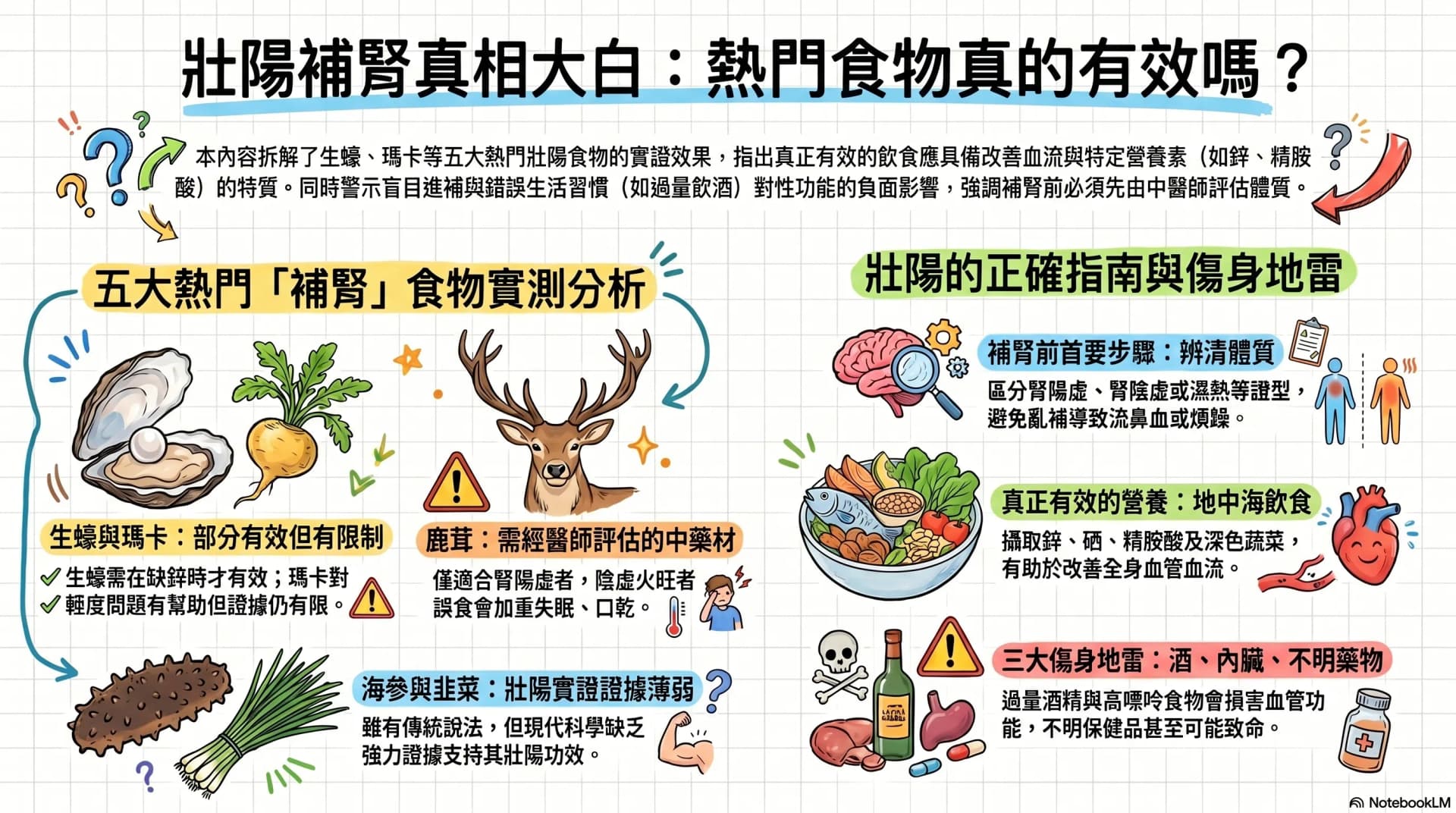
Do Oysters, Maca and Deer Antler Boost Male Vitality? 5 Myths
Do aphrodisiac foods actually work? This article opens with a rating table (effective / partly effective / effective within a TCM framework / weak evidence / no strong evidence), reviews the Chinese and Western medical evidence behind oysters, maca, deer antler, sea cucumber and Chinese chives, distils the 3 shared traits of foods that genuinely support male sexual function, and flags 3 commonly eaten items that can actually harm performance.
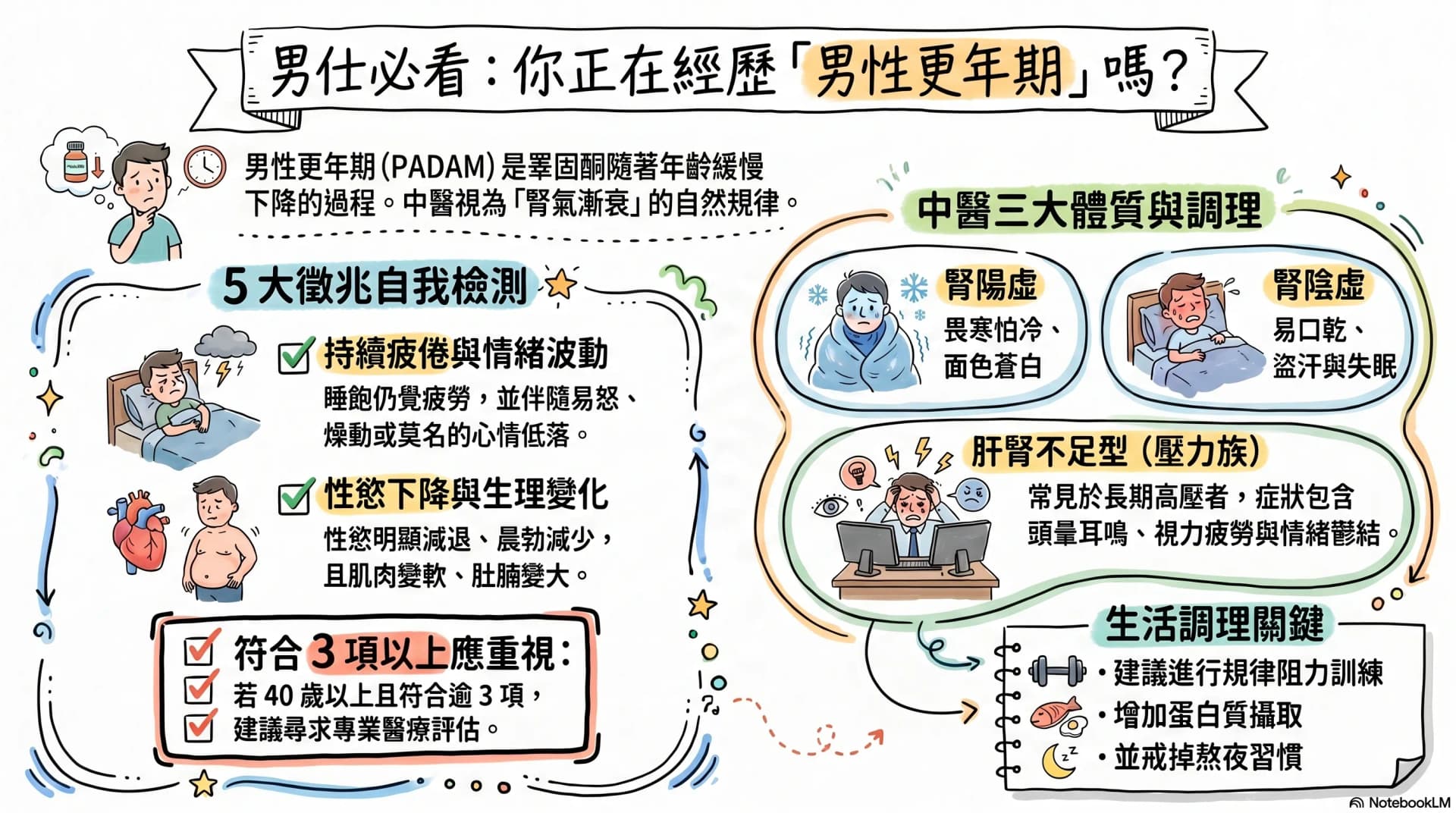
Male Menopause Through the TCM Lens: 5 Signs in Men Over 40
Unexplained fatigue, irritability, lower libido, poorer sleep and a growing belly after 40 are not just ageing or work stress — they may be male menopause. This article begins with a five-sign self-check, sets out three TCM patterns (kidney-yang deficiency, kidney-yin deficiency, liver-and-kidney insufficiency) with matching improvements, and compares the two treatment routes — testosterone replacement therapy versus TCM constitutional care.