How to Choose a Good TCM Doctor? 5 Questions You Must Ask
Choosing the right TCM doctor shouldn't be a gamble. This guide covers 5 essential questions to ask before your first visit — from verifying credentials to checking fee transparency — so you can find a trustworthy practitioner who truly fits your needs.
Medical review: Dr. Tai Wai Ho, Samson,Registered Chinese Medicine Practitioner #008702
1-Minute Quick Answer
Choosing a TCM doctor shouldn't be a gamble. Dr Tai (CMCHK 008702) at Aspira TCM Lai Chi Kok lists the 5 questions you must ask before your first visit — registration credentials, fee transparency, treatment expectations, herb sourcing, and follow-up cadence — so you avoid pitfalls.
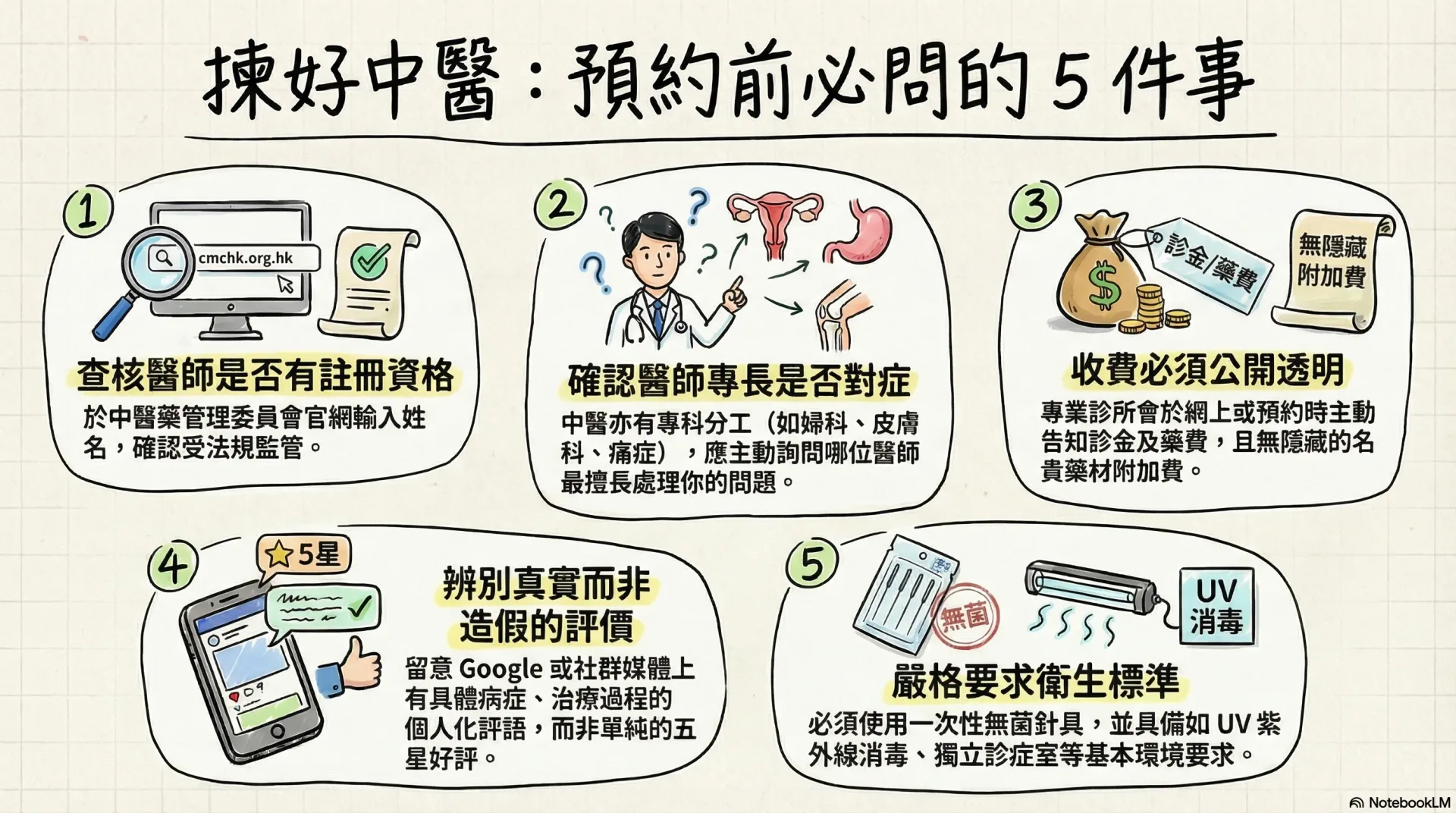 To help readers quickly grasp the content, this image was generated by NotebookLM. Some Chinese characters may not render correctly.
When you search for a Traditional Chinese Medicine (TCM) practitioner in Hong Kong, the sheer number of options can be overwhelming. From private clinics to chain operations, from neighbourhood shops to modern medical centres — how do you tell which ones are truly professional and which ones just look the part?
This article isn't here to promote any particular clinic. Instead, it gives you a practical framework: 5 questions to ask before booking your first appointment. Use them as a checklist, and you'll be able to separate the trustworthy clinics from the rest.
Question 1: Is the Practitioner a Registered TCM Doctor?
This may sound basic, but it's the single most overlooked step.
Hong Kong has regulated TCM practice since 1999. The Chinese Medicine Council of Hong Kong (CMCHK) oversees registration, requiring practitioners to pass licensing examinations and complete supervised clinical training before they can legally treat patients.
How to Verify
Visit the CMCHK's official website (www.cmchk.org.hk), enter the practitioner's name or registration number, and confirm their status. It takes less than a minute.
Why It Matters
- Safety: Registered practitioners are held accountable under Hong Kong law. If something goes wrong, you have formal channels for complaints and recourse.
- Professional standards: Registration requires ongoing continuing education, keeping practitioners' knowledge up to date.
- Accountability: Unregistered practitioners operate outside the regulatory framework — if problems arise, you have virtually no legal protection.
Don't skip this step just because a friend recommended someone or because online reviews look good. One minute of verification is worth far more than the regret of discovering a problem too late.
Question 2: Does the Practitioner's Specialty Match Your Condition?
Many people assume every TCM doctor treats everything. In reality, TCM has distinct areas of specialisation, just like Western medicine. A practitioner who excels at dermatological conditions may not be the best choice for musculoskeletal pain, and a gynaecology specialist may not be ideal for respiratory issues.
Common TCM Specialisations
| Area of Focus | Typical Conditions |
|---|---|
| Internal Medicine | Coughs, colds, digestive issues, insomnia |
| Gynaecology | Menstrual irregularities, menopause, postpartum care |
| Dermatology | Eczema, acne, urticaria |
| Orthopaedics / Pain | Neck and shoulder pain, lower back pain, sciatica |
| Paediatrics | Children's coughs, digestive issues, developmental concerns |
| Acupuncture | Pain management, stroke rehabilitation, facial paralysis |
What to Ask
- Before booking, ask the clinic directly: "Which practitioner is most experienced with [your condition]?"
- Check the clinic's website to see if each practitioner's areas of expertise are clearly listed.
- Look for evidence of relevant advanced training or published clinical experience.
A good clinic will proactively match you with the most suitable practitioner, rather than assigning whoever is available. If a clinic claims every practitioner "handles everything," that should give you pause.
Question 3: Are the Fees Transparent?
"How much does TCM treatment cost?" — it's a question many patients want to ask but feel awkward raising. And it's precisely this awkwardness that leads to bill shock at the end of a consultation.
What a Good Clinic Should Offer
- Published fee schedules: Consultation fees, herbal medicine costs, and acupuncture fees should be available on the clinic's website before you visit.
- Upfront pricing: A good clinic will give you a clear cost estimate when you book, not wait until you're seated in the consultation room.
- No hidden charges: Some clinics add surcharges for "premium herbs" without prior notice, catching patients off guard at checkout.
Red Flags to Watch For
- "Consultation fee separate": Some clinics advertise low medicine costs but charge high consultation fees — the total may not be cheap at all.
- Premium herb surcharges: Expensive ingredients like cordyceps or deer antler may be added to your prescription with additional fees you weren't told about.
- High-pressure treatment packages: Some clinics push large prepaid treatment packages that may not suit your actual needs.
The simplest test: if a clinic won't even publish its fees, what else might it be reluctant to disclose?
Question 4: Are There Genuine Patient Reviews?
Word of mouth has always been one of the most important factors when choosing a doctor. But in the digital age, you need to distinguish between authentic feedback and manufactured reputations.
Where to Check
- Google Reviews: The most accessible source and relatively difficult to fake at scale. Look beyond the star rating — read the actual comments for specific details.
- Social media (Instagram / Facebook): Some clinics share real treatment cases and before-and-after comparisons. If the follower count is substantial and the engagement looks organic, credibility is higher.
- Personal referrals: The most reliable source, though remember that individual results vary based on constitution and expectations.
How to Spot Fake Reviews
- Authentic reviews typically mention specific conditions, treatment experiences, and personal feelings. The language is detailed and individual.
- Fake reviews tend to be vague ("Great! Highly recommend!") or appear in suspiciously large batches over a short period.
- A mix of ratings is actually more credible: If a clinic has 100% five-star reviews with no exceptions, that itself is a red flag.
The most trustworthy clinics don't delete negative reviews — they respond to them thoughtfully. That attitude says more than any number of five-star ratings.
Question 5: What Are the Clinic's Hygiene and Environment Standards?
TCM treatments such as acupuncture and cupping involve direct skin contact. Hygiene standards are non-negotiable.
Hygiene Indicators to Check
- Acupuncture needles: Must be single-use, sterile, and disposed of immediately after treatment. If you ever see a clinic reusing needles, leave immediately.
- Disinfection protocols: Treatment beds, cupping equipment, and other tools should be thoroughly disinfected between patients.
- Air quality: Does the clinic have ventilation systems or air purification? Post-pandemic, air disinfection has become a baseline expectation.
Environment
- Consultation room privacy: Your conversation with the practitioner should be private — other patients in the clinic shouldn't be able to overhear.
- Waiting area: Clean, comfortable, and spacious enough that patients aren't crowded into corridors.
- Accessibility: Can elderly patients and those with mobility issues access the clinic comfortably?
A clinic that maintains high standards for its environment usually applies the same rigour to its treatments. The two almost always go hand in hand.
How Aspira TCM Meets These Standards
After covering all five questions, you might wonder: does any clinic actually tick every box?
We won't claim perfection, but at Aspira TCM, these five standards are what we hold ourselves to every single day.
Registered Credentials: 5 Registered TCM Practitioners + 1 Registered Physiotherapist
All five of our TCM practitioners are registered with the Chinese Medicine Council of Hong Kong, with publicly verifiable registration numbers. Our team also includes a registered physiotherapist, enabling integrated East-meets-West treatment approaches.
Clear Specialisation
We never claim that one practitioner treats everything. Instead, we match you with the right specialist:
- Dr Tai: Internal and external medicine, dermatology, men's health, gastroenterology, and cough (with a three-visit effectiveness guarantee — refund if no improvement)
- Dr. To: Gynaecology, TCM aesthetics, postnatal belly binding, and paediatrics
- Dr. Au: TCM weight management, nutritional therapy, and eczema (holding a Nutritionist qualification for dual professional expertise)
- Dr. Chan: Women's health for middle-aged and elderly patients, menopause syndrome, uterine fibroids, and internal medicine
- Dr. Wong: Pain management, orthopaedics / bone-setting, postural correction, and internal medicine
When you call or WhatsApp to book, our team first understands your situation, then recommends the most suitable practitioner.
Transparent Pricing
Our pricing page clearly lists fees for all services, including consultation, herbal medicine, and acupuncture. We are committed to no premium herb surcharges — all prescribed herbs are included in the standard medicine fee. There are no unpleasant surprises at checkout.
Authentic Reviews, Real Cases
Aspira TCM's Instagram account has over 10,000 genuine followers, with regular posts featuring real clinical cases and treatment progress. These numbers weren't bought — they're the result of years of patient trust and word-of-mouth. You're welcome to check our social media for yourself.
Hygiene and Environment
- Daily UV disinfection: The clinic undergoes UV sterilisation daily to ensure a hygienic treatment environment.
- Single-use acupuncture needles: All needles are disposable and discarded after one use.
- Private consultation rooms: Ensuring every patient's privacy and comfort.
AI-Assisted Diagnosis: Traditional Expertise Meets Modern Technology
Aspira TCM is the first TCM clinic in Hong Kong to introduce an AI-assisted diagnostic system. The AI helps practitioners analyse the four diagnostic methods and cross-reference historical case data, improving diagnostic accuracy and consistency. Of course, the final clinical judgement and treatment plan always rest with our experienced registered practitioners.
Our motto is "Full dedication in medicine, conscience in healing" — and it's not just words on a wall. It's our daily working standard.
Frequently Asked Questions (FAQ)
How many TCM clinics are there in Hong Kong?
According to the Chinese Medicine Council of Hong Kong, there are currently over 7,000 registered TCM practitioners across thousands of clinics in the territory. With so many options, quality inevitably varies — which is precisely why using the five questions in this article can help you narrow down the field.
What is the difference between a "TCM practitioner" and a "TCM doctor"?
Under Hong Kong's legal framework, a "Registered Chinese Medicine Practitioner" is a professional regulated by the Chinese Medicine Council who has passed the licensing examination. Terms like "TCM doctor" or "Chinese medicine doctor" are informal and do not necessarily indicate registered status. Always confirm that your practitioner is formally registered before seeking treatment.
What should I bring to my first TCM appointment?
No special preparation is needed, but we recommend bringing: (1) your Hong Kong ID or medical card; (2) any previous test results or Western medical records (if available); (3) a list of medications you're currently taking. Wear loose, comfortable clothing to make physical examination easier.
For more details, visit our First Visit Guide.
How long does TCM treatment typically take to show results?
It depends on the condition and individual constitution. Acute conditions (e.g., common cold, acute lower back pain) may show noticeable improvement within 1-3 treatments. Chronic conditions (e.g., eczema, long-term insomnia) typically require several weeks to months of treatment. A good practitioner will give you a realistic timeline at your first consultation, rather than asking you to keep coming back indefinitely.
Can I see a TCM doctor and a Western doctor at the same time?
Yes, but you must inform both sides about all treatments you're receiving. Some Chinese herbs may interact with Western medications, so full disclosure is essential for safety. A responsible TCM practitioner won't ask you to stop your Western medication — instead, they'll coordinate treatment based on your overall situation.
If you're looking for a TCM clinic that meets all five of these standards, we invite you to learn more about Aspira TCM.
Book an Appointment:
- WhatsApp: Book Now
- Address: Unit 2706, Saxon Tower, 7 Cheung Shun Street, Lai Chi Kok
Disclaimer: The above content is for health education purposes only and does not constitute medical advice or diagnosis. Each person's constitution and circumstances are different, and treatment plans vary accordingly. If you have health concerns, we recommend booking an in-person consultation with a registered TCM practitioner who can develop a treatment plan tailored to your specific situation.
Related at Aspira TCM: Aspira TCM's doctor team (Dr Tai)
Disclaimer: This article is for health education and reference purposes only and does not constitute medical advice, diagnosis, or treatment. Each patient's condition is unique and treatment outcomes vary. Please consult a registered TCM practitioner or qualified healthcare professional for health concerns.
Further Reading
Hand-picked related articles and real cases to read next.
Want to learn more? WhatsApp us for a free consultation
Book via WhatsAppExplore our full range of treatments: Traditional TCM Services
Related Articles
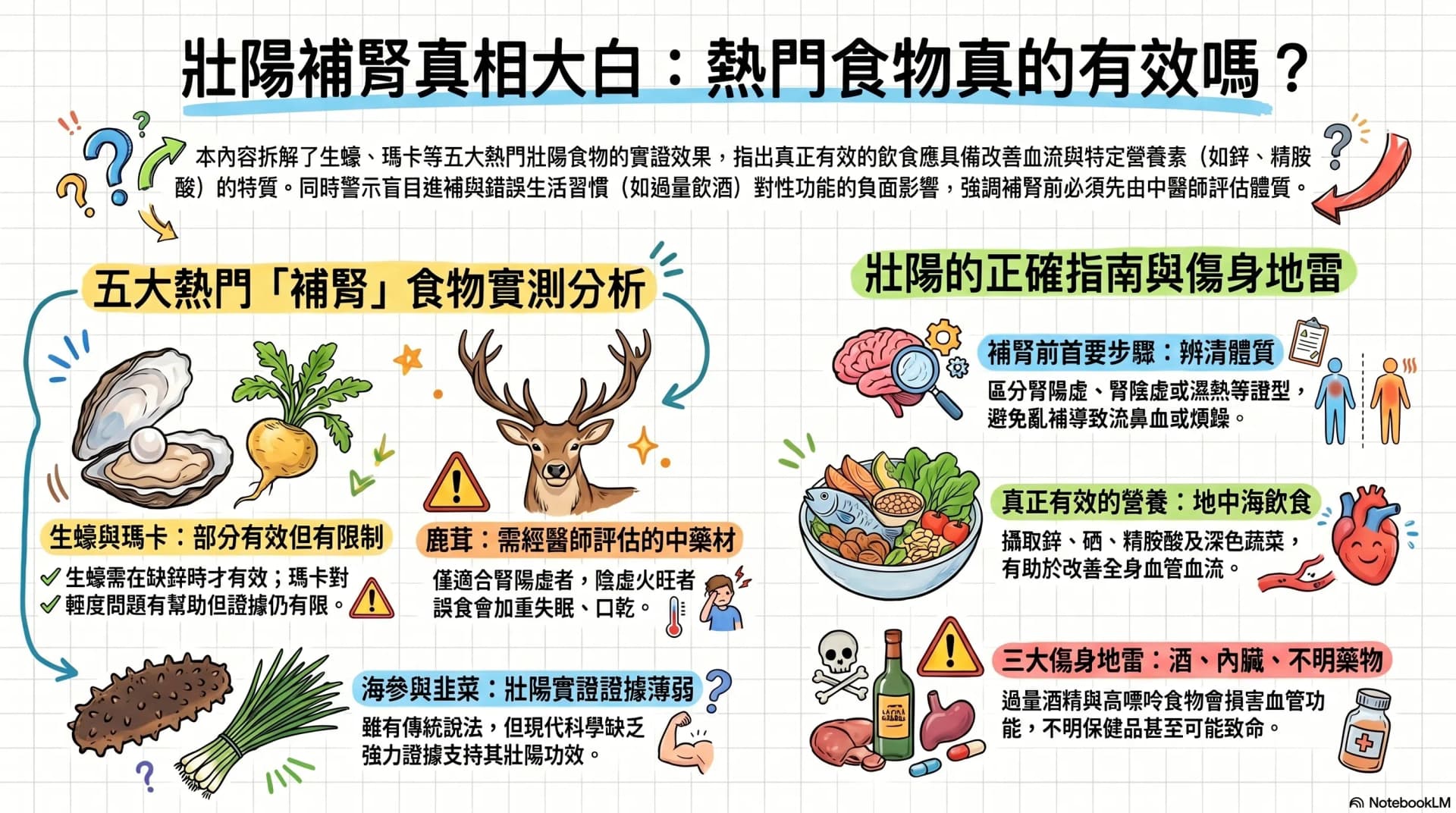
Do Oysters, Maca and Deer Antler Boost Male Vitality? 5 Myths
Do aphrodisiac foods actually work? This article opens with a rating table (effective / partly effective / effective within a TCM framework / weak evidence / no strong evidence), reviews the Chinese and Western medical evidence behind oysters, maca, deer antler, sea cucumber and Chinese chives, distils the 3 shared traits of foods that genuinely support male sexual function, and flags 3 commonly eaten items that can actually harm performance.
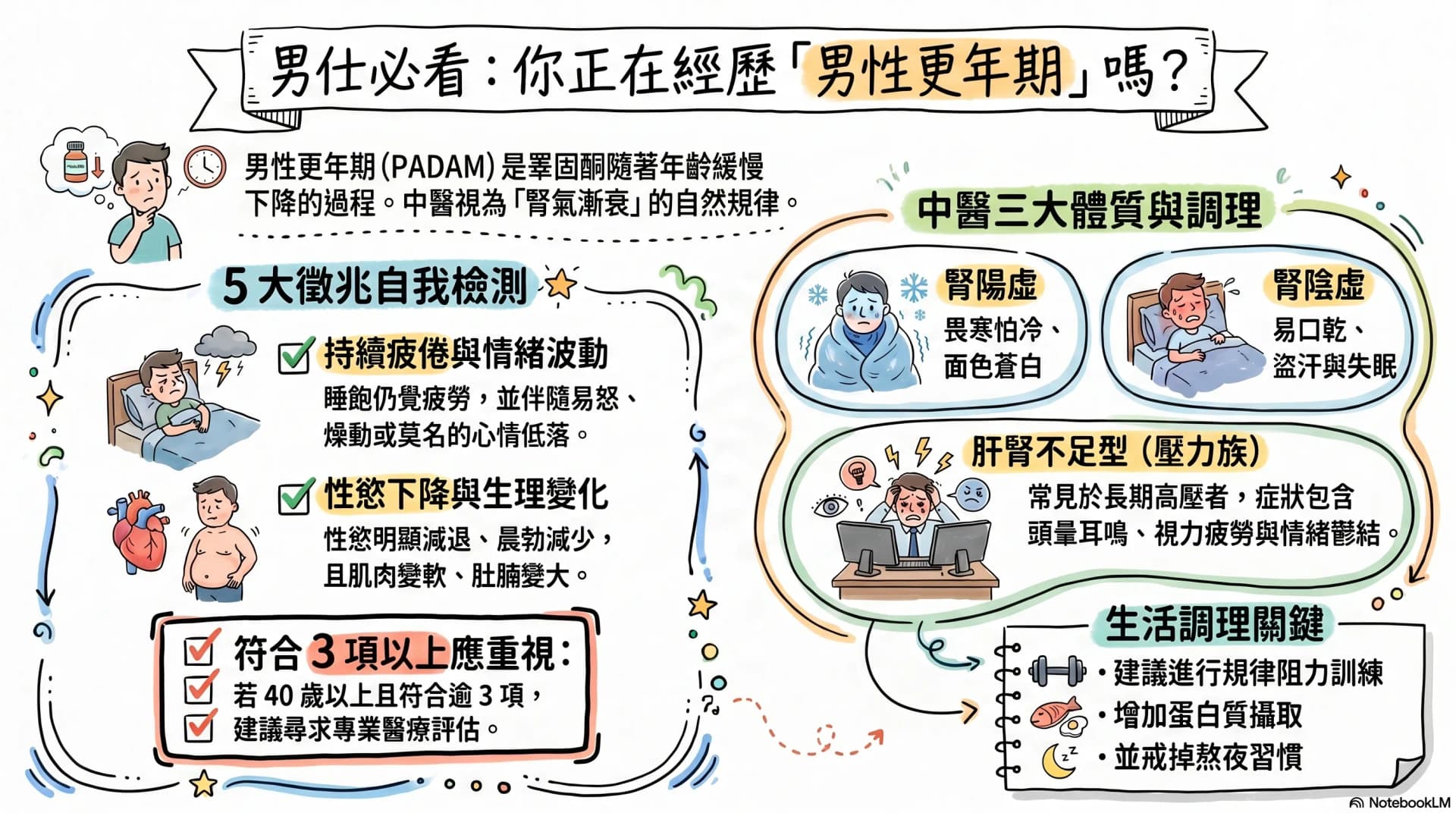
Male Menopause Through the TCM Lens: 5 Signs in Men Over 40
Unexplained fatigue, irritability, lower libido, poorer sleep and a growing belly after 40 are not just ageing or work stress — they may be male menopause. This article begins with a five-sign self-check, sets out three TCM patterns (kidney-yang deficiency, kidney-yin deficiency, liver-and-kidney insufficiency) with matching improvements, and compares the two treatment routes — testosterone replacement therapy versus TCM constitutional care.
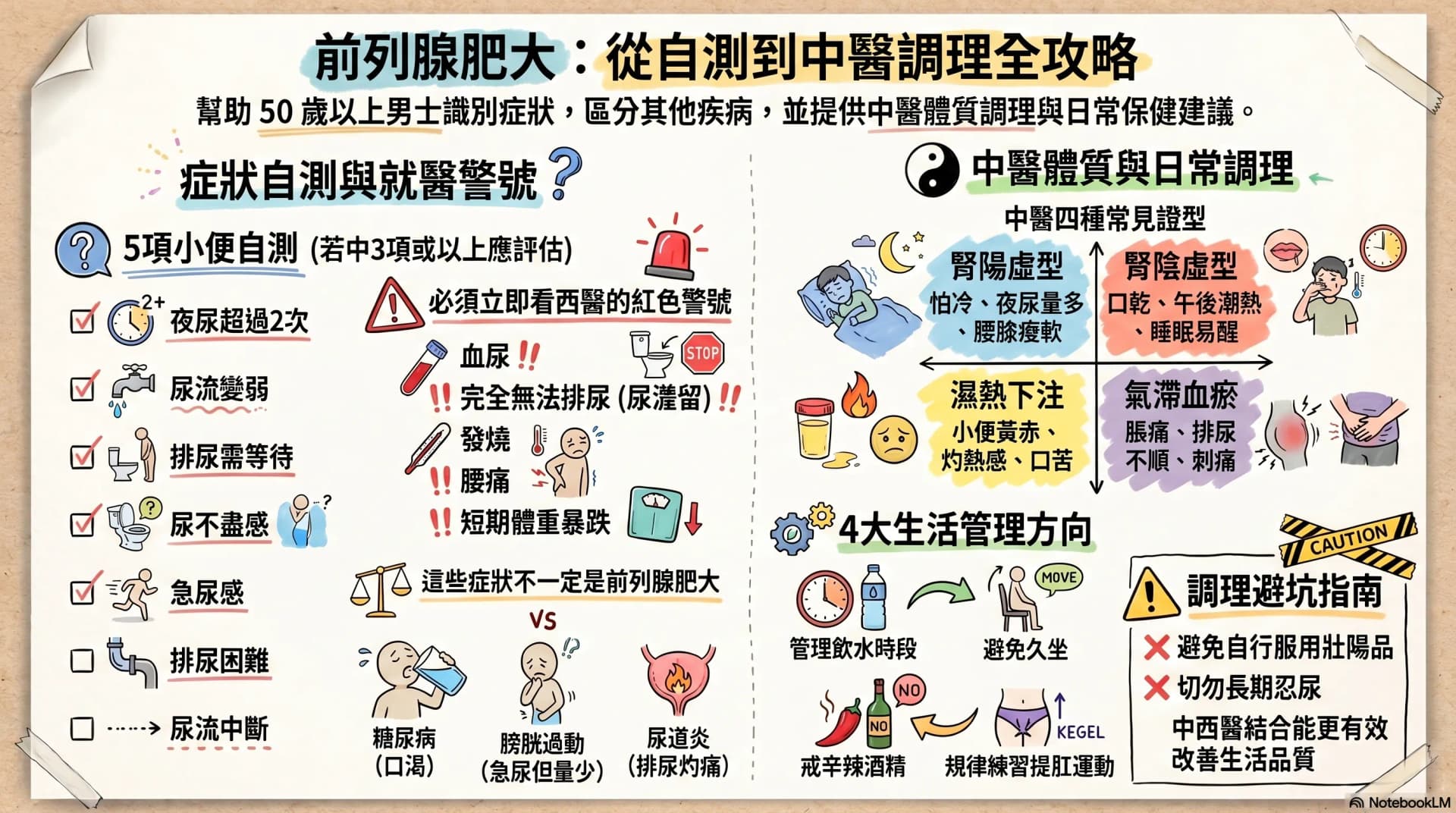
Enlarged Prostate: Are Nocturia and a Weak Stream Warning Signs?
After age 50, urinary frequency, nocturia, a weaker stream and having to urinate in stages may not simply be ageing. This article opens with a 7-symptom self-check, then sets out warning signs that warrant seeing a Western doctor immediately, four TCM constitution patterns, and four daily care directions any man can start with — helping you or your father decide the next step.