Hairy Crab Food Taboos: Is Crab With Persimmon Poisonous?
Hairy crab food taboos: what can't you eat with crab? This article checks the popular "incompatible foods" claims — persimmon, tomato, orange juice, alcohol, tea — explains the real food-safety risks and how to tell male from female crabs, and shows from a TCM perspective why crab is cooling and how to warm up afterwards.
Medical review: Dr. Chan Wing Kiu, Joanne,Registered Chinese Medicine Practitioner #009463
1-Minute Quick Answer
Hairy crab must be cooked thoroughly and dead crab never eaten. Most claims that crab "poisons" when eaten with persimmon, tomato or orange juice are folklore; the real risks are undercooked or dead crab, overeating and piling cold on cold. Crab is cooling in TCM, so people with cold digestion can pair it with ginger vinegar or ginger tea (reviewed by Dr Chan Wing Kiu, CMCHK 009463).
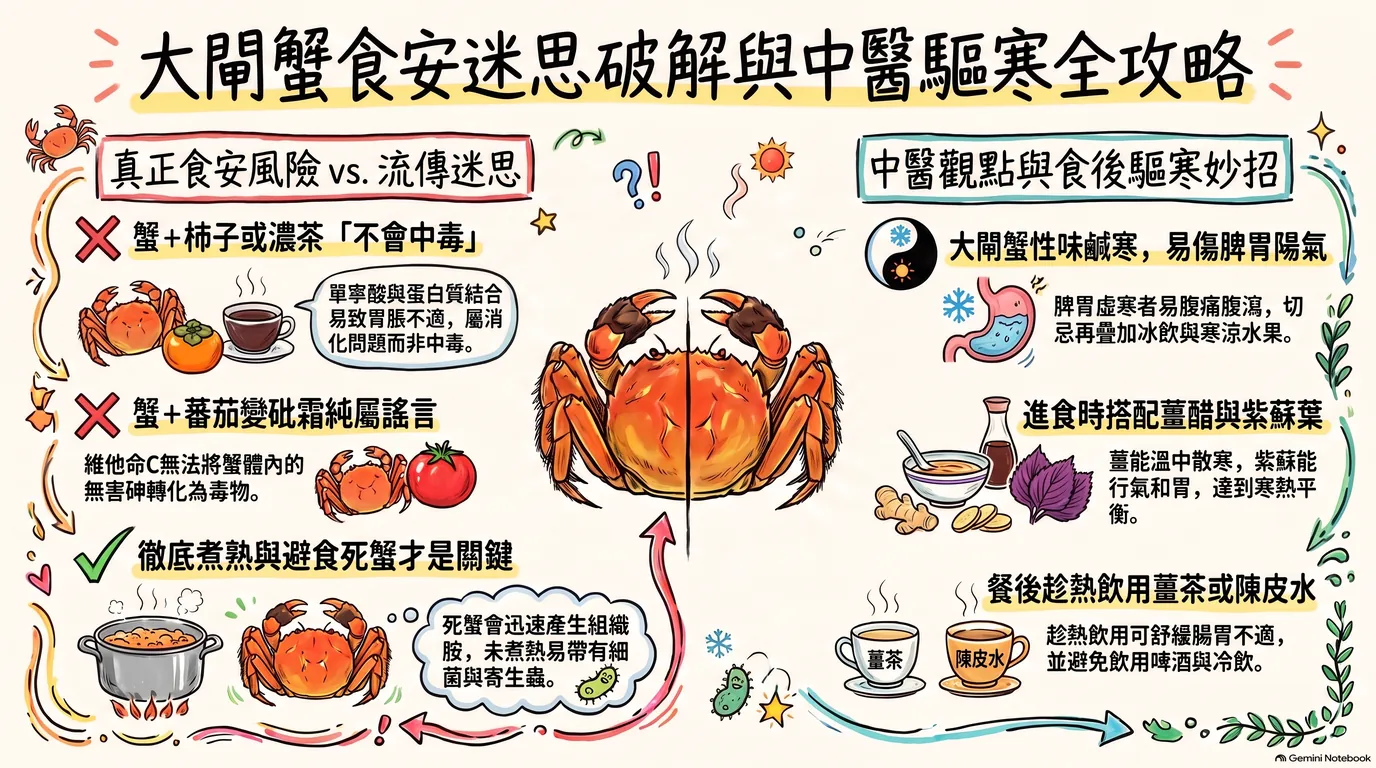 To help readers quickly grasp the content, this image was generated by NotebookLM. Some Chinese characters may not render correctly.
Important
Hairy crab must be cooked thoroughly, and dead crab must never be eaten. Crab roe and tomalley are high in cholesterol. People with gout or high uric acid, high cholesterol or shellfish allergy, and pregnant women and young children, should speak to a doctor first. If you develop persistent severe abdominal pain, vomiting, diarrhoea, fever, a rash or difficulty breathing after eating, seek medical care promptly.
When autumn arrives, it is hairy crab season, and hairy crab food taboos become one of the most searched topics. Every year, two questions come up online: what can't be eaten with crab, or you'll be poisoned? And crab is so cooling — how do you warm up again afterwards?
This article first covers the real food-safety risks of hairy crab, then checks the popular "incompatible foods" claims one by one, explains from a TCM perspective why crab is cooling and how to warm up afterwards, and finishes with portions, how to tell male from female crabs, and who should take extra care.
Hairy Crab Food Taboos: What Are the Real Risks?
Rather than "incompatible foods", the following are what food-safety authorities such as Hong Kong's Centre for Food Safety repeatedly stress:
- Cook it thoroughly. Crab may carry bacteria or parasites, and salt, vinegar, wine or wasabi cannot kill them. Drunken crab and other wine-soaked raw preparations therefore carry a higher risk.
- Buy and store with care. Buy from licensed, reliable shops and choose live crabs with an intact, shiny shell and no foul smell. Keep raw crab in the fridge, separate from other foods, to avoid cross-contamination.
- Wash before cooking, remove the organs before eating. Scrub the shell and claws before steaming; once cooked, remove the internal organs completely before eating. Eat cooked crab promptly rather than leaving it out.
- Roe and tomalley are high in cholesterol. Don't overdo it, particularly if you have high cholesterol or cardiovascular disease.
What Shouldn't You Eat With Hairy Crab? The "Poisonous Combination" Claims, Checked
Many online posts claim that eating certain foods with crab will poison you — even that it can kill. Let's look at them one by one.
Is It Poisonous to Eat Hairy Crab With Persimmon?
A popular claim: "Eating crab with persimmon will poison you." So what are the facts?
Taiwan's Food and Drug Administration states clearly that eating the two together will "absolutely not cause poisoning". However, persimmon is rich in tannins and crab is rich in protein, and tannins readily clump with protein, which may hinder digestion and cause bloating or stomach pain. So this is "possible discomfort", not "poisoning".
Does Hairy Crab With Tomato or Orange Juice (Vitamin C) Turn Into Arsenic?
A popular claim: "Crab contains arsenic and tomato / orange juice contains vitamin C, so eating them together makes arsenic poison." So what are the facts?
This is a long-circulating rumour. A research simulation found that vitamin C does not turn the harmless arsenic in crab into arsenic trioxide, and even at the legal limit, you would have to eat over 100 kg of crab at once to be poisoned. Normal portions carry no such risk. The same logic applies to orange juice, lemon, kiwi and other vitamin C-rich foods, so there is no need to worry about a glass of orange juice at a crab feast.
Is Hairy Crab With Alcohol or Beer Poisonous?
A popular claim: "Crab with alcohol is poisonous and makes you vomit white foam." So what are the facts?
Crab and alcohol do not produce a toxin together. The real signs of food poisoning are vomiting, diarrhoea and abdominal pain, usually caused by bacteria. Two points deserve attention. First, drunken crab and wine-soaked crab are raw, and alcohol cannot kill bacteria or parasites. Second, beer is high in purines and affects uric acid excretion, and crab itself contains purines, so people with gout or high uric acid face a higher risk of a flare-up if they combine them.
Can You Drink Strong Tea After Hairy Crab?
A popular claim: "Drinking strong tea after crab will poison you." So what are the facts?
The mechanism is similar to persimmon: tea contains tannins, which may interfere with protein digestion and leave some people bloated or uncomfortable. It is a digestive problem, not poisoning. If you are concerned, wait an hour or two after eating crab before drinking strong tea, or have ginger tea instead.
Can You Eat Dead Hairy Crab?
A popular claim: "Eating dead crab can kill you." So what are the facts?
"Can kill" is an exaggeration, but dead crab genuinely should not be eaten. After a crab dies, bacteria multiply quickly and break down histidine into histamine and other substances, which may not be destroyed by cooking. Eating it may cause vomiting, diarrhoea, headache and rash. It is usually managed with fluids and medication and is mostly not fatal, but it can be very unpleasant, and severe cases need medical care. One dietitian advises that once a live crab has died, it is best cooked and eaten within a day; a crab that has been dead for a long time or whose condition is unclear should be thrown away.
What About Hairy Crab With Honey, Cold Drinks or Other Combinations?
Online posts also claim that crab can't be eaten with honey, cold drinks or other seafood. From the sources we reviewed, we found no reliable evidence that these combinations poison people. That said, cold drinks may well worsen abdominal pain and diarrhoea in people whose digestion runs cold, which we explain from a TCM perspective below.
In short, most "incompatible food" claims are folklore. What genuinely needs guarding against is undercooked or dead crab, overeating, and piling cold on cold.
Why Is Hairy Crab "Cooling"? The TCM View
In TCM, crab is salty and cold in nature, with a heat-clearing effect. For people with normal digestion, a moderate amount makes little difference. But in those whose spleen and stomach already run cold and weak, cold food injures the yang qi of the digestive system, which then cannot transform food properly, leading to abdominal pain, diarrhoea and bloating. Adding cold drinks, watermelon or pear — also cooling — makes it worse.
This is also why crab is traditionally eaten with ginger-vinegar dip, perilla and yellow rice wine. Ginger is warming and disperses cold in the middle burner; perilla is held in traditional materia medica to neutralise "fish and crab toxin" and also moves qi and harmonises the stomach. These are traditional dietary wisdom aimed at balancing the crab's cooling nature, not substitutes for thorough cooking and hygienic handling.
If your digestion runs on the weak side, everyday staple choices matter too; see our article on cutting out rice and your digestion.
How Do You Warm Up After Eating Hairy Crab?
- Ginger-vinegar dip. Mix grated ginger with vinegar as a dip, warming the digestion as you eat and whetting the appetite.
- Ginger tea. Simmer a few slices of fresh ginger in water and drink it hot. A little brown sugar may be added, but not for people with diabetes.
- Perilla leaves. Boil them with ginger, or lay them under the crab when steaming, for their qi-moving, stomach-harmonising effect.
- Dried tangerine peel. Boil it or add it to ginger tea to help move qi and reduce bloating.
- Stick to warm drinks. During and after the meal, avoid cold drinks, beer and cooling fruits in favour of hot tea or warm water.
- Yellow rice wine in moderation. It is traditionally used to warm and disperse, but alcohol is unsuitable for people with liver disease or gout, pregnant women, and anyone driving.
How Much Hairy Crab Is Safe to Eat? Portions and Habits
- Moderate portions. For a healthy adult, one or two crabs per sitting is enough; avoid eating it daily in a row.
- Don't eat on an empty stomach. Cold food on an empty stomach irritates digestion more easily.
- Eat slowly. Crab meat is rich in protein, and chewing well helps digestion.
- Refrigerate leftovers. Cooked crab shouldn't sit at room temperature for long; refrigerate what you can't finish and eat it by the next meal.
What Is the Difference Between Male and Female Hairy Crabs?
In crab season you will often hear the saying "females in the ninth month, males in the tenth". Here is how to tell them apart, and what it means for your health.
How do you tell a male from a female? Turn the crab over and look at the flap on its belly:
- a female's flap is round or oval
- a male's flap is triangular or pointed
What are crab roe and crab paste? Female crabs have orange-yellow roe, which is firmer and also called "red paste". Male crabs have a creamy paste that turns milky white when cooked, softer in texture and also called "white paste".
What does "females in the ninth month, males in the tenth" mean? It is a saying from the crab-growing regions: eat female crabs in the ninth lunar month and male crabs in the tenth, roughly October and November. It is traditional trade experience for picking the best flavour, not a nutritional finding.
Does the sex of the crab matter for health? The roe and paste are the parts many people love most, and also the parts Hong Kong's Centre for Food Safety advises against eating in excess. A registered dietitian has pointed out that one crab of about 5 to 6 taels (roughly 190 to 225 g) contains about 267 mg of cholesterol.
So whether you eat a male or a female, the rules are the same: cook it thoroughly, remove the internal organs before eating, and keep roe and paste in moderation. For people with high cholesterol, gout and similar conditions, see the next section.
Who Should Be Careful With Hairy Crab?
- People whose digestion runs cold, or who often have diarrhoea or bloating
- People with gout or high uric acid
- People with high cholesterol or cardiovascular disease, especially regarding roe and tomalley
- People allergic to shellfish
- Pregnant women and young children, who should speak to a doctor first
- Older adults and people with weaker digestion
When Should You See a Doctor After Eating Hairy Crab?
Mild bloating after eating crab usually settles with warm drinks and rest. But please seek medical care promptly if you have any of the following:
- Persistent severe abdominal pain, repeated vomiting or diarrhoea
- Fever, or blood in the stool
- A rash, swelling of the face or throat, or difficulty breathing
- A sudden red, swollen, severely painful joint if you have gout
How Can Chinese Medicine Help?
Chinese medicine approaches digestive upset after eating crab through pattern differentiation — first identifying whether it stems from cold injuring the spleen, food stagnation with qi stagnation, or dampness obstructing the spleen, then providing care accordingly, such as warming the middle burner and dispersing cold, or regulating qi to relieve stagnation, alongside adjustments to eating habits.
It should be made clear that Chinese medicine here is supportive in nature and does not replace necessary medical examination. If your situation matches the warning signs above, please see a doctor first; if your digestion usually runs cold and cold foods upset it, it's worth having a registered Chinese medicine practitioner assess your constitution before deciding on a direction.
Upset Every Time You Eat Hairy Crab? Have Your Constitution Assessed
If your digestion runs cold and crab always upsets you, you are welcome to enquire with Aspira TCM via WhatsApp (WhatsApp: 9679 2293 / wa.me/85296792293); a practitioner can then assess and advise on a suitable direction. If you experience any of the warning signs above, please see a doctor first.
References
- Centre for Food Safety: Test results of seasonal food surveillance project on hairy crabs all satisfactory (2021, with consumer advice) — https://www.cfs.gov.hk/english/press/20211115_8981.html
- Centre for Food Safety: Hairy crabs (2007) — https://www.cfs.gov.hk/sc_chi/programme/programme_fs/files/Hairy_crabs.pdf
- EDH Health: "Does eating persimmon and crab together cause poisoning? Eating on an empty stomach or with these 2 foods is riskier" (Chinese; citing Taiwan FDA) — https://www.edh.tw/article/25412
- Central News Agency: Eight crab rumours not to fall for — https://www.cna.com.tw/news/acn/201709300078.aspx
- etnet Health: Notes on eating crab (dead crab, food pairings and high-risk groups) — https://www.etnet.com.hk/www/tc/health/378532
- Sing Tao Headline: "How to eat hairy crab: telling males from females, parts not to eat, steaming steps" (Chinese) — https://www.stheadline.com/food-safety/3624350/大閘蟹要點食一文了解點分公乸忌食部位蒸煮步驟-去腥蟹膏不流失
- Central News Agency: "In September, crabs' fates differ: females on the plate, males busy eating" (Chinese) — https://www.cna.com.tw/news/acn/201709270271.aspx
Disclaimer: This article is for health education and reference only and does not constitute personalised medical advice. Each person's constitution and condition differ, and treatment plans and outcomes vary. Chinese medicine can provide supportive care and ease symptoms but cannot replace necessary Western examination. If symptoms persist or worsen, or if the warning signs above occur, please seek prompt care from a qualified healthcare professional.
Disclaimer: This article is for health education and reference purposes only and does not constitute medical advice, diagnosis, or treatment. Each patient's condition is unique and treatment outcomes vary. Please consult a registered TCM practitioner or qualified healthcare professional for health concerns.
Further Reading
Hand-picked related articles and real cases to read next.
Skipping White Rice to Lose Weight: Can Your Digestion Cope?
Many people switch to sweet potato, taro, brown rice or oats to lose weight, only to find themselves bloated and burping within days. For the spleen and stomach, white rice is the gentlest staple, and the other common weight-loss staples fall short of it. This article explains why, and how people with weaker digestion can switch gradually and cook them properly.
Plenty of Protein but No Muscle Gain? Could It Be Your Digestion?
Many people who exercise load up on protein to build muscle, only to find themselves bloated with loose stools before any gains show. Weak digestion does not mean no absorption, but the more you eat, the heavier the load. This article explains how protein becomes muscle, how much is enough, and how people with weaker digestion can adjust.
Bigger Belly, Same Weight? TCM on Bloating, Constipation, and Fat
Stable weight but a more prominent belly does not always mean fat. Water retention, constipation, gastrointestinal bloating, posture, reduced muscle mass, and central obesity can all make the abdomen appear larger. This article uses TCM perspectives on digestion, phlegm-damp, qi stagnation, and constipation to help you distinguish situations and decide next steps.
Want to learn more? WhatsApp us for a free consultation
Book via WhatsAppExplore our full range of treatments: Traditional TCM Services
Related Articles

Uneven Face: Side Sleeping, Chewing and Facial Acupuncture
Is an uneven face caused by side sleeping and chewing on one side? This article explains the common causes, when to see a dentist or doctor first, what to adjust day to day, and how TCM facial massage and facial acupuncture can help with contour differences caused by muscle tension.

Poor Posture in Children: Scoliosis and Height Myths
Do crossed legs and homework on the stomach cause scoliosis, and does poor posture affect a child's height? This article clears up both worries using Scoliosis Research Society material, explains what long-term posture really affects, and covers good sitting, a 30-second wall check and a TCM posture assessment.
Scoliosis, Uneven Shoulders, Rounded Back in Children
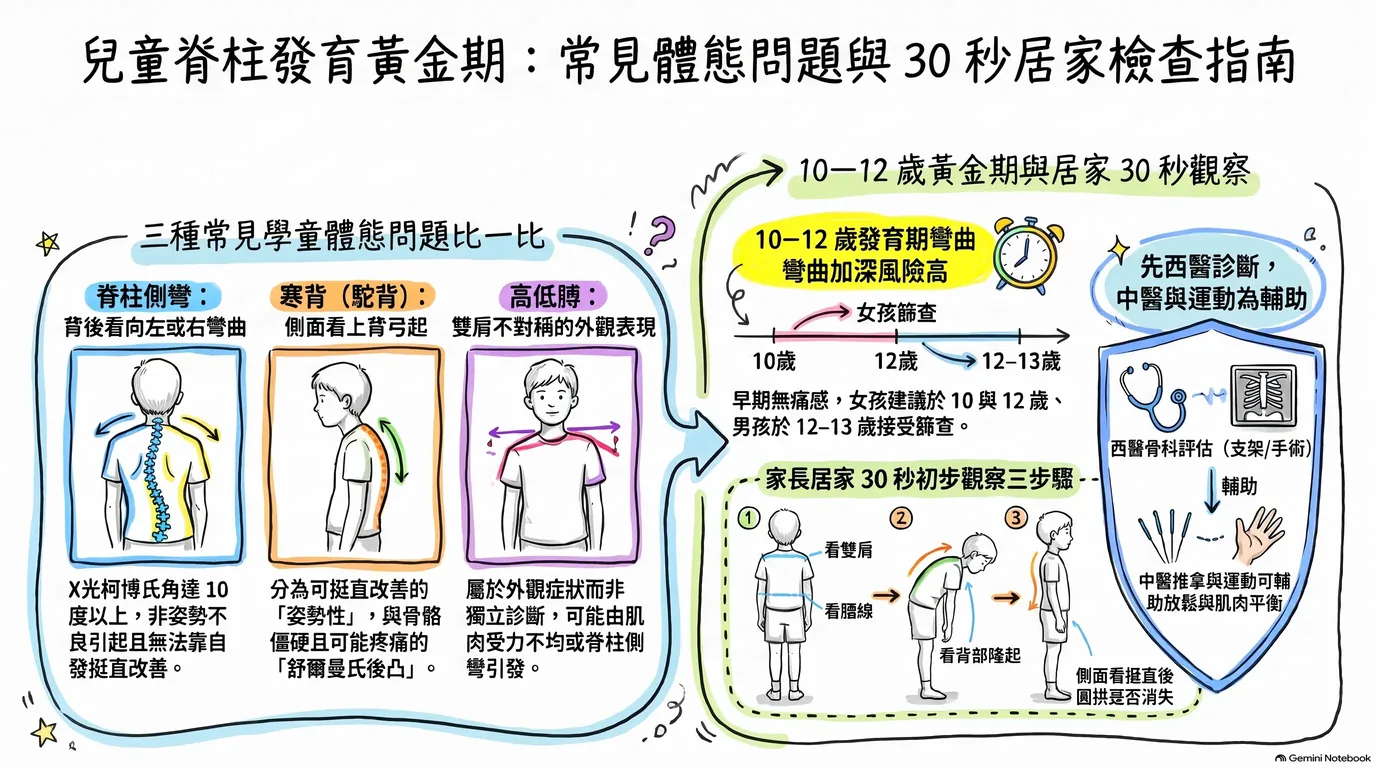
What is the difference between scoliosis, uneven shoulders and a rounded back, and can they be fixed? This article compares the three in a table, explains why ages 10 to 12 need attention, a 30-second home check, when a full-spine X-ray is needed, and how a TCM posture assessment fits in.