Uneven Face: Side Sleeping, Chewing and Facial Acupuncture
Is an uneven face caused by side sleeping and chewing on one side? This article explains the common causes, when to see a dentist or doctor first, what to adjust day to day, and how TCM facial massage and facial acupuncture can help with contour differences caused by muscle tension.
Medical review: Dr. Tu Hsiang Ying, Sandy,Registered Chinese Medicine Practitioner #010445
1-Minute Quick Answer
An uneven face is usually mild. Common causes include side sleeping, chewing on one side, bite and jaw-joint problems, and a tight masseter from grinding or clenching. Dental and joint problems need a dentist first. For contour differences from habit-related muscle tension, TCM facial massage and acupuncture can help, with results varying between people.
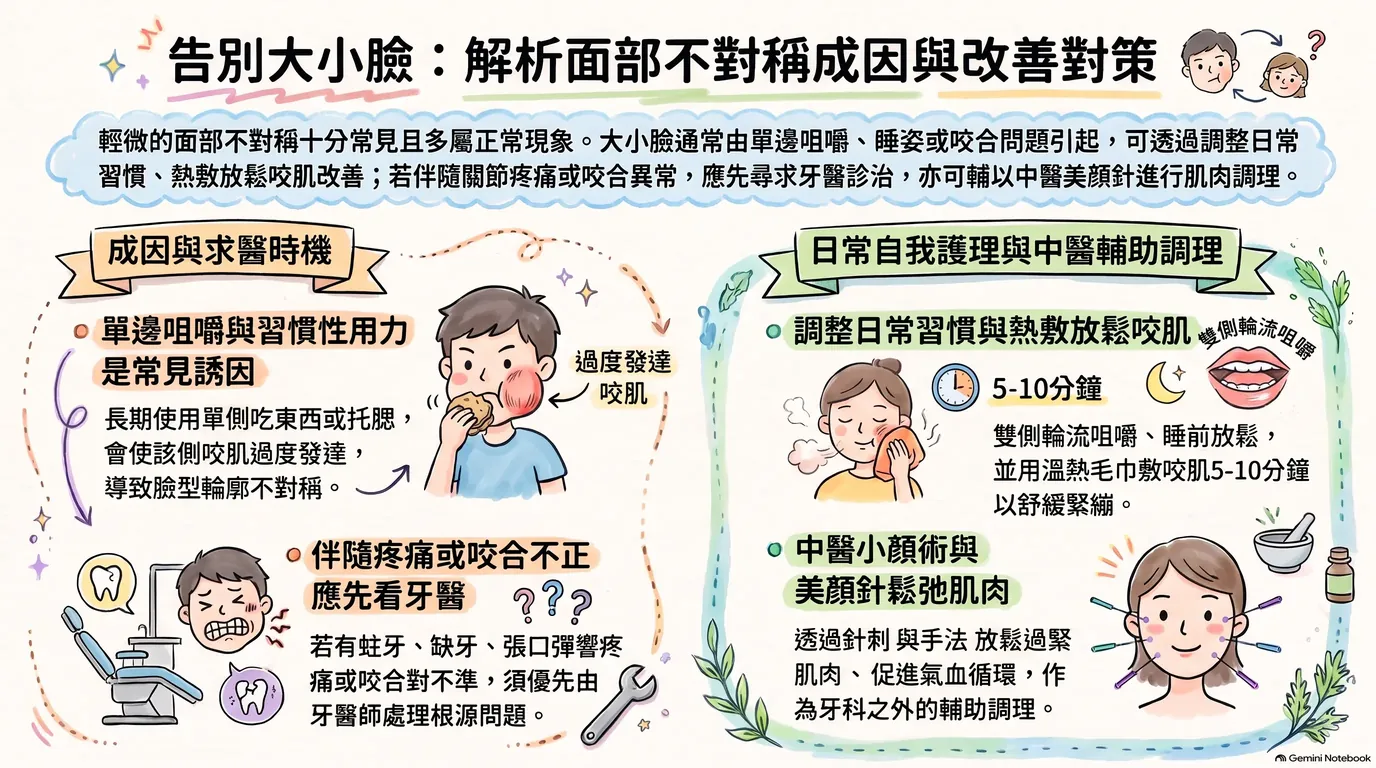 To help readers grasp the content quickly, the image was generated with NotebookLM. Some Chinese characters may not display correctly.
You look in the mirror and notice that one cheek seems fuller than the other, or that your smile sits higher on one side. Or your child always sleeps facing the same way and chews only on the left. Could these habits be the cause of an uneven face?
This article explains the common causes of an uneven face, which situations call for a dentist or doctor first, what you can adjust day to day, and how TCM facial massage (小顏術) and facial acupuncture (美顏針灸) can support the process.
The short answer: a mildly uneven face (also called facial asymmetry) is very common and usually nothing to worry about. What needs attention is a difference that is obvious, keeps growing, or comes with bite or jaw-joint problems.
Is an Uneven Face Normal? Mild Asymmetry Is Common
No face is perfectly symmetrical. A study that followed children's facial development from the age of one to six found that facial asymmetry is common in early childhood, and that most of it lessens as children grow.
So a slight difference between the two sides is no cause for alarm. What deserves attention is a difference that keeps deepening.
What Causes an Uneven Face?
There is often more than one cause. These are the common ones.
Can Sleeping on One Side Cause an Uneven Face?
Spend seven or eight hours a night with the pillow pressing on the same cheek and jaw, and that side is under constant pressure. A child's facial bones are still growing, and bone and soft tissue can be shaped to some extent, so the two sides may grow in different directions or at different speeds. The same study listed sleeping position among the possible factors linked to facial asymmetry at the age of six, although the sample was small and the conclusions are limited.
An adult's bones are largely set, so sleeping position mainly affects the tension of facial muscles and soft tissue.
Babies should sleep on their backs for safety. Never switch a baby to side sleeping for the sake of face shape.
Can Chewing on One Side Cause an Uneven Face?
If you habitually chew on the same side, the chewing muscles on that side, the masseter in particular, grow stronger, and the jawbone takes more load. The angle of the jaw then looks wider and more prominent. The less-used side stays relatively weaker, and over time the size and outline of the two sides drift apart.
That said, chewing on one side is often a result rather than a cause. Common reasons behind it include:
- a cavity or toothache on one side, so you avoid biting hard
- the milk-teeth stage, or a missing tooth on one side
- a bite problem, such as a one-sided crossbite where the upper and lower teeth do not meet properly on one side
- discomfort in the jaw joint (the temporomandibular joint, just in front of the ear), with pain or clicking when opening the mouth or chewing
- simply a long-standing habit
If the cause is dental or a matter of bite, reminding yourself to alternate sides is not enough. The root cause has to be dealt with first.
What Other Causes Are There?
- Bite and jaw joint. When the upper and lower teeth do not meet properly, the chin tends to shift and push to one side. Discomfort in the jaw joint also makes people avoid the painful side without noticing. Over time the muscles and contour on the two sides diverge.
- One-sided expressions and small habits. Smiling, raising an eyebrow, resting the chin on a hand or biting a pen mostly on one side makes the same group of muscles work repeatedly, until it becomes stronger or tighter than the other side.
- Bone structure from birth. The facial bones on the two sides are never exactly alike. This is not caused by habit and cannot be changed by adjusting habits.
- Mirror and camera angles. In a mirror or a selfie, light coming from only one side makes shadows exaggerate the difference. It may be less obvious in real life than it looks.
Why Does the Chewing Muscle Keep Growing?
The masseter is the muscle that does the work in chewing, and like any muscle it grows stronger with use. Chewing on one side makes that side larger, while grinding and clenching keep the masseter tight for long stretches, and both sides may become bigger and harder.
Mayo Clinic says grinding and clenching are linked to stress, anxiety and tension, and can also happen unconsciously while concentrating. Common signs include:
- tired or tight jaw muscles, with the chewing muscle looking larger than normal
- clicking in the jaw, or the jaw catching
- a dull headache around the temples
- worn or flattened teeth, or sensitive teeth
Long periods of gum chewing are also listed as a risk habit for clenching while awake. Grinding is common in young children and mostly fades before adulthood.
If you often wake up with a sore jaw, or your teeth are clearly worn, see a dentist to check whether you grind at night and whether a mouth guard is needed.
Should You See a Dentist or a TCM Practitioner First?
In these situations, see a dentist or doctor first:
- toothache on one side when chewing, or obvious cavities or missing teeth
- the upper and lower teeth do not meet properly, and the chin shifts clearly to one side
- the chin deviates to one side when opening the mouth, with clicking, pain or catching
- waking up with a sore jaw most mornings, or clearly worn teeth
- facial asymmetry that deepens quickly, or a lump in one cheek or jaw
Important If the face suddenly droops, for example a sagging corner of the mouth, being unable to close one eye fully, slurred speech, or weakness in an arm or leg on one side, it may be a stroke or a facial nerve problem. Go to the emergency department immediately. Do not wait for treatment to take effect.
How to Adjust Habits and Relax the Chewing Muscle at Home
Habit changes
- Alternate sides when chewing. Switch sides on purpose during meals. It feels odd at first, but a few weeks of reminders is enough for a new habit to form.
- Deal with dental problems. Fill cavities, replace missing teeth, and leave bite problems to a dentist. This is the most basic fix for one-sided chewing.
- Choose a pillow of the right height. Too high and the neck tilts to one side; too low and the face is pressed down harder.
- Do not force a sleeping position. Turning naturally during sleep is normal, and forcing yourself into one position can spoil your sleep. Adults can try starting the night on their back. For children, gentle reminders are enough.
- Avoid resting your chin on your hand or biting pens. Small habits that load one side for long periods also unbalance the facial muscles.
Simple ways to relax the chewing muscle
- Warm compress: hold a warm (not hot) towel against the chewing muscle just below and in front of the ear for five to ten minutes. Warmth helps a tight muscle relax.
- Gentle massage: make small circles on the muscle with your fingertips, with a pressure that feels comfortable. Do not rub hard or pull at the skin.
- Keep the teeth apart: when relaxed, keep the lips lightly closed and the upper and lower teeth not touching, so the muscle can rest.
- Chew less gum and hard food: this reduces the extra load on the muscle.
- Wind down before bed: people under stress clench more easily. A warm bath and a few deep breaths before bed help.
If pressing the chewing muscle is clearly painful, or the facial skin has a wound or inflammation, do not massage it yourself. Have a practitioner assess it first.
Three Common Myths About an Uneven Face
- Is an uneven face always caused by sleeping position? No. Sleeping position is only one possible factor. Bite, jaw joint, chewing habits and bone structure matter just as much.
- Does chewing gum slim the face? It does the opposite. The masseter grows stronger with use, and long periods of gum chewing are linked to clenching and jaw discomfort.
- Must you force yourself to stop chewing on one side? Find the cause first. If a cavity, a missing tooth or a bite problem is why you avoid the other side, forcing a change only hurts. Deal with the teeth first.
How Does TCM Treat an Uneven Face? Can Facial Massage and Acupuncture Correct It?
In TCM, when the chewing and facial muscles stay tight for a long time, the flow of qi and blood in that area becomes sluggish, and the contour looks stiff. People under heavy stress tend to clench without noticing, which TCM calls liver qi stagnation, and this is taken into account in treatment.
After an assessment, Dr Tu Hsiang Ying can use facial massage (小顏術) to loosen over-tight facial muscles, and facial acupuncture (美顏針灸) at the face and related acupoints, alongside overall regulation.
What does "correct" mean here? It means relaxing tight muscles and improving contour differences caused by habit and muscle tension. Acupuncture cannot correct bone structure or a bite problem. Those belong with a dentist or a maxillofacial specialist.
How much evidence is there? Research on cosmetic acupuncture is limited so far. A 2018 systematic review found only 7 studies with 216 participants in total. Most reported positive results, but the quality of the studies was low, and the author concluded that the evidence is not yet enough to establish effectiveness. So results vary between people and are not guaranteed.
What reactions can follow? The review mentions itching, mild bruising, bleeding, pain and swelling. Needles must be sterile and single-use, and the treatment should be given by a registered practitioner. The US National Center for Complementary and Integrative Health notes that complications of acupuncture are relatively few, and those that occur are linked to non-sterile needles or improper delivery.
Who must tell the practitioner first? People who are pregnant, who have a skin infection or wound on the face, who have a clotting disorder, or who take blood-thinning medication must tell the practitioner first, who will decide whether it is suitable. For children and teenagers, face shape concerns are managed mainly through everyday habits and a dental assessment, and whether a cosmetic treatment is appropriate is for the practitioner to decide.
To learn more about choosing cosmetic acupuncture and what it costs, see our guide to choosing cosmetic acupuncture.
Want to Know What Kind of Uneven Face You Have? Book an Assessment
If you would like to know whether your uneven face comes from habit, muscle or the bite, which parts habit changes can help, and whether facial massage or facial acupuncture would be a suitable addition, you can book a consultation with Dr Tu Hsiang Ying (registered Chinese medicine practitioner in Hong Kong, registration number 010445). To book, contact us on WhatsApp.
TCM treatment is supportive. It does not guarantee results and cannot replace diagnosis and treatment by a dentist or doctor.
References
- University of Oulu research repository: A longitudinal study of facial asymmetry in a normal birth cohort up to 6 years of age and the predisposing factors — https://oulurepo.oulu.fi/handle/10024/45817
- Mayo Clinic: Teeth grinding (bruxism) — https://www.mayoclinic.org/diseases-conditions/bruxism/symptoms-causes/syc-20356095
- Mayo Clinic: TMJ disorders — https://www.mayoclinic.org/diseases-conditions/tmj/symptoms-causes/syc-20350941
- Lim KT: Acupuncture for cosmetic use: a systematic review of prospective studies (Journal of Cosmetic Medicine, 2018) — https://scholar.kyobobook.co.kr/article/detail/4010027376967
- National Center for Complementary and Integrative Health (NCCIH): Acupuncture: What You Need To Know — https://www.nccih.nih.gov/health/acupuncture-what-you-need-to-know
Disclaimer: This article is for general health information only. It is not a diagnosis or medical advice and cannot replace a consultation with a registered practitioner. Every person's constitution and circumstances are different, and results vary. If you feel unwell, please consult a practitioner promptly.
Disclaimer: This article is for health education and reference purposes only and does not constitute medical advice, diagnosis, or treatment. Each patient's condition is unique and treatment outcomes vary. Please consult a registered TCM practitioner or qualified healthcare professional for health concerns.
Further Reading
Hand-picked related articles and real cases to read next.
Poor Posture in Children: Scoliosis and Height Myths
Do crossed legs and homework on the stomach cause scoliosis, and does poor posture affect a child's height? This article clears up both worries using Scoliosis Research Society material, explains what long-term posture really affects, and covers good sitting, a 30-second wall check and a TCM posture assessment.
How to Choose Cosmetic Acupuncture That Is Effective and Safe: A 2026 Hong Kong Guide to Pricing, Needles and Clinic Choice
Hong Kong cosmetic acupuncture fees range from a few hundred to over three thousand dollars per session — but why? This guide breaks down 2026 market price ranges, six factors driving the fee differences, seven questions to ask before booking, four warning signs, and a transparent line-by-line look at Aspira TCM's packages — to help you choose what genuinely suits you.
“Pillow Face” After Injectables? 4 Common Causes and How TCM Cosmetic Acupuncture May Help
If the face looks increasingly puffy, heavy or unnatural after injectables, it may not be simple swelling. It may be the “pillow face” look that follows repeated aesthetic injections. This article explains four common causes, when to return to your injector first, and where TCM cosmetic acupuncture may help.
Eye Bags and Dark Circles That Eye Cream Cannot Fix: 4 TCM Patterns and How Cosmetic Acupuncture Can Help
Daily eye cream and eye masks, but the dark circles and eye bags only deepen — is it 'just age', or is the body sending a signal? Dark circles and eye bags can stem from qi-blood deficiency, liver-qi stagnation with insomnia, spleen deficiency with water retention, or kidney deficiency with blood stasis — and they may also reflect structural fat, chronic disease, or allergy. Dr To breaks down four TCM patterns, a self-check guide, five red-flag signals warranting medical investigation, and the cosmetic acupuncture directions that correspond to each pattern.
Want to learn more? WhatsApp us for a free consultation
Book via WhatsAppExplore our full range of treatments: cosmetic acupuncture
Related Articles
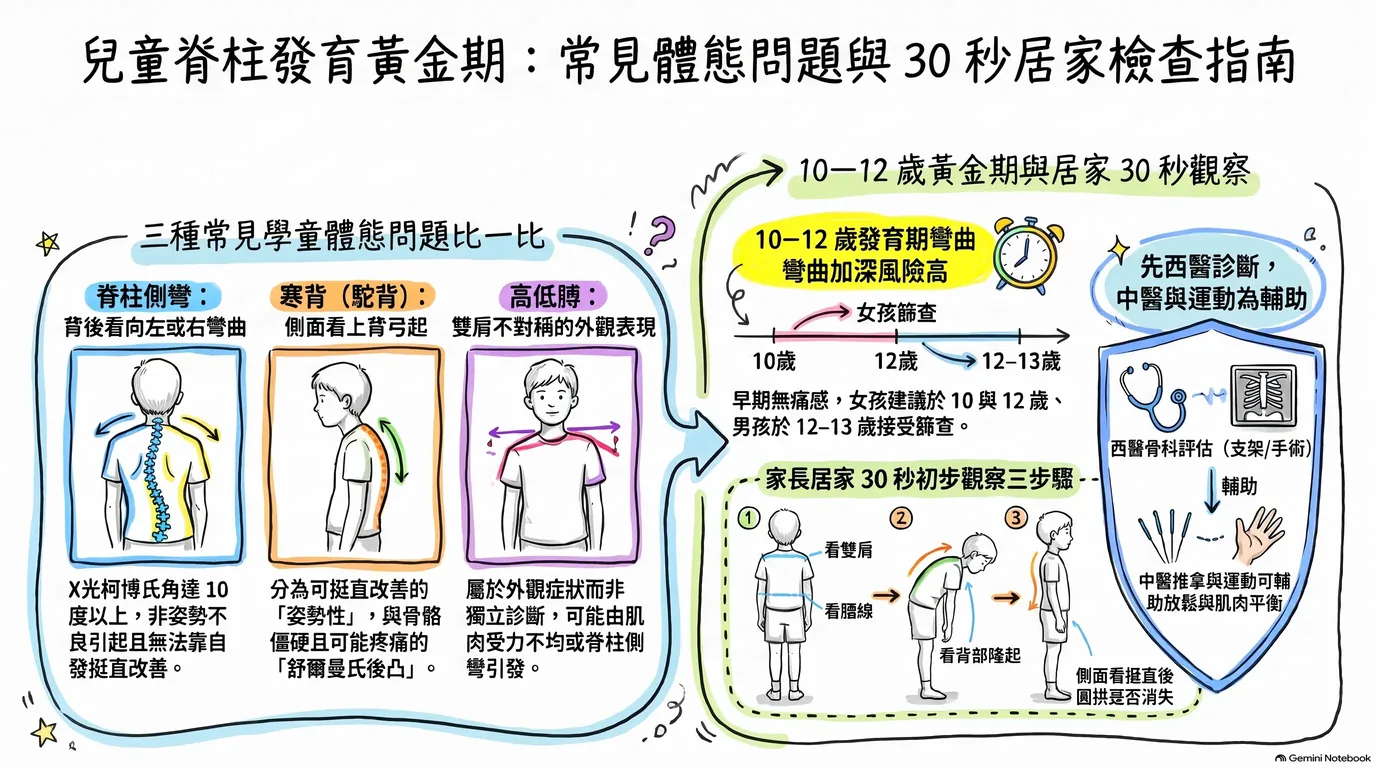
Scoliosis, Uneven Shoulders, Rounded Back in Children
What is the difference between scoliosis, uneven shoulders and a rounded back, and can they be fixed? This article compares the three in a table, explains why ages 10 to 12 need attention, a 30-second home check, when a full-spine X-ray is needed, and how a TCM posture assessment fits in.

Hairy Crab Food Taboos: Is Crab With Persimmon Poisonous?
Hairy crab food taboos: what can't you eat with crab? This article checks the popular "incompatible foods" claims — persimmon, tomato, orange juice, alcohol, tea — explains the real food-safety risks and how to tell male from female crabs, and shows from a TCM perspective why crab is cooling and how to warm up afterwards.

Plenty of Protein but No Muscle Gain? Could It Be Your Digestion?
Many people who exercise load up on protein to build muscle, only to find themselves bloated with loose stools before any gains show. Weak digestion does not mean no absorption, but the more you eat, the heavier the load. This article explains how protein becomes muscle, how much is enough, and how people with weaker digestion can adjust.