Poor Posture in Children: Scoliosis and Height Myths
Do crossed legs and homework on the stomach cause scoliosis, and does poor posture affect a child's height? This article clears up both worries using Scoliosis Research Society material, explains what long-term posture really affects, and covers good sitting, a 30-second wall check and a TCM posture assessment.
Medical review: Dr. Tu Hsiang Ying, Sandy,Registered Chinese Medicine Practitioner #010445
1-Minute Quick Answer
Crossed legs and doing homework on the stomach do not cause scoliosis, and there is no reliable evidence that posture stunts a child's growth. Height depends mainly on genes, nutrition, sleep and puberty. Long-term poor posture affects muscle balance and causes neck, shoulder and back aches.
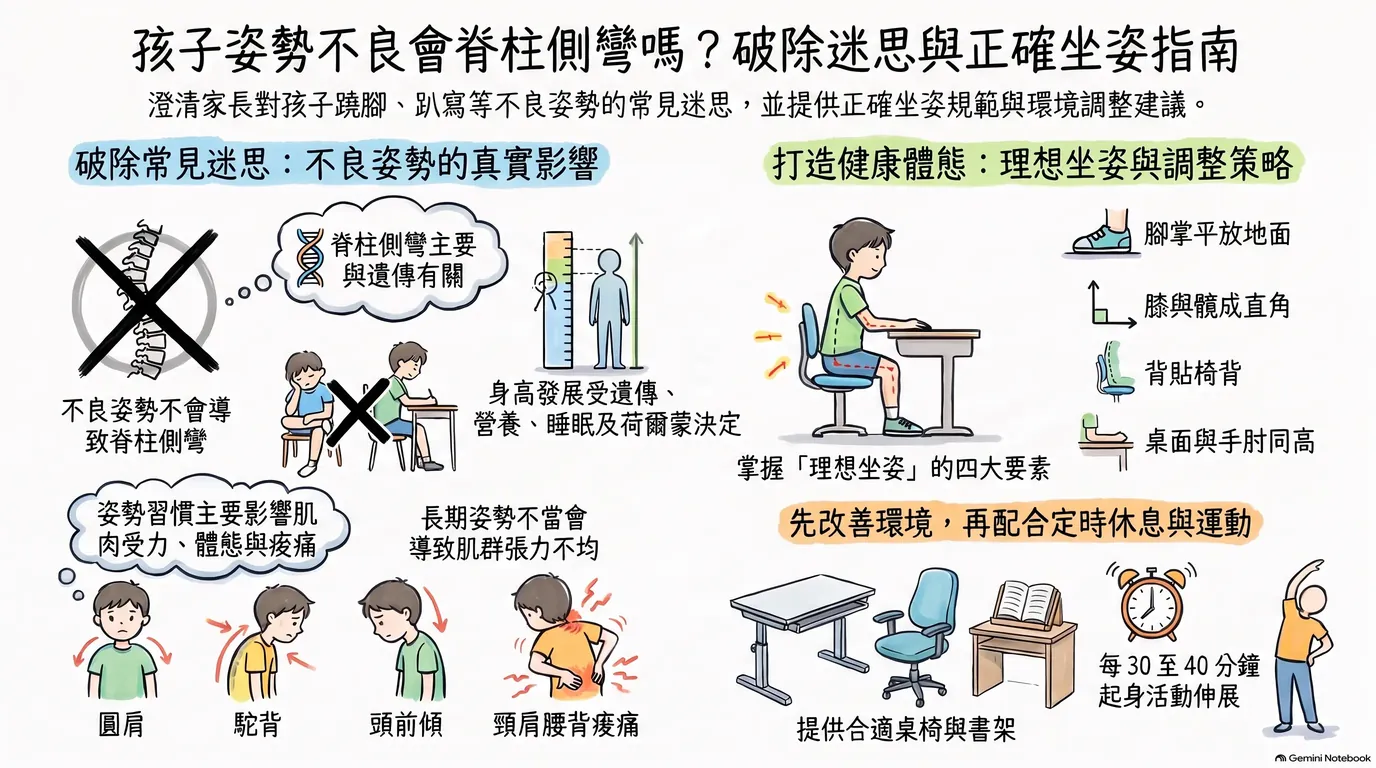 To help readers grasp the content quickly, the image was generated with NotebookLM. Some Chinese characters may not display correctly.
Your child sits with crossed legs, or does homework lying on the bed, and you cannot help saying, "Keep that up and your spine will bend, and you'll stop growing." The answer to both worries is no: poor posture does not cause scoliosis, and there is no reliable evidence that posture stunts a child's growth.
What poor posture really affects is how the muscles are used, how the body looks, and neck, shoulder and back aches. This article first clears up the two common beliefs, then explains the actual effects of crossed legs and homework on the stomach, with good sitting habits, a posture check and how a TCM posture assessment can support you.
Do Crossed Legs and Homework on the Stomach Cause Scoliosis?
No. Material from the Scoliosis Research Society states clearly that bad posture does not cause scoliosis, and that heavy school bags do not cause scoliosis or make a curve worse. The exact cause of the common adolescent idiopathic scoliosis is still unknown, and it is linked to heredity. If anything, it is children who already have a curve whose standing and sitting posture may look crooked.
So when a child is found to have scoliosis, parents need not blame themselves for not policing posture. Equally, good posture does not mean a child will never develop it, so ages 10 to 12 still call for attention. See our article on scoliosis, uneven shoulders and a rounded back.
What Does Poor Posture Really Affect?
Posture habits held over a long time mainly affect three things:
- Muscles: some muscle groups stay tight and others stay slack, so the two sides take uneven load.
- Appearance: over time a child may develop rounded shoulders, a stooped back and a forward head.
- Aches: your child often complains of neck, shoulder, back or lower back aches.
Children are still growing, so the earlier habits are adjusted, the easier it is.
What Happens When a Child Sits With Crossed Legs?
With crossed legs the two sides of the pelvis sit at different heights, so the muscles on either side of the back take uneven load, tight on one side and slack on the other.
An occasional cross does no harm. The problem is crossing the same way for years. You can ask your child to alternate sides, but it matters more to make sitting comfortable: feet flat on the floor and a chair at the right height leave little need to cross the legs.
What Happens When a Child Does Homework on the Stomach?
Lying on the stomach or back to write:
- the head pokes forward, the neck and upper back take extra strain, and the back rounds
- body weight rests on one elbow, so the shoulders easily end up uneven
- eyes that are too close to the page are also bad for eyesight
Looking down at phones and tablets for long periods is similar: the head and neck stay tilted forward and the neck and shoulder muscles stay tense.
Does Poor Posture Affect a Child's Height and Growth?
There is no reliable evidence that posture stunts growth. The main factors affecting height include:
- Genetics: Medical News Today quotes health experts as saying that about 80% of a person's height is genetic. Parents' heights are only a rough predictor, and siblings can differ.
- Nutrition: nutrition and general health in childhood and adolescence affect growth and height.
- Sleep and exercise: the article cites a 2018 study saying exercise and good sleep help the release of growth hormone.
- Hormones: a shortage of thyroid hormone or growth hormone can affect growth.
- Timing of puberty: growth spurts come at different times for each child, and slower puberty can run in families.
- Health conditions: illness, premature birth, skeletal problems and long-term chest or gut conditions can all affect growth.
The article does not list posture among them.
Two situations can make a measured height look lower:
- Measured while slouching: height measured standing tall is slightly more than when slumped. This is a difference in posture, not less bone growth.
- A marked scoliosis curve: the curve itself shortens the body's vertical length, so measured height may be lower than it would be without the curve. Orthopaedic research has looked at how to estimate this loss. It is a result of the curve, not of posture.
If you are worried about your child's height, check whether growth is on track rather than correcting posture. If growth is clearly behind other children of the same age or suddenly slows, ask a paediatrician to assess it. For other factors in growth, see our article on children who are not growing tall.
School Bags: Weight and Straps
Material from the Scoliosis Research Society says an overly heavy bag is linked to back pain. If your child has back pain, lighten the bag and make sure both straps are used, not slung over one shoulder.
A Better Sitting Position
- feet flat on the floor, with a footrest if they do not reach
- knees and hips at about a right angle
- back against the chair, not slumped down
- desk about level with the elbows, with books tilted or on a stand
- the page roughly 30 cm from the eyes
- get up and move every 30 to 40 minutes
A 30-Second Wall Posture Check
This is a simple observation aid put together for this article, to look at your child's posture habits. It is not a medical diagnostic tool.
Have your child stand against a wall with heels touching it, and look at whether:
- ☐ the back of the head, shoulder blades and buttocks can touch the wall naturally, without tilting the head back on purpose
- ☐ from the side, the ears sit clearly in front of the shoulders
- ☐ the shoulders roll forward
- ☐ the upper body sinks lower and lower while writing
- ☐ your child often complains of neck, shoulder, back or lower back aches
The more boxes you tick, the more the posture is worth working on. If you also notice uneven shoulders or one side of the back standing out, ask a Western medicine doctor to check first.
How Can I Help My Child Adjust Their Posture?
Change the environment first, then remind. With a desk and chair at the right height and a book stand or sloped board, children sit straighter on their own. Scolding alone rarely lasts.
Take regular breaks. Every 30 to 40 minutes or so, have your child stand, stretch or walk around.
Add exercise. Exercises that strengthen the core and back muscles help children hold their posture.
Take aches seriously. A child who often says it hurts should not simply be called lazy. Find the cause.
How Can a TCM Posture Assessment Support You?
Dr Tu Hsiang Ying specialises in teenage postural correction. She assesses postural imbalance, muscle balance and daily habits, then combines massage with exercise training, working on loosening tight muscle groups and strengthening weak ones. If the assessment raises a suspicion of scoliosis, she will advise a Western medicine check first.
TCM care is supportive and not guaranteed. Improving posture still depends on keeping up the adjustments in your child's daily habits.
Posture Habits Hard to Change? Have a Practitioner Assess Before Training
If your child already has rounded shoulders, a forward head, or frequent neck, shoulder and back aches, you can book an assessment with Dr Tu Hsiang Ying (registered Chinese medicine practitioner in Hong Kong, registration number 010445) through WhatsApp.
TCM treatment is supportive. It does not guarantee results and cannot replace diagnosis and treatment in Western medicine.
References
- Scoliosis Research Society: Adolescent Idiopathic Scoliosis — A Handbook for Patients — https://www.srs.org/Files/Patient-Brochures/Patient.Adolescent_Idiopathic_Scoliosis_Handbook_for_Patients.pdf
- Medical News Today: How tall will I be? (medically reviewed by Stacy Sampson, D.O.; updated 26 September 2023) — https://www.medicalnewstoday.com/articles/how-tall-will-i-be
- Shi B et al.: Accurate prediction of height loss in adolescent idiopathic scoliosis: Cobb angle alone is insufficient (European Spine Journal, 2016, abstract) — https://doi.org/10.1007/s00586-016-4530-4
Disclaimer: This article is for general health information only. It is not a diagnosis or medical advice and cannot replace a consultation with a registered practitioner. Every child's constitution and condition are different, and results vary. If your child is unwell, please consult a doctor promptly.
Disclaimer: This article is for health education and reference purposes only and does not constitute medical advice, diagnosis, or treatment. Each patient's condition is unique and treatment outcomes vary. Please consult a registered TCM practitioner or qualified healthcare professional for health concerns.
Further Reading
Hand-picked related articles and real cases to read next.
Scoliosis, Uneven Shoulders, Rounded Back in Children
What is the difference between scoliosis, uneven shoulders and a rounded back, and can they be fixed? This article compares the three in a table, explains why ages 10 to 12 need attention, a 30-second home check, when a full-spine X-ray is needed, and how a TCM posture assessment fits in.
Is My Child Growing Tall Enough? A TCM View of Growth and "Zhuan Gu"
When a child looks shorter than their peers, or grows only a little each year, parents naturally wonder about "bone transformation". This article first explains what normal growth is (the growth curve) and when to see a paediatric endocrinologist, then covers the key drivers of height (genetics, nutrition, sleep, exercise), and how TCM — through "the kidney governs the bones" and "the spleen and stomach are the foundation of later life" — conditions the spleen, stomach and kidney according to the stage of development. The point is to create good conditions for a child to grow, not to "force height", and no centimetre figure is promised.
Want to learn more? WhatsApp us for a free consultation
Book via WhatsAppExplore our full range of treatments: Traditional TCM Services
Related Articles
Uneven Face: Side Sleeping, Chewing and Facial Acupuncture
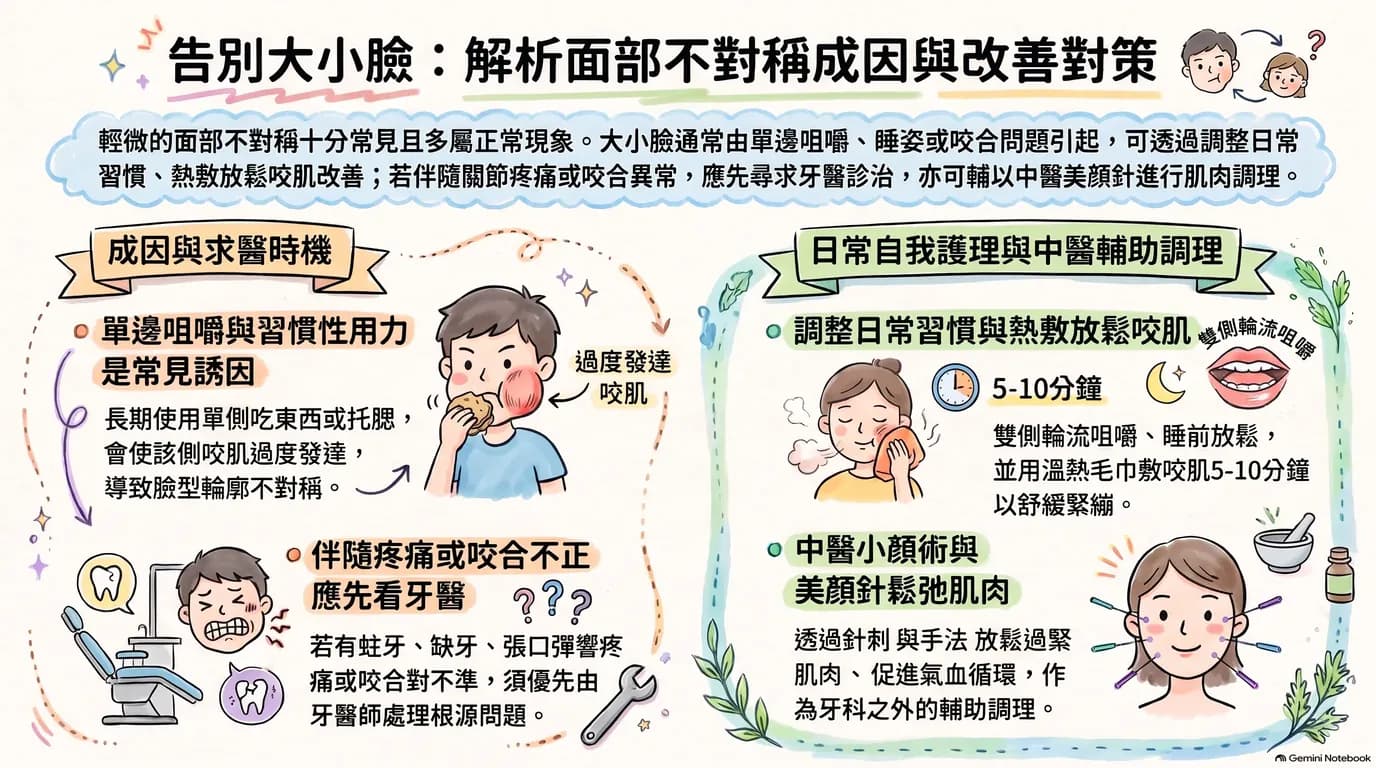
Is an uneven face caused by side sleeping and chewing on one side? This article explains the common causes, when to see a dentist or doctor first, what to adjust day to day, and how TCM facial massage and facial acupuncture can help with contour differences caused by muscle tension.
Hairy Crab Food Taboos: Is Crab With Persimmon Poisonous?
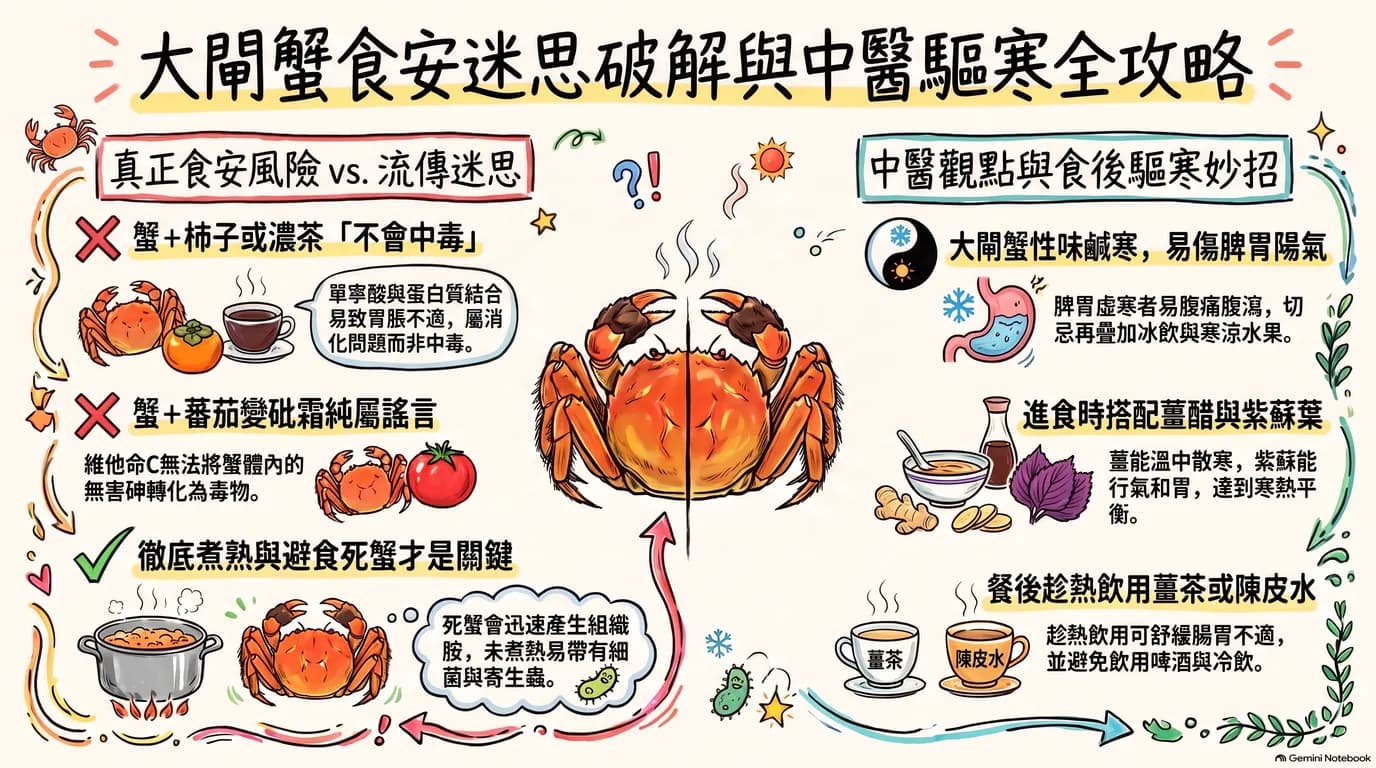
Hairy crab food taboos: what can't you eat with crab? This article checks the popular "incompatible foods" claims — persimmon, tomato, orange juice, alcohol, tea — explains the real food-safety risks and how to tell male from female crabs, and shows from a TCM perspective why crab is cooling and how to warm up afterwards.
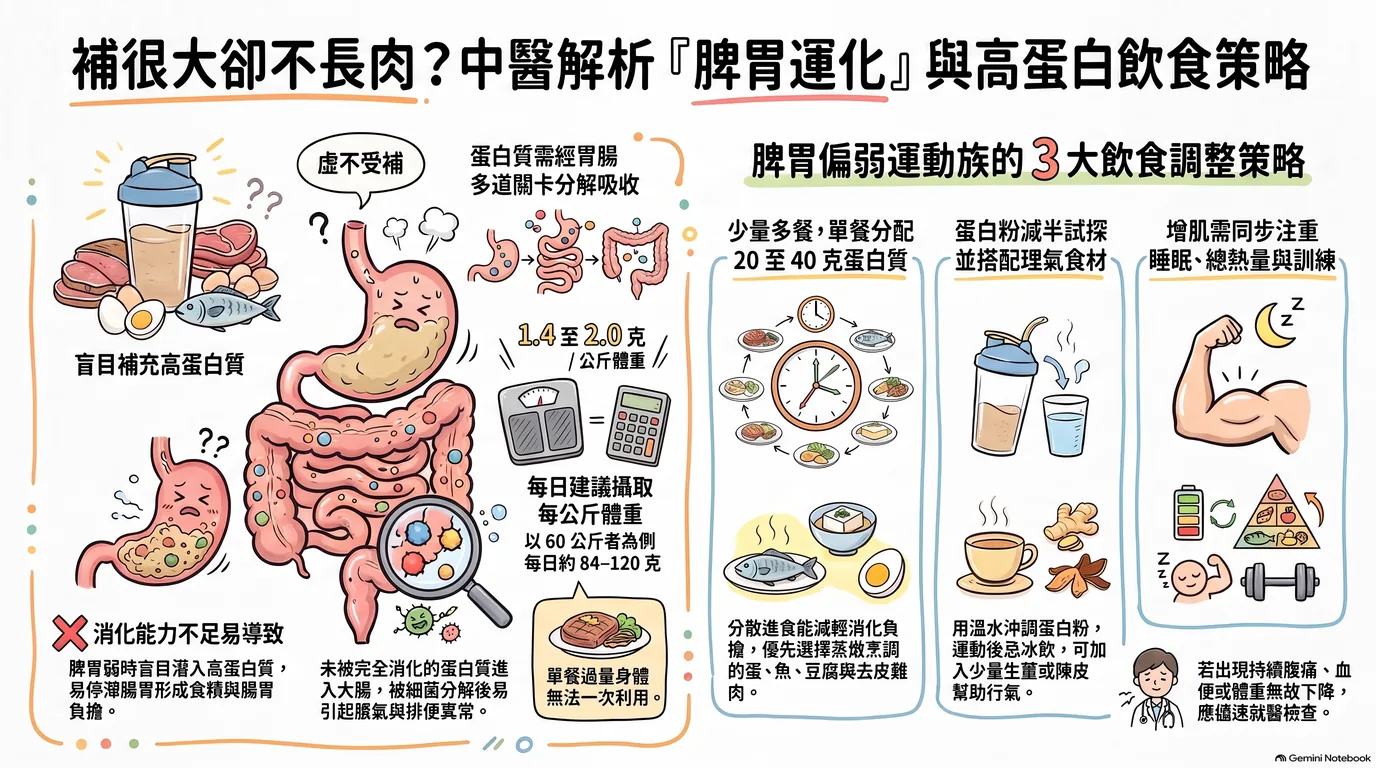
Plenty of Protein but No Muscle Gain? Could It Be Your Digestion?
Many people who exercise load up on protein to build muscle, only to find themselves bloated with loose stools before any gains show. Weak digestion does not mean no absorption, but the more you eat, the heavier the load. This article explains how protein becomes muscle, how much is enough, and how people with weaker digestion can adjust.