Can't Stop Snacking After Dinner? A TCM Case Study on Emotional Eating and Late-Night Cravings
Dinner was enough, yet after 9 pm the biscuits, chocolate, crisps or ice-cream call again — followed by guilt and a smaller breakfast the next morning. This case study of a 35-year-old office worker walks through how to tell real hunger from emotional eating, the four TCM lines (liver-spleen, stomach heat, heart-spleen deficiency, phlegm-damp), and a five-step routine to break the 9–11 pm craving cycle.
Medical review: Dr. Chan Wing Kiu, Joanne,Registered Chinese Medicine Practitioner #009463
1-Minute Quick Answer
Late-night cravings are usually emotional eating, not real hunger — wanting more after fullness and feeling guilty afterwards are telltale signs. Daytime restriction crashing at night is linked to the cortisol curve, blood-sugar swings and restriction rebound. TCM assesses four lines. Bulimic purging, intense food fear or amenorrhoea fall within eating disorders and need psychiatric or clinical-psychology referral first. Reviewed by Dr Chan Wing Kiu (CMCHK 009463).
Can't Stop Snacking After Dinner? A TCM Case Study on Emotional Eating and Late-Night Cravings
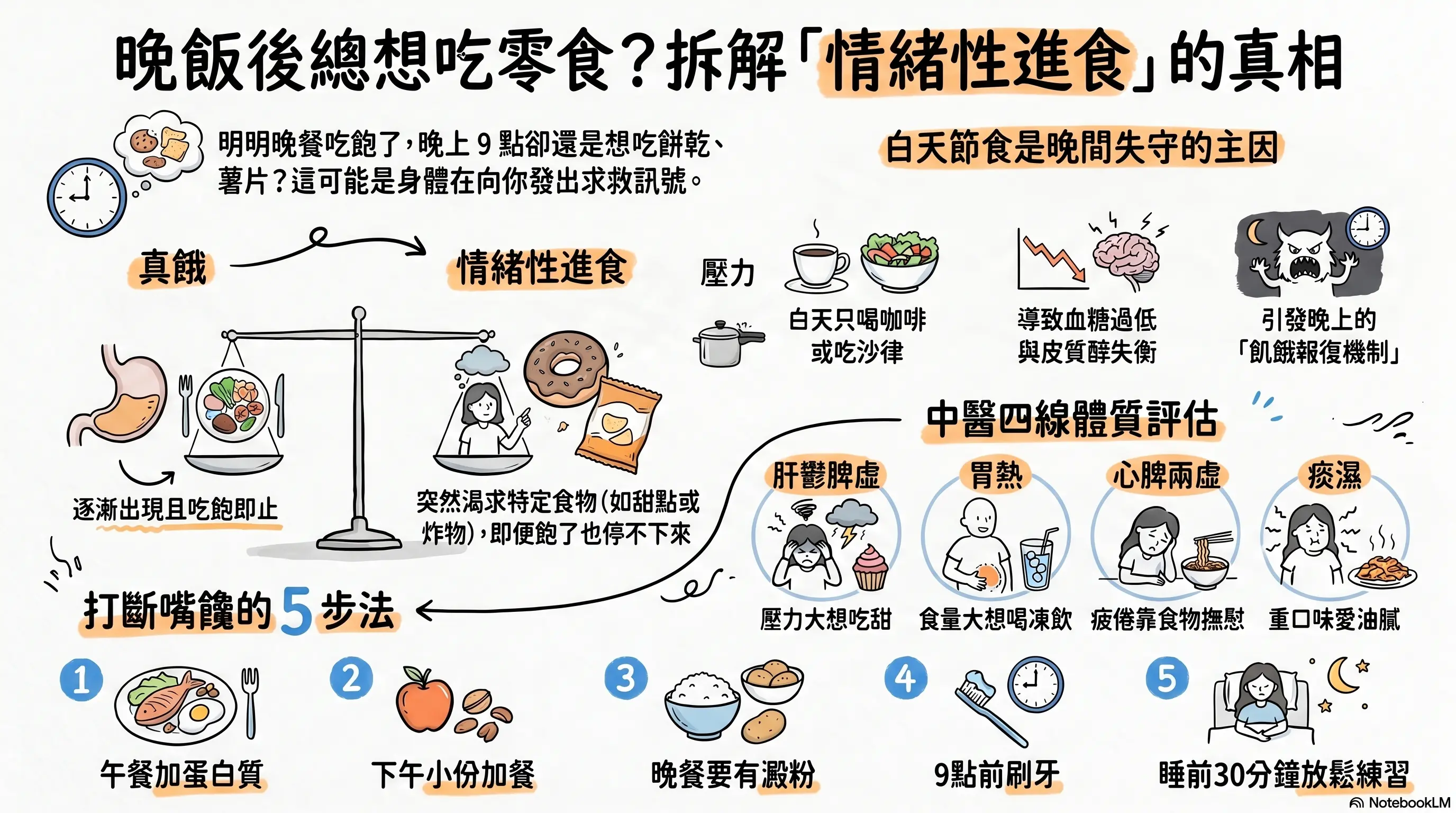 Image generated by NotebookLM for quick visual reference; some Chinese characters may not render correctly.
Medical review: Dr Chan Wing Kiu (CMCHK 009463 | Internal and external medicine, gynaecology, emotional wellbeing, elderly care).
Ms Ching (alias), 35, is a senior account manager at a PR agency. Mornings are too busy for breakfast — coffee instead; lunch is usually a salad; the 3 pm slump is patched with an iced Americano. Dinner at home is not large. Yet after 9 pm she reaches for biscuits, chocolate, crisps or a tub of ice-cream. The frustration is precisely that she "holds the line through the day, then loses it at night", followed the next morning by guilt and an even smaller breakfast.
In the consultation she said: "I don't eat much and I do exercise, but the busier I get the heavier I become. On holidays I think I'll finally slim down — instead I let go and the weight climbs again." This loop has run for over a year. This article unpacks how to tell real hunger from emotional eating, why daytime restriction so often crashes at night, and the four directions Traditional Chinese Medicine (TCM) uses to assess such cases.
Our position: bulimic compensation (purging), intense food fear or amenorrhoea fall within eating disorders and need specialist referral; TCM alone is not appropriate as the only treatment.
Telling real hunger from emotional eating
| Dimension | Real hunger | Emotional eating |
|---|---|---|
| Onset rhythm | Builds gradually 3–4 hours after a meal | Strikes suddenly, in sync with stress, boredom or fatigue |
| Food choice | Any food will do | Pulls toward specific foods (sweet, salty-crunchy, cold) |
| Satiety | Eating until full stops it | Continues even after fullness |
| After the meal | Satisfied, relaxed | Guilty, regretful, self-critical |
| Body signal | Empty stomach, low-blood-sugar cues | Psychological need outweighs physiological |
Ms Ching's 9 pm urge is mostly emotional: dinner was actually enough, but her mind kept circling back to "I want something more" — a rebound from stress, boredom and an under-fuelled day.
Why daytime restriction crashes at night
Several physiological currents run in parallel:
- Cortisol curve. Long-term work stress pushes cortisol up. By late afternoon and evening, fatigue stacks up; as cortisol falls the body seeks quick energy, usually sugar and starch.
- Glucose roller-coaster. A day of coffee and salad keeps blood sugar low; once the body relaxes at home, it craves carbohydrates strongly.
- Restriction rebound. Hard daytime calorie restriction triggers a hunger-recovery response — the harder you press, the harder it pushes back.
- TCM rhythm of the spleen-stomach. The spleen-stomach is at its most active in the morning and should rest by night. Eating little in the day and a lot at night inverts the digestive load.
Short sleep amplifies each of these, but is not the dominant driver.
Four TCM lines
| TCM pattern | Common signs | The "I want to eat" signal |
|---|---|---|
| Liver qi stagnation with spleen deficiency | High stress, chest tightness, abdominal bloating, pre-menstrual mood swings, post-meal fatigue | Want something sweet, want a snack to release stress |
| Stomach heat with hyperactive appetite | Easily hungry, bitter-dry mouth, breakouts, constipation, craving cold drinks | Large appetite, can't stop, especially craves cold |
| Heart-spleen deficiency | Fatigue, insomnia, pale complexion, palpitations, light periods | Want sweets, food as self-comfort |
| Phlegm-damp encumbering the spleen | Heaviness, copious phlegm, thick tongue coating, loose stools, prominent belly | The more she eats, the more she wants — especially oily or rich flavours |
In plain terms: "liver qi stagnation" describes the body's energy flow getting stuck under pressure; "spleen deficiency" describes a weakened digestive capacity; "stomach heat" describes excess heat in the stomach.
Ms Ching presents as "liver qi stagnation with spleen deficiency, plus mild stomach heat" — chest tightness and bloating under stress, evening cravings for sweet or salty-crunchy snacks, a classic two-line activation.
Worse in the week before her period?
Many women find the week before menstruation especially craving-heavy and irritable. This is not imagined:
- Luteal-phase progesterone rises, increasing appetite and carbohydrate craving
- Serotonin fluctuations during the same window influence mood and appetite regulation
- From a TCM angle, the liver qi tends to stagnate pre-menses and the spleen-stomach load goes up
If the cravings cluster in the week before the period, an appetite diary across 2–3 cycles will make the hormonal pattern visible. TCM care can adapt to the cycle accordingly.
When this is no longer "just a weight issue"
The following fall within eating disorders and need referral to a clinical psychologist, psychiatrist or eating-disorder specialist:
- Bulimic compensation after a binge (vomiting, laxatives or excessive exercise) — bulimia nervosa signs
- Intense fear of food, deliberate restriction of entire food groups, ongoing weight loss — anorexia nervosa signs
- Three or more months of amenorrhoea (not from pregnancy or menopause) — possible severe restriction or hormonal disturbance
- Out-of-control binges at least weekly for over three months — binge-eating disorder signs
- Major impact on work, relationships or daily functioning
If any of these apply, please seek specialist assessment first. TCM can support as part of an integrated treatment, but it should not be the only line of care.
A 5-step routine to break the late-night craving cycle
- Add protein to lunch. Top the salad with chicken, eggs, tofu or salmon — this stabilises afternoon glucose.
- Have a real 3–4 pm snack. A deliberate small meal (a handful of nuts and fruit, or wholegrain toast with egg).
- Keep some starch at dinner. Do not cut rice entirely. Half a bowl of brown or multigrain rice helps the spleen-stomach settle for the evening.
- Brush teeth before 9 pm. Eating after brushing carries a higher "activation cost" — a useful behavioural friction.
- Replace the snack ritual. Spend 30 minutes before bed on slow breathing or reading instead of reaching for snacks.
After 2–3 weeks most people notice the 9 pm urge tapering.
How Aspira TCM Clinic assesses such cases
The treating practitioner reviews the patient's tongue and pulse, menstrual records (for women, a 7-day food and mood diary is preferred), sleep hours, sources of stress and daytime eating structure. The toolkit includes herbal medicine (with a liver-soothing, spleen-strengthening focus), acupuncture or auricular point pressing, and lifestyle adjustments. If signs of bulimia, food fear or amenorrhoea appear at the first visit, the treating practitioner will recommend referral to psychiatry or clinical psychology first.
FAQ | Common Questions About Late-Night Snacking and Emotional Eating
Q1: Do I have bulimia?
The key difference between ordinary late-night cravings and bulimia is the sense of loss of control and the use of compensating behaviour. If you occasionally overeat and feel guilty but life continues as normal, this is mostly emotional eating. If you experience uncontrolled binges at least weekly with vomiting or laxative use, lasting three months or more, please seek psychiatric or eating-disorder specialist assessment.
Q2: Do I need to see a psychiatrist?
If emotional eating is now affecting your work, relationships or sleep, or if it appears alongside marked depression or anxiety, psychiatry or clinical psychology will give a fuller picture than TCM alone. TCM can sit alongside as part of integrated care.
Q3: Is it OK to have a late-night snack?
Occasionally, yes. The problem is when "occasional" becomes nightly and it cuts into sleep. If you do snack at night, choose low-sugar, low-fat options (boiled egg, unsweetened oats, Greek yoghurt) and finish 1.5–2 hours before bedtime.
Q4: How long before TCM weight care shows results?
TCM weight care is not direct kilogram-cutting; it works on constitution and appetite rhythm. Most patients report a steadier appetite and fewer evening blowouts within 2–4 weeks; weight changes are usually more visible after 6–8 weeks. Walk away from any clinic that "guarantees X pounds in one week" — rapid loss almost always rebounds.
Disclaimer: Every patient's constitution and condition are different, and treatment outcomes vary accordingly. The above is for reference only. Please consult a practitioner for a treatment plan tailored to your specific situation. Prescription details are shared for TCM academic purposes only and do not constitute prescribing advice. Do not self-prescribe.
References
- Department of Health — Mental health information https://www.dh.gov.hk/english/main/main_orh/main_orh.html
- Centre for Health Protection — Healthy weight management https://www.chp.gov.hk/en/static/100013.html
- Hospital Authority — Eating disorders information https://www21.ha.org.hk/smartpatient/en/encyclopaedia-of-health.html
- Hong Kong Eating Disorders Association — Public education materials https://www.heda-hk.org/
Disclaimer: This article is for health education and reference purposes only and does not constitute medical advice, diagnosis, or treatment. Each patient's condition is unique and treatment outcomes vary. Please consult a registered TCM practitioner or qualified healthcare professional for health concerns.
Further Reading
Hand-picked related articles and real cases to read next.
Eating Little but Not Losing Weight? TCM on Weak Digestion
Skipping breakfast, eating only salad for lunch, and cutting rice at dinner may still leave weight unchanged — or even make you more tired, swollen, and stuck. This article explains why eating less does not always lead to better fat loss, and how TCM interprets weak digestion, dampness, deficiency, and the weight-loss plateau.
Does Black Coffee Help with Weight Loss? Timing and Side Effects
Black coffee may briefly raise metabolism and suppress appetite, but for those with acid reflux, palpitations, insomnia, chronic fatigue or premenstrual symptoms, it can do more harm than good. This article looks at the evidence and the TCM perspective, identifies five body types that should drink with care, and explains how to arrange timing and quantity sensibly.
Bloating, Fatigue, Insomnia After 168 Fasting? A TCM View
168 fasting does not suit everyone. Bloating, fatigue, cold intolerance, insomnia, dizziness, constipation, or appetite rebound after starting may signal that the eating window, nutrient distribution, digestion, or qi-blood state is not aligned. This article explains how TCM distinguishes digestive burden, qi-blood deficiency, phlegm-damp with qi stagnation, and yin deficiency with internal heat — and flags situations where pushing through is unwise.
Want to learn more? WhatsApp us for a free consultation
Book via WhatsAppExplore our full range of treatments: Traditional TCM Services
Related Articles
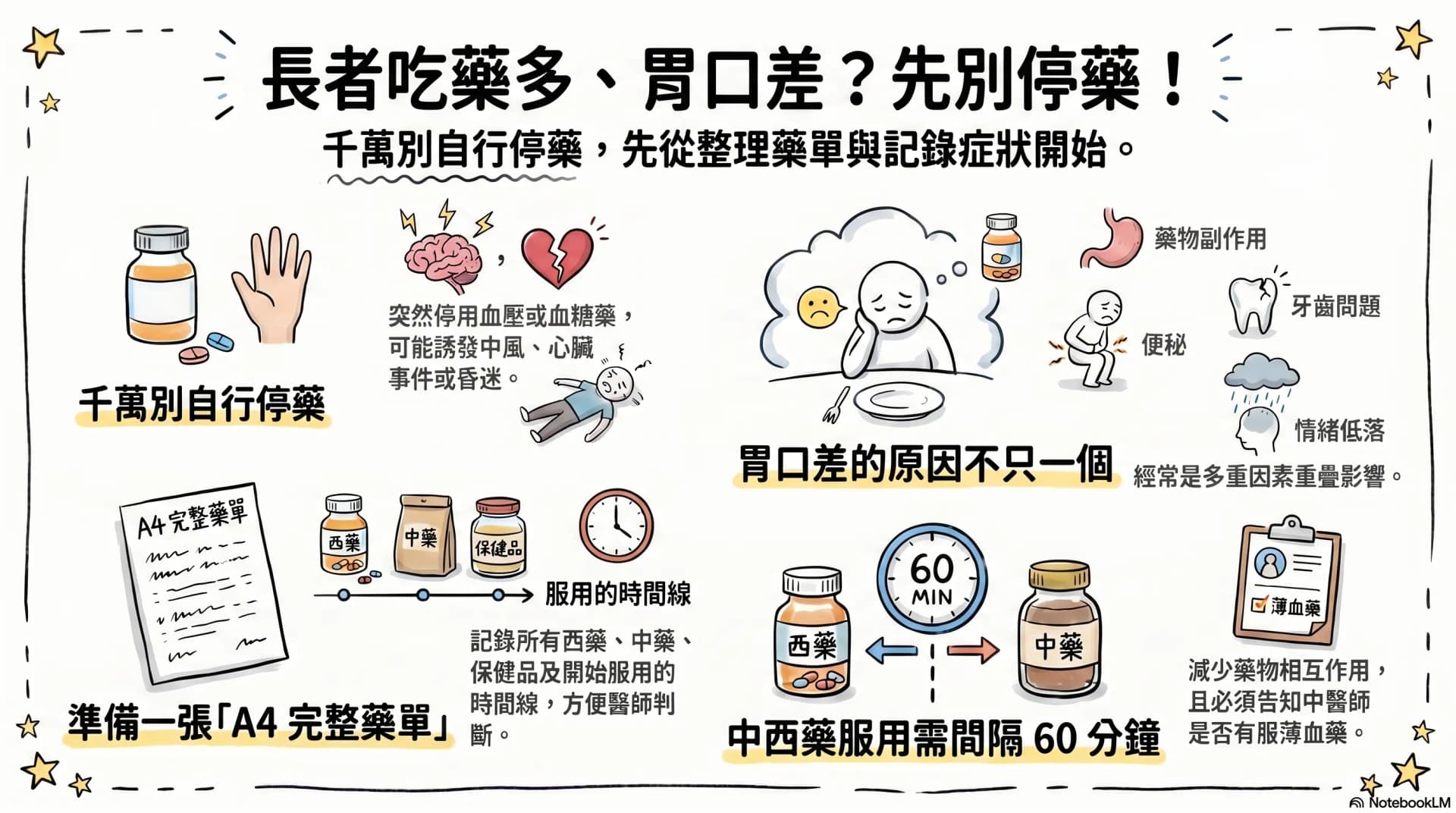
Poor Appetite in Older Adults on Long-Term Medication and Supplements? A TCM Case Study on Spleen-Stomach Care Under Polypharmacy
Several chronic-disease pills, then poor appetite, early fullness and daytime tiredness — family carers naturally wonder whether some of those medications are "harming the stomach". Stopping them on your own, however, can destabilise blood pressure, blood sugar and cardiovascular risk. This case of a 76-year-old maps out 7 possible causes, 6 things family carers should do, the safety conditions for TCM (60-minute spacing between Western and Chinese medicine), and the spleen-stomach directions that TCM can offer.
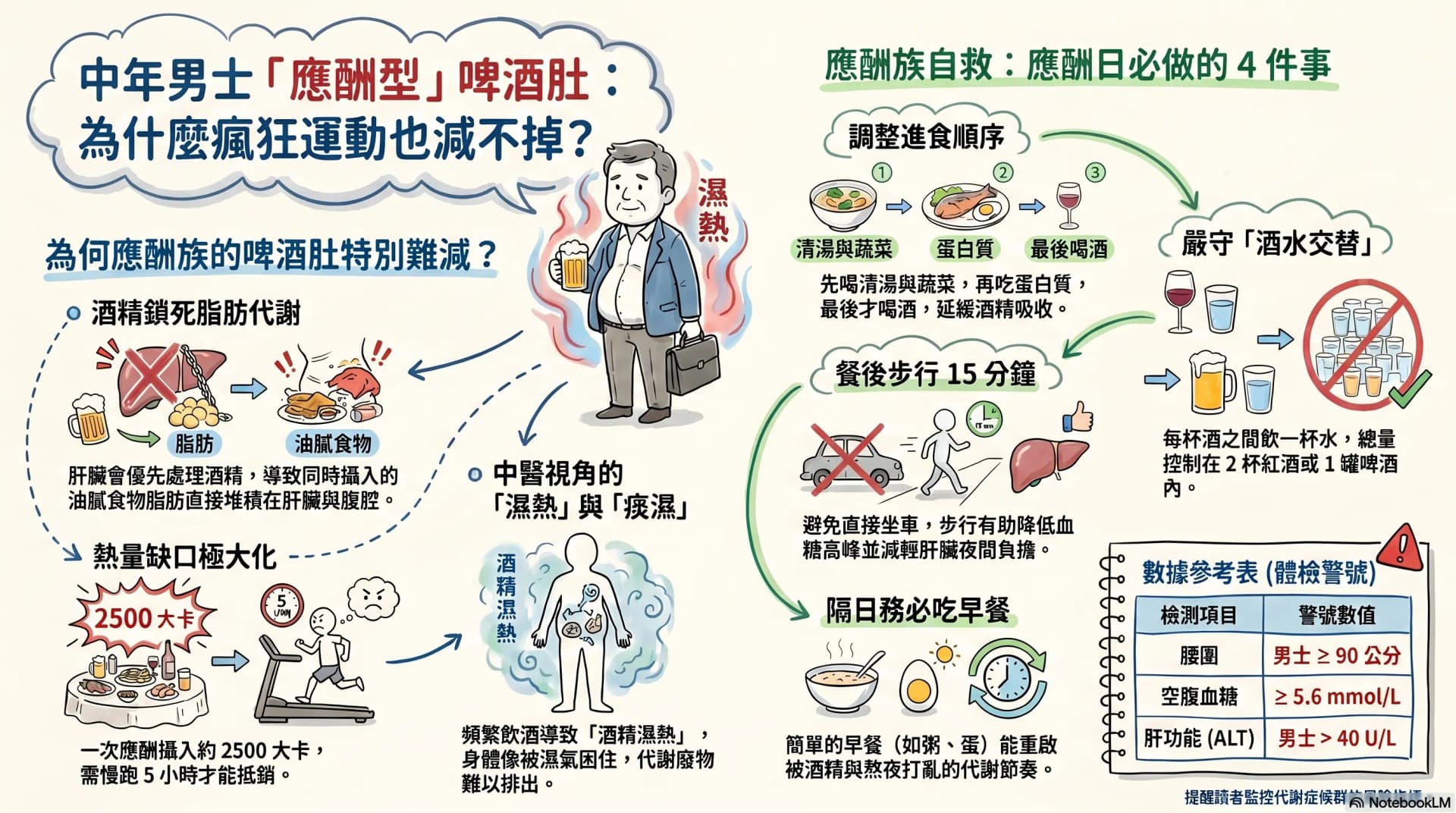
Middle-Aged Beer Belly That Won't Shrink? A TCM Case Study on Business Entertainment and Visceral Fat
Frequent client dinners, late-night meals and rising alcohol intake, yet the waistline keeps growing and the annual check-up flags borderline metabolic syndrome. This case study of a 48-year-old explains why visceral fat accumulates so readily in middle-aged men, how alcohol fuels the fatty-liver pathway, and how TCM evaluates four parallel drivers: damp-heat, phlegm-damp, late eating and stress-induced liver qi stagnation.
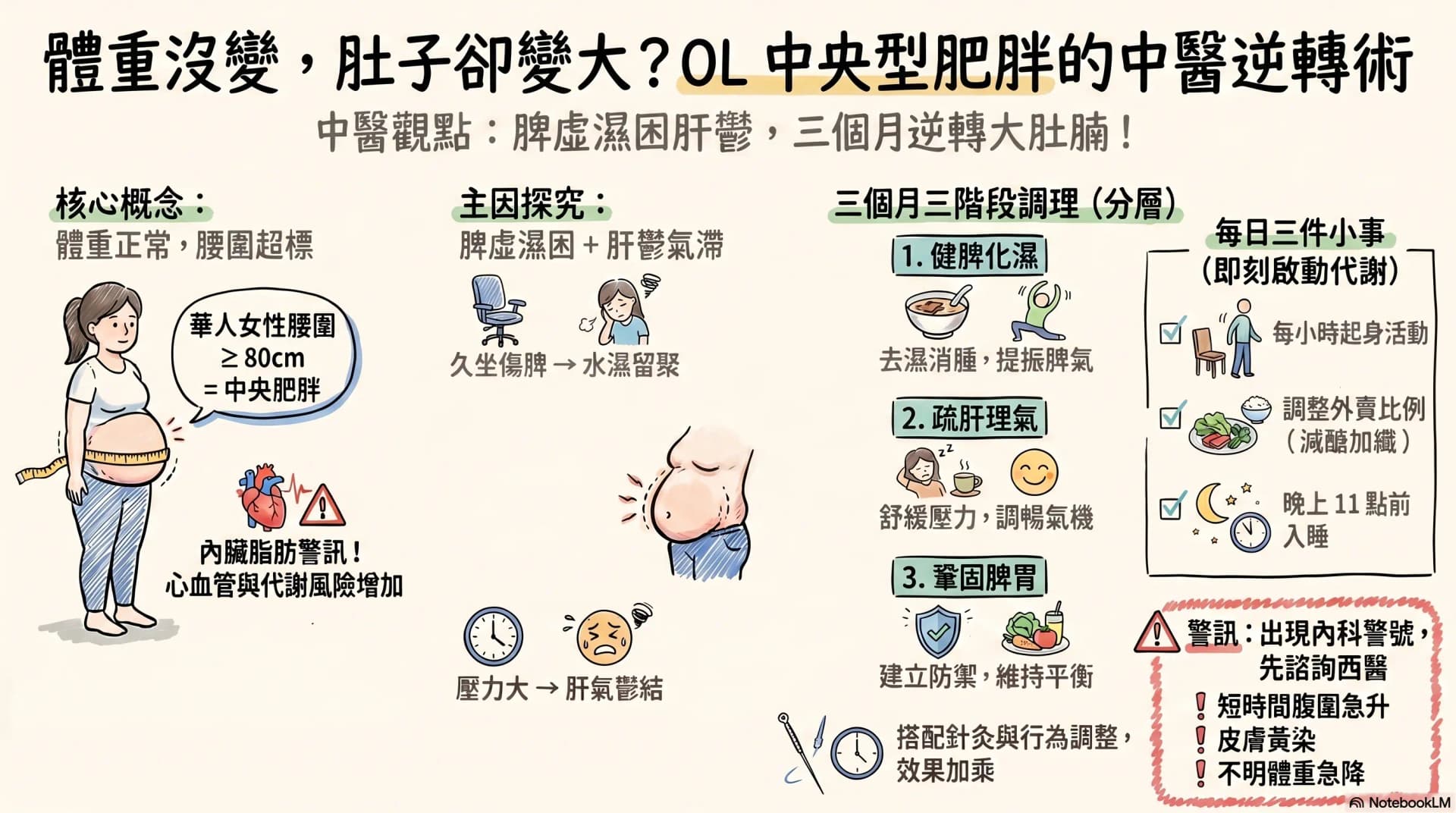
Weight Unchanged but the Belly Keeps Growing? A TCM Turnaround Plan for Central Obesity in Office Workers
Weight has risen only 2 kg in six months, but the waist is 8 cm wider; the health-check report flags "elevated visceral fat" in red. This is a common frustration for women in their 30s working office jobs. This case study follows the typical consultation profile of "Ms Chan" (pseudonym) — explaining the TCM evaluation of sedentary central obesity, the spleen-damp-with-liver-stagnation pattern, the three-month phased plan, when to see a Western doctor first, and three things readers can start doing today.