Muscle Strain: TCM or Western Doctor? Acupuncture Timing
Pulled a muscle running or playing sport? Learn when to see a Western doctor first, how to manage the first 72 hours and when acupuncture fits in. Reviewed by Dr Wong.
Medical review: Dr. Wong Ka Fai,Registered Chinese Medicine Practitioner #009985
1-Minute Quick Answer
Judge the strain first. A popping sensation, inability to bear weight or swelling that keeps worsening calls for a Western medical check. Once the first 72 hours have passed, mild to moderate strains may benefit from acupuncture alongside gradual loading, after assessment (reviewed by Dr Wong, CMCHK 009985).
Muscle Strain: TCM or Western Doctor? Acupuncture Timing
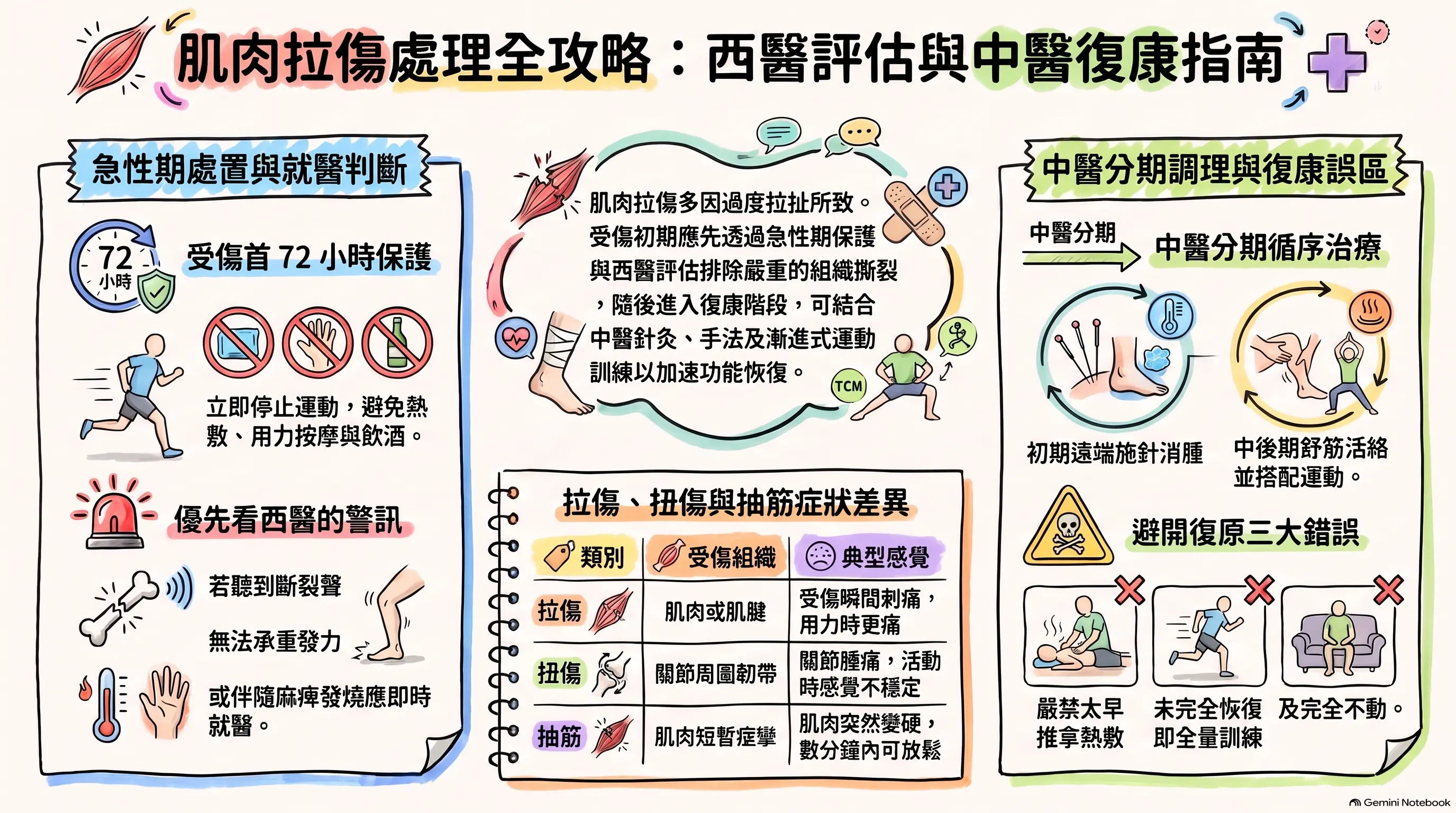 This image was generated with NotebookLM to help summarise the article; some Chinese characters may not display correctly.
You are picking up pace on a run when the back of your thigh suddenly tugs. Or you turn during a game and your calf hurts every time you push off. By the next morning, you are holding the handrail on every step down the stairs.
Two questions usually follow: should you see a Western doctor or a Traditional Chinese Medicine (TCM) practitioner first, and can you have acupuncture straight away?
The answer depends on how badly the muscle is injured. A serious tear or fracture should be ruled out first; acupuncture, manual therapy and exercise can then be combined according to the stage of recovery.
1. Strain, Sprain or Cramp?
A muscle strain happens when a muscle or tendon is overstretched. Mild strains damage a few fibres; severe ones involve a partial or complete tear. They are most common in the lower back and the hamstrings. A sprain affects the ligaments around a joint, while a cramp is a brief muscle spasm.
| Type | Tissue affected | Typical situation | How it usually feels |
|---|---|---|---|
| Strain | Muscle or tendon | Sprinting, jumping, lifting | Sharp or pulling pain at the moment of injury, worse on effort |
| Sprain | Ligaments around a joint | Rolling an ankle, twisting a knee | Joint pain and swelling, feels unstable |
| Cramp | Brief muscle spasm | Heavy sweating, muscle fatigue | Muscle suddenly hardens, usually eases within minutes |
Post-exercise soreness is different again. It usually appears the day after training and fades within a few days, whereas a strain tends to hurt at the moment of injury and comes with weakness.
2. What to Do in the First 72 Hours
The first 72 hours or so are the acute phase. The goal during this time is to avoid making the injury worse.
- Stop exercising straight away. Do not push through the rest of the run.
- Offload the injured muscle. Protect it for the first one to three days, and let pain guide how much you do.
- Elevate and compress. Raise the limb and use an elastic bandage to help limit swelling.
- Avoid heat, firm massage and alcohol. All three may increase swelling.
- Ask before taking painkillers. Some anti-inflammatory medicines may interfere with soft tissue healing, so check with a doctor or pharmacist first.
- Keep icing brief. Short cold packs can ease pain early on, but the PEACE & LOVE soft tissue guidance published in the British Journal of Sports Medicine in 2020 questions whether ice speeds recovery, so long icing sessions are unnecessary.
3. Six Signs You Should See a Western Doctor First
Any of the following may point to a serious tear, a fracture or another problem. See a Western doctor first; an ultrasound or MRI may be needed.
- You heard or felt a "pop" at the moment of injury
- You cannot bear weight, cannot walk normally, or cannot contract the injured muscle at all
- There is a visible dent or obvious deformity in the muscle
- Swelling or bruising is severe, or keeps getting worse within the first 24 hours
- You have numbness or tingling at the injury or further down the limb
- The area is red, hot and swollen, and you also have a fever
A complete tear of a muscle or tendon may need surgical repair. In these cases, the structural problem comes first; TCM can support rehabilitation after surgery or once the treating doctor agrees.
4. How Long Does a Muscle Strain Take to Heal?
| Severity | Common signs | Usual next step |
|---|---|---|
| Mild | A few fibres damaged; painful on pressure or effort, daily activities largely normal | Usually manageable with self-care; generally improves in about three to six weeks |
| Moderate | Partial tear; swelling, bruising, clear pain and weakness on effort | Assessment first, then staged rehabilitation |
| Severe | Extensive or complete tear; visible dent, unable to contract the muscle | See a Western doctor first; surgery may be needed |
Moderate to severe strains take longer; the goal of recovery is being able to return to your usual sport.
5. How TCM Understands a Muscle Strain
In TCM, a muscle strain falls under "injury to the sinews" (shang jin). External force damages the muscles and tendons and disrupts the flow of qi and blood in the area, leading to "qi stagnation and blood stasis". In simpler terms, "where there is blockage, there is pain".
TCM treats sinew injuries in stages:
- Early stage (the first few days): the aim is to reduce swelling and pain, which TCM calls "activating blood and resolving stasis". Firm massage over the injury is generally avoided at this point; external applications, or needling at points away from the injury, are more common.
- Middle stage (swelling settled, pain remains): the aim is to ease pain and release tight muscles, known as "relaxing the sinews and unblocking the channels". Acupuncture can be applied around the injured area, with gentle manual techniques, while movement is gradually restored.
- Late stage (pain reduced, strength not yet back): the focus shifts to rebuilding strength and flexibility. TCM holds that "the liver governs the sinews" and that the sinews need nourishment from qi and blood, so for people who strain muscles repeatedly or recover slowly, the practitioner may add herbal medicine suited to their constitution where appropriate.
A strain on day three and a strain in week three call for different approaches; how treatments are combined is decided by the practitioner according to the stage and the individual's constitution.
6. Can You Have Acupuncture Straight After a Strain?
Not necessarily. It depends on the injury and the timing.
- Before a serious tear is ruled out: get checked first. Needling or manual therapy directly over the injury is not advisable.
- During the acute phase: while the area is clearly swollen, practitioners generally avoid deep needling or firm massage at the site. In some cases, points away from the injury may be used to ease pain, but only after assessment.
- After the acute phase: acupuncture is more commonly used to ease pain and muscle tightness, alongside gradual loading exercises.
On the research side, a 2026 meta-analysis reviewed studies of Western medical acupuncture (needling based on conventional anatomy and physiology) for pain in athletes. The certainty of evidence was moderate when needling was combined with physiotherapy or exercise, and low when it was used alone. The analysis did not focus on muscle strains specifically, but the direction is clear: acupuncture is best arranged alongside exercise-based rehabilitation rather than used on its own.
7. How TCM and Physiotherapy Work Together
| Stage | What TCM can offer | What physiotherapy can offer |
|---|---|---|
| After the acute phase | Acupuncture and manual therapy to ease pain and tightness | Assessing the injury and designing a gradual loading plan |
| Rehabilitation | Constitutional care for recurring tightness | Strength, flexibility and movement control training |
| Before returning to sport | Following up areas that remain tight or keep aching | Testing readiness to return to sport |
TCM and physiotherapy can run at the same time. If you are already seeing a physiotherapist, share your treatment plan with your TCM practitioner so the two can be coordinated.
8. Three Common Mistakes During Recovery
- Massaging or heating the injury too early. In the acute phase, this can increase swelling and bruising.
- Returning to full training as soon as the pain stops. Strength and elasticity may not have recovered yet, and re-injury often happens at this point.
- Not moving at all for fear of pain. Prolonged rest leaves the muscle weaker and stiffer, which slows recovery.
9. For Runners Preparing for the Hong Kong Marathon
The Standard Chartered Hong Kong Marathon 2027 takes place on 17 January 2027, and the two months before race day are when many runners increase their training load.
- With a new injury, pause for a day or two and observe. Let pain guide your training load; use painkillers only for short-term relief, and check with a doctor or pharmacist first.
- Cut intensity before mileage. Drop sprints, hills and speed sessions, and keep easy runs or cross-training that you can complete without pain.
- Return on flat routes first. For your first few runs after injury, avoid downhills and stairs, which place greater stretch on the thigh and calf muscles.
- If you are injured close to race day, get assessed before deciding whether to start. If running hurts straight away, or you have to change your stride to keep going, finishing the race injured can make the damage worse.
A Note from the Practitioner
When the same muscle keeps getting strained, the problem usually lies beyond the injured spot itself. A sudden jump in training load, too little warm-up or a strength imbalance between the two sides can all play a part. In these cases, easing the pain is only one step; the trigger also needs to be identified, followed by strength training and a gradual return to load.
Still Not Healing? Start with an Assessment
If you are unsure which situation applies to you, or your strain still hurts after several weeks and flares up whenever you run, you are welcome to book an assessment with Dr Wong. Dr Wong holds a master's degree in orthopaedics and traumatology from Guangzhou University of Chinese Medicine, and his practice covers pain, musculoskeletal injuries and sports injuries. He will first judge whether you need a referral to a Western doctor or a scan, then recommend a suitable approach. For more on pain conditions, visit our pain page.
How to book:
- WhatsApp: Book here
- Phone: 2110 9337
- Address: Unit 2706, Saxon Tower, 7 Cheung Shun Street, Lai Chi Kok
— Dr Wong Ka-fai | Registered Chinese Medicine Practitioner
Frequently Asked Questions about Muscle Strains
Q1: Should I see a TCM practitioner or a Western doctor first for a muscle strain?
It depends on the injury. If you felt a pop, cannot bear weight, can see a dent or deformity in the muscle, or the swelling keeps getting worse within the first 24 hours, see a Western doctor first; an ultrasound or MRI may be needed. Once a serious tear has been ruled out, mild to moderate strains can be managed with TCM, combining acupuncture, manual therapy and exercise according to the stage of recovery.
Q2: Can I have acupuncture straight after a strain?
Not necessarily. Needling directly over the injury is not advisable until a serious tear has been ruled out. While the area is clearly swollen in the acute phase, practitioners generally avoid deep needling or firm massage at the site; in some cases, points away from the injury may be used to ease pain, but only after assessment. After the acute phase, acupuncture is more commonly used to ease pain and muscle tightness.
Q3: Should I use ice or heat on a muscle strain?
Brief cold packs can ease pain early on, but soft tissue guidance published in the British Journal of Sports Medicine in 2020 questions whether ice speeds up recovery, so long icing sessions are unnecessary. Avoid heat in the first 72 hours, as it may increase swelling. Once the swelling has settled, warmth can be introduced on your practitioner's advice, alongside gentle movement.
Q4: How long before I can run again after a muscle strain?
It depends on severity. Mild strains generally improve in about three to six weeks; moderate to severe strains take longer. Being able to walk, jog and perform single-leg loading without pain is the basic starting point for returning to running. Less pain does not mean full strength has returned, so increase training gradually after assessment.
Q5: Is it normal to feel more pain the day after acupuncture for a strain?
Some people feel mild aching for one to two days after acupuncture, which usually settles on its own. If the pain clearly worsens, the swelling increases, the bruising spreads or you develop numbness, contact your practitioner promptly.
References
- Mayo Clinic: Muscle strains
- Better Health Channel (Victoria State Government): Sprains and strains
- Dubois B, Esculier JF. Soft-tissue injuries simply need PEACE and LOVE. Br J Sports Med 2020;54(2):72-73. PubMed
- Western medical acupuncture techniques for pain management in athletes: a systematic review and meta-analysis. Front Med 2026;13:1737602. PubMed
- CommonHealth Magazine (Taiwan): Muscle strain management and when to see a doctor (in Chinese)
- Standard Chartered Hong Kong Marathon: 2027 race press release, 4 September 2026 (in Chinese)
Every patient's constitution and condition are different; outcomes vary and require individual TCM assessment.
Disclaimer: This article is for health education only and does not replace individual consultation, examination, medication or treatment advice. If you have a related condition, persistent symptoms or are taking medication, please follow your doctor's instructions for follow-up and monitoring, and consult your attending doctor before making any change to your medication.
Disclaimer: This article is for health education and reference purposes only and does not constitute medical advice, diagnosis, or treatment. Each patient's condition is unique and treatment outcomes vary. Please consult a registered TCM practitioner or qualified healthcare professional for health concerns.
Further Reading
Hand-picked related articles and real cases to read next.
Acupuncture vs Physiotherapy: Which Is Better for Your Pain?
Both acupuncture and physiotherapy can treat pain, but each has its strengths for different conditions. This article offers an honest comparison across treatment principles, suitable conditions, cost, and duration to help you decide.
Herbal Medicine or Acupuncture? A TCM Doctor's Guide to Choosing the Right Treatment
"Doctor, should I take herbal medicine or have acupuncture?" This is one of the most common questions in the consultation room. This article compares herbal medicine and acupuncture from a TCM perspective, analysing their principles, suitable conditions, and pros and cons across six common health issues.
TCM Limitations: 5 Times to See a Western Doctor First
TCM has genuine strengths in chronic care and holistic wellness, but it is not the right first choice for every situation. This article honestly discusses 5 scenarios where Western medicine should come first, what TCM truly excels at, and how to make informed decisions between the two.
Want to learn more? WhatsApp us for a free consultation
Book via WhatsAppExplore our full range of treatments: Traditional TCM Services
Related Articles
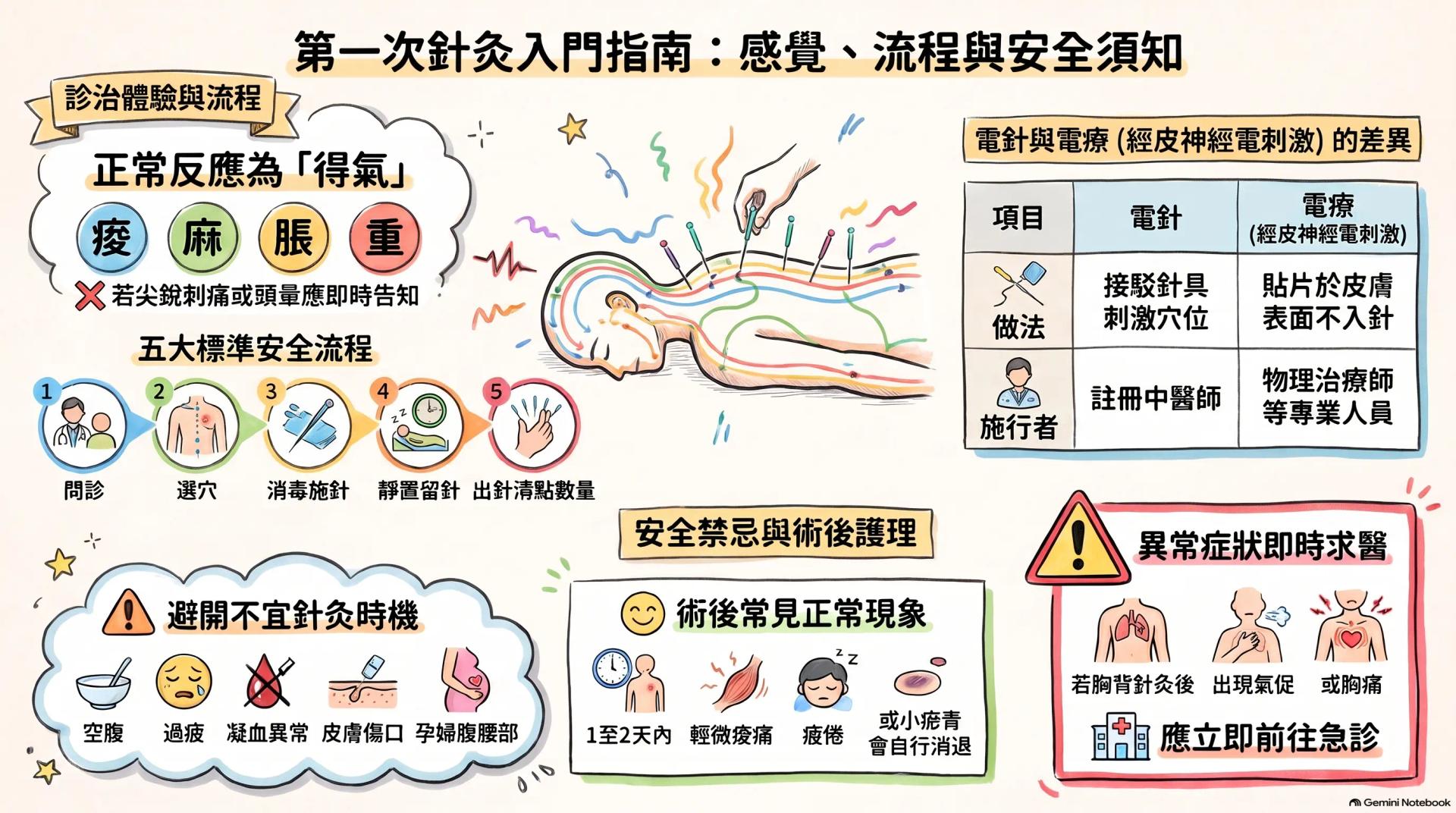
Does Acupuncture Hurt? What to Know Before Your First Visit
Does acupuncture hurt, and is feeling worse afterwards normal? Reviewed by Dr Wong, this guide covers the sensation, a typical session, electroacupuncture, session numbers and who should avoid it.
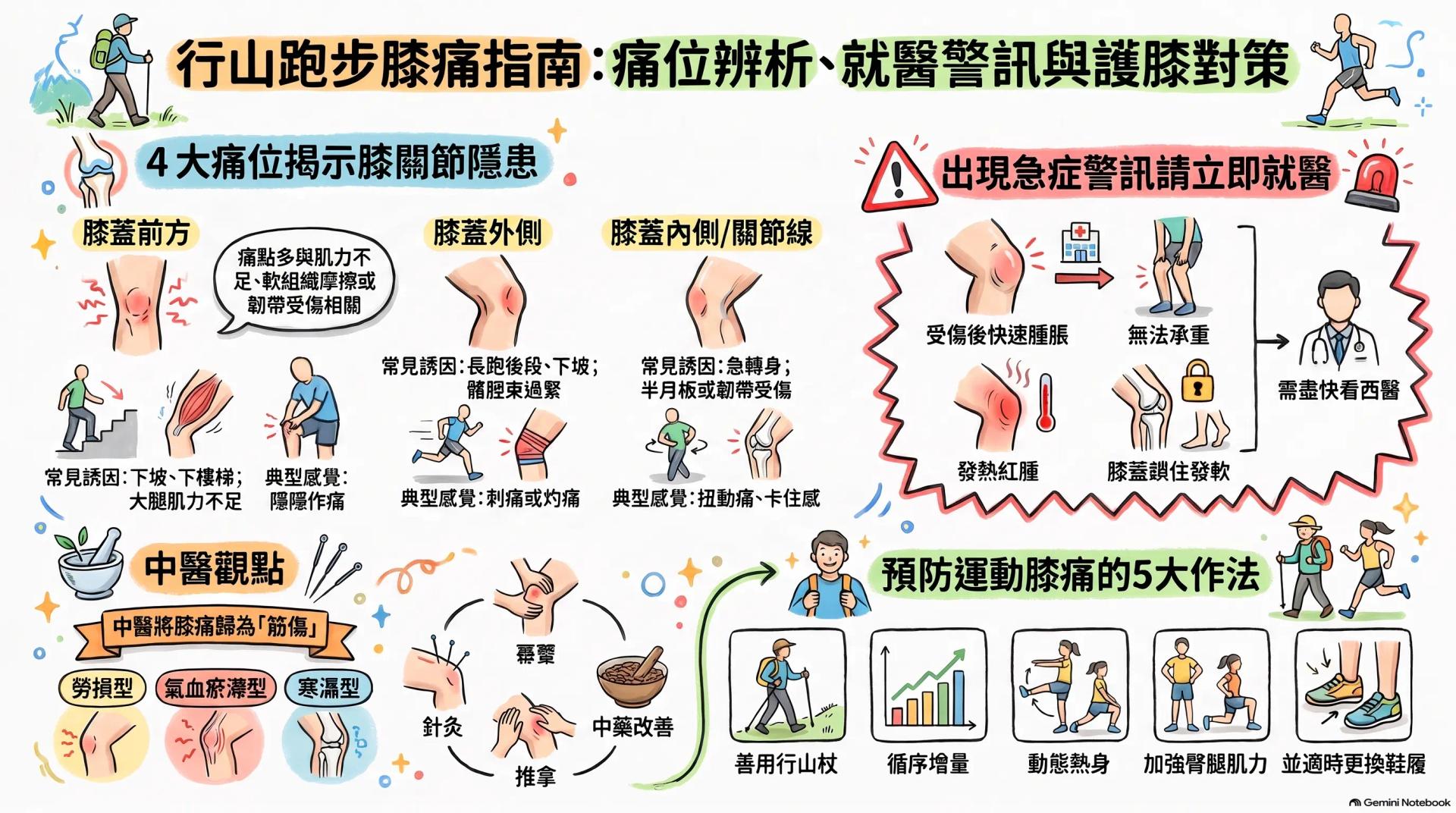
Knee Pain After Hiking or Running: TCM or Western Doctor?
Knee pain after a downhill hike or a long run? Reviewed by Dr Wong, this guide explains four common pain locations, warning signs that need a Western doctor, the TCM approach and prevention tips.
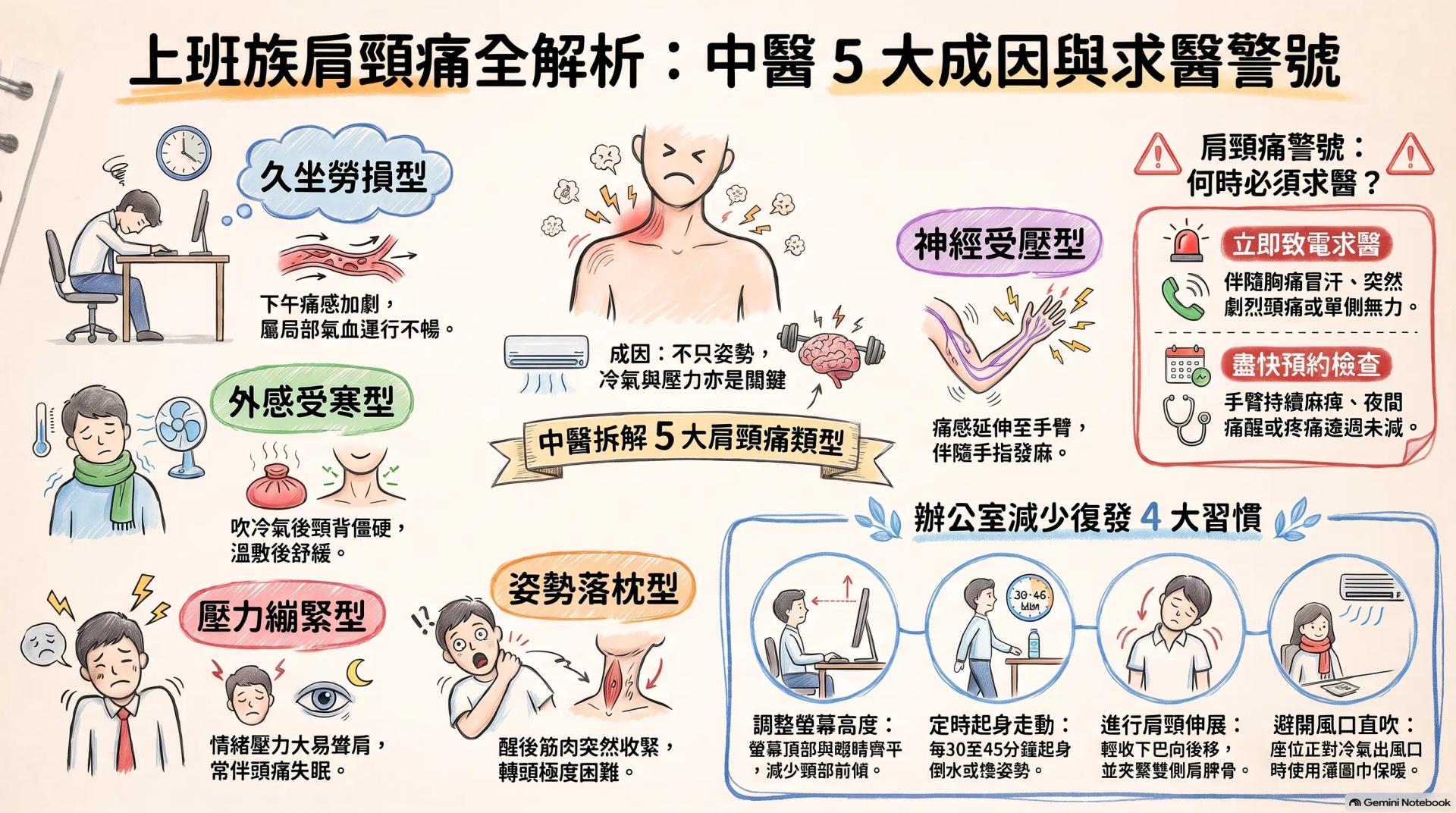
Office Neck and Shoulder Pain: 5 Causes and Warning Signs
Neck and shoulder pain at work is not just about posture. Reviewed by Dr Wong, this guide covers five common causes, the TCM approach, warning signs that need urgent care and simple office habits.